Curtis Ripley: High Fidelity Opening

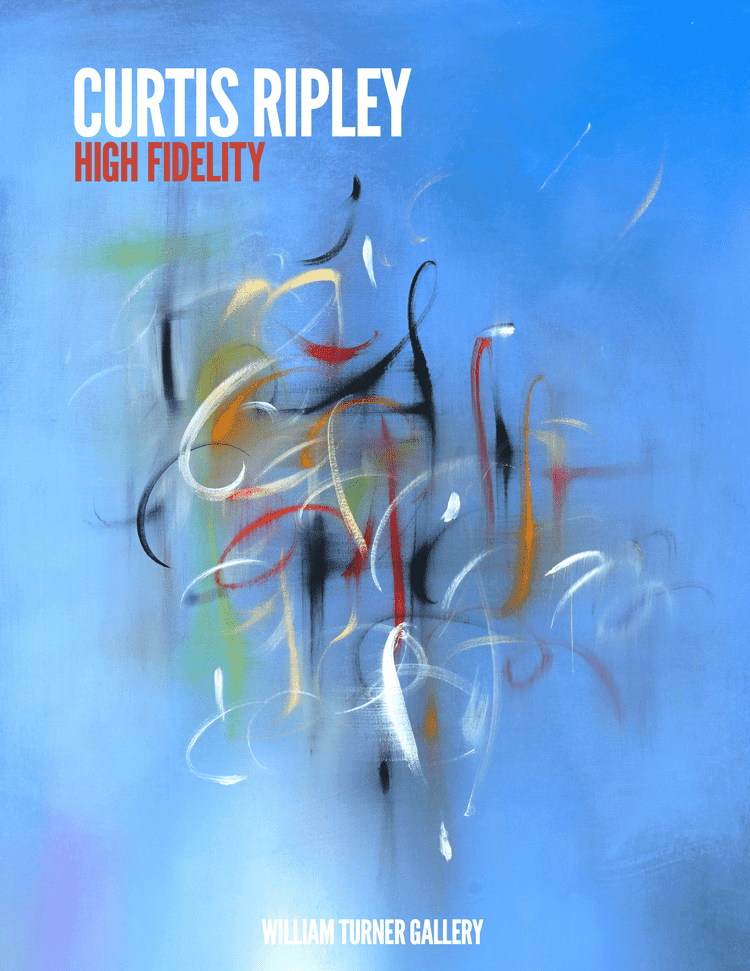
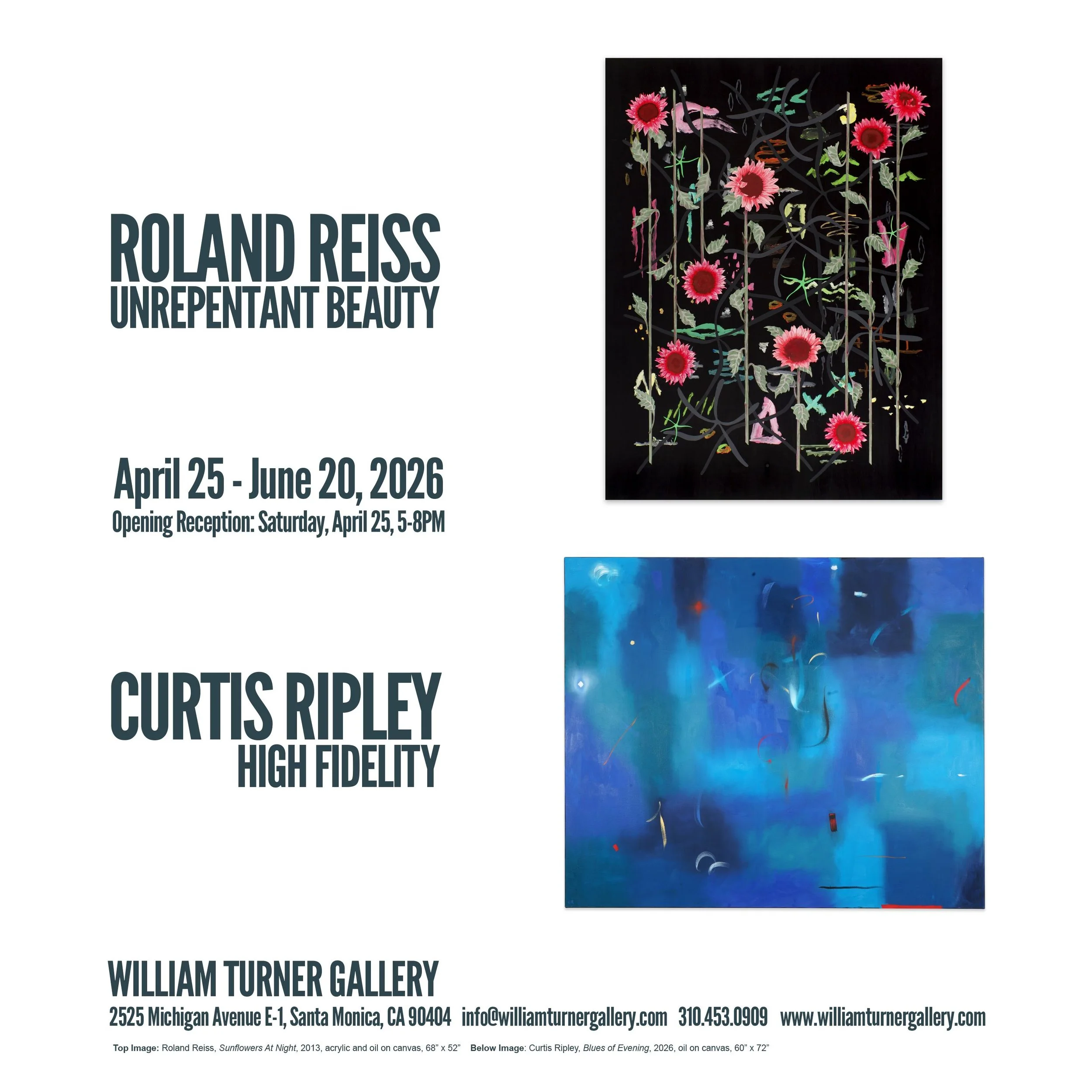
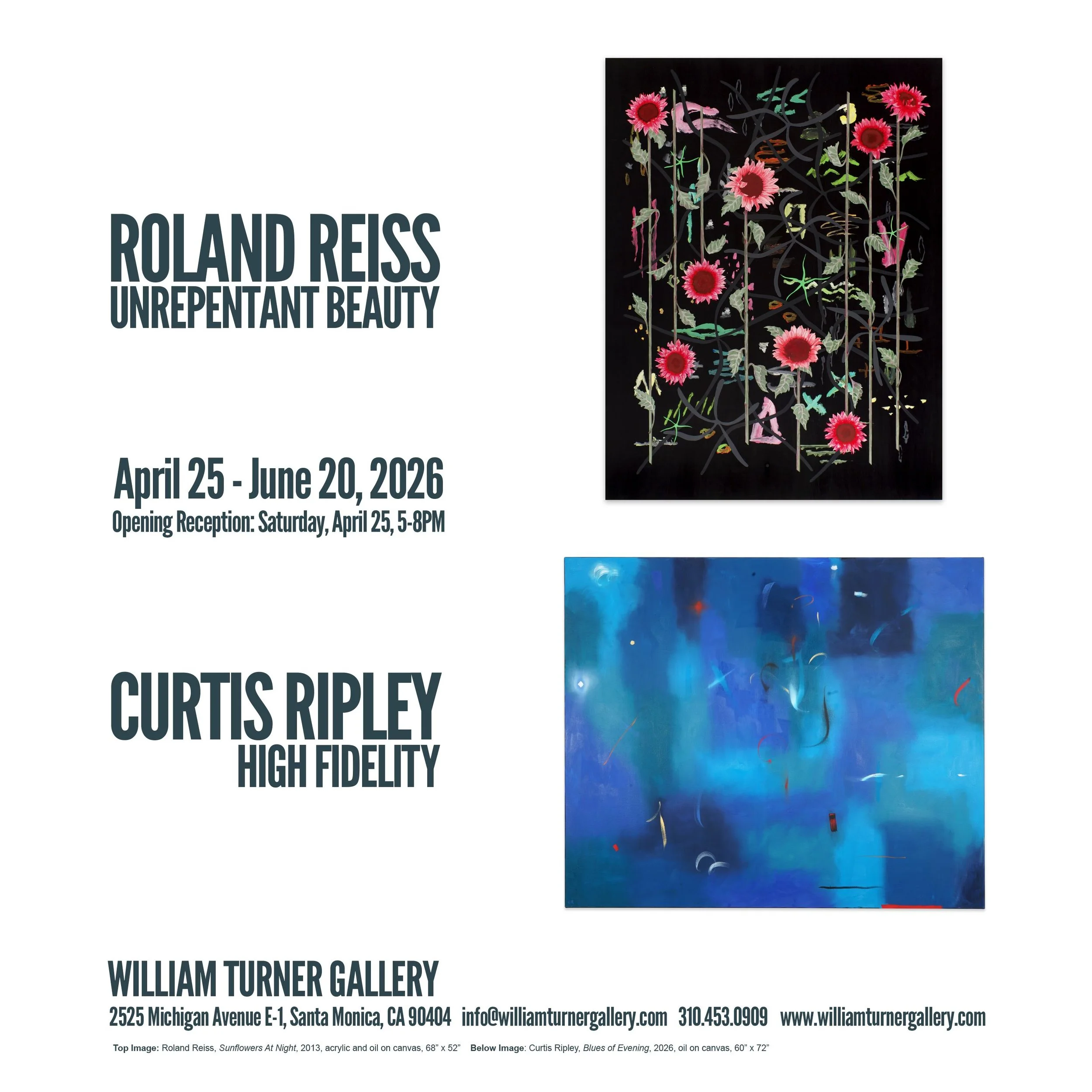
Santa Monica, CA - William Turner Gallery is pleased to present Curtis Ripley: High Fidelity, an exhibition of new paintings by Curtis Ripley opening April 25, 5-8 PM, and on view through June 20, 2026. The exhibition unfolds as a visual composition: lyrical, atmospheric, and finely attuned to the rhythms of perception.

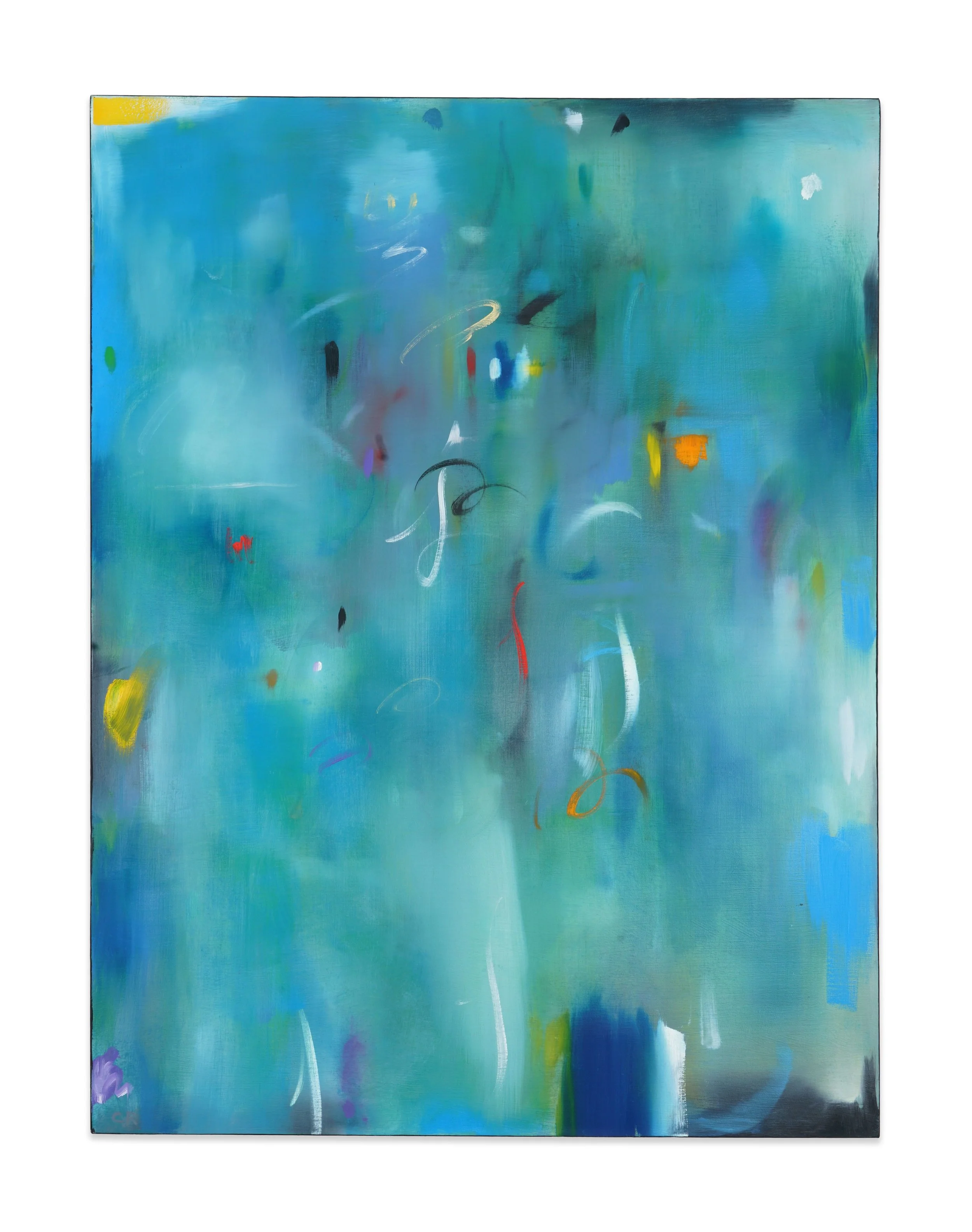
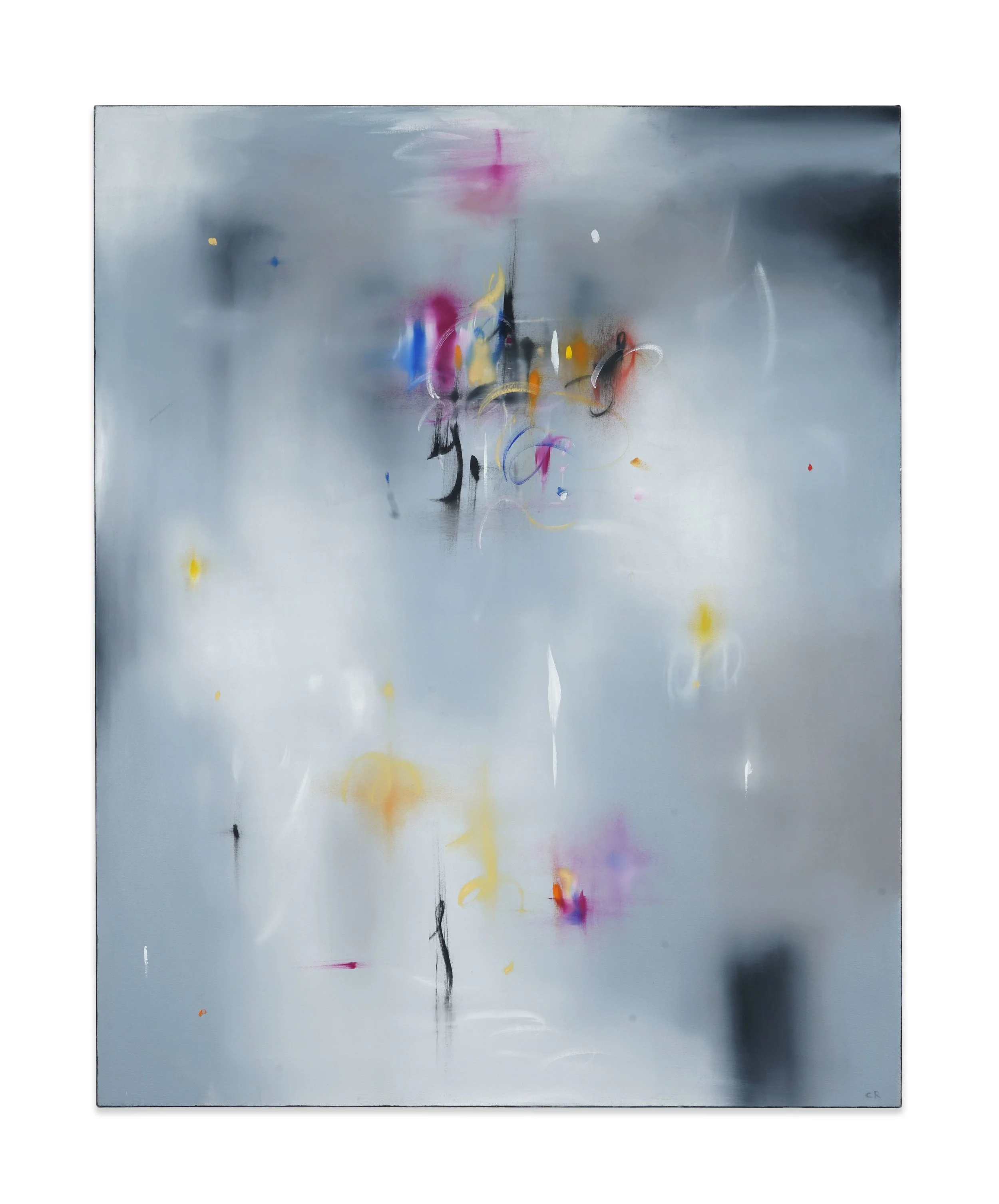
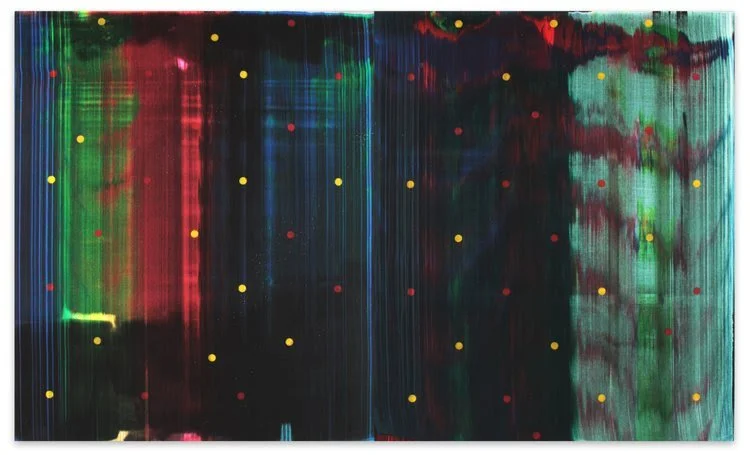
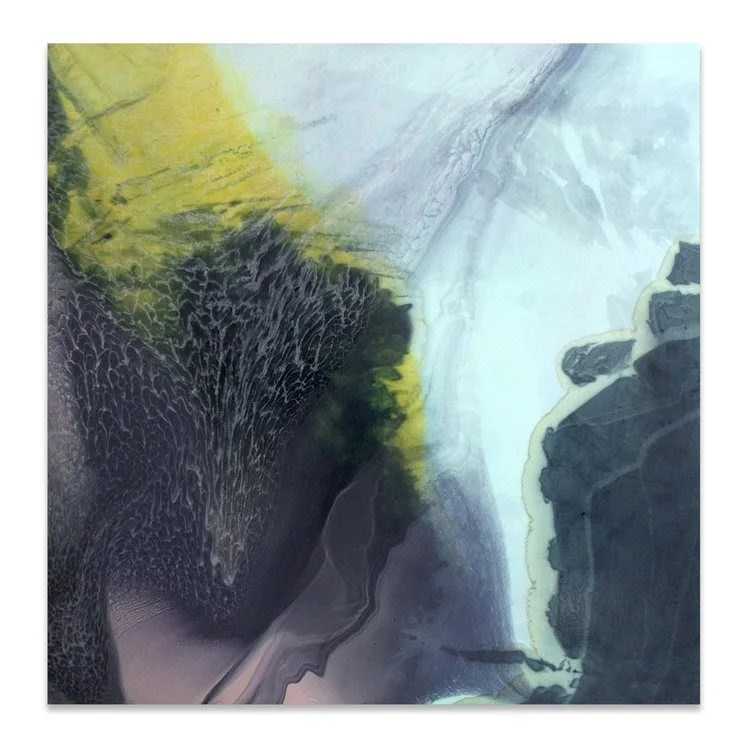
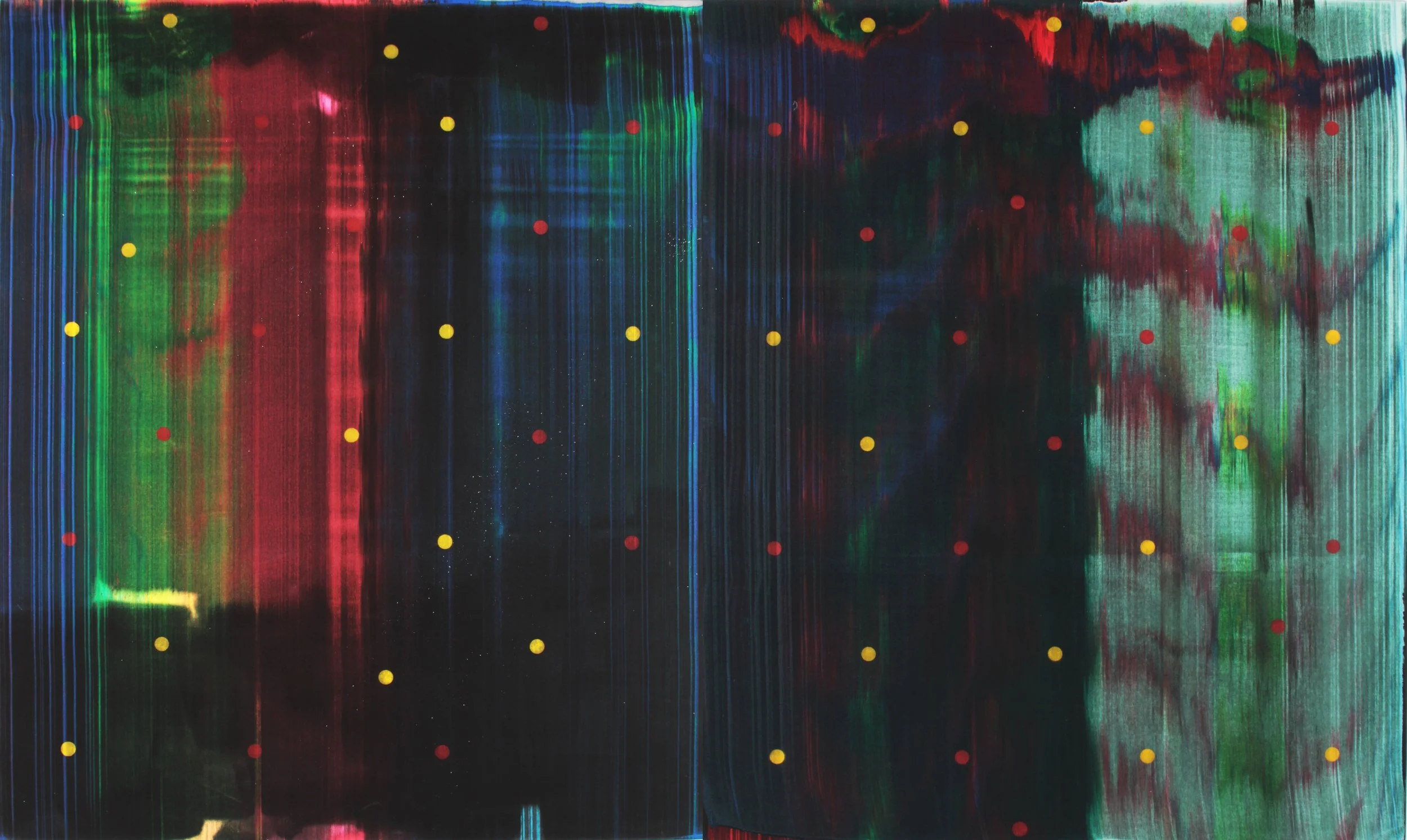
In Ripley’s paintings, glimmers of paint flicker and flare across darkened grounds, activating the surface with a sense of movement and light. Gestural curls and swirls interact with lines and dashes that guide the viewer’s eye in a choreographed passage across the picture plane. These marks are not merely expressive—they are structural, establishing a sense of tempo and poetic cadence that gives each work its internal coherence.

Forms in Ripley’s work do not resolve immediately. They hover, coalesce, and dissolve, shifting in and out of focus as the viewer’s attention lingers. Color behaves similarly: shapes emerge from the ground only to recede again, creating a continuous interplay between presence and disappearance.

Curtis Ripley, Dreaming in Color, 2026, oil on canvas, 40 x 30”.

The result is a dynamic tension between flatness and depth that remains deliberately unsettled. This instability gives rise to a pronounced sense of atmosphere. Gestural forms drift across layered fields of tone, while Ripley’s palette moves between moments of luminous intensity and expanses of saturated darkness. Subtle gradations of color produce fleeting effects — recalling distant light, reflective shimmer, or the charged stillness of a landscape at dusk. The paintings unfold perceptually, revealing themselves over time rather than at a glance.

Ripley’s practice occupies a space between the gestural immediacy of Abstract Expressionism and the immersive chromatic sensibility of Color Field painting. His work synthesizes these traditions into a contemporary language grounded in process, layering, and revision. While resonant with historical explorations of light and atmosphere, his paintings remain distinctly present—open-ended, responsive, and experiential.

Curtis ripley, Silver Springs, 2026, oil on canvas, 60” x 48

Presented concurrently with Unrepentant Beauty by Roland Reiss, High Fidelity offers a complementary approach to perception—one grounded not in constructed illusion, but in painterly sensation and temporal experience.

Throughout a career spanning more than four decades, Curtis Ripley has exhibited nationally and internationally, with an extensive record of solo exhibitions. Born in Lubbock, Texas in 1949, he received his MFA from the University of Wisconsin, Madison in 1975.

Roland Reiss: Unrepentant Beauty Opening

Santa Monica, CA  - William Turner Gallery is pleased to present Roland Reiss: Unrepentant Beauty, an exhibition of late paintings by Roland Reiss (1929–2020), opening April 25, 5-8PM and on view through June 20, 2026.

A pioneering figure in postwar American art, Reiss spent more than six decades redefining the possibilities of painting. From his early explorations of abstraction and representation to his groundbreaking sculptural works and miniature environments, his practice consistently expanded the boundaries of the medium.

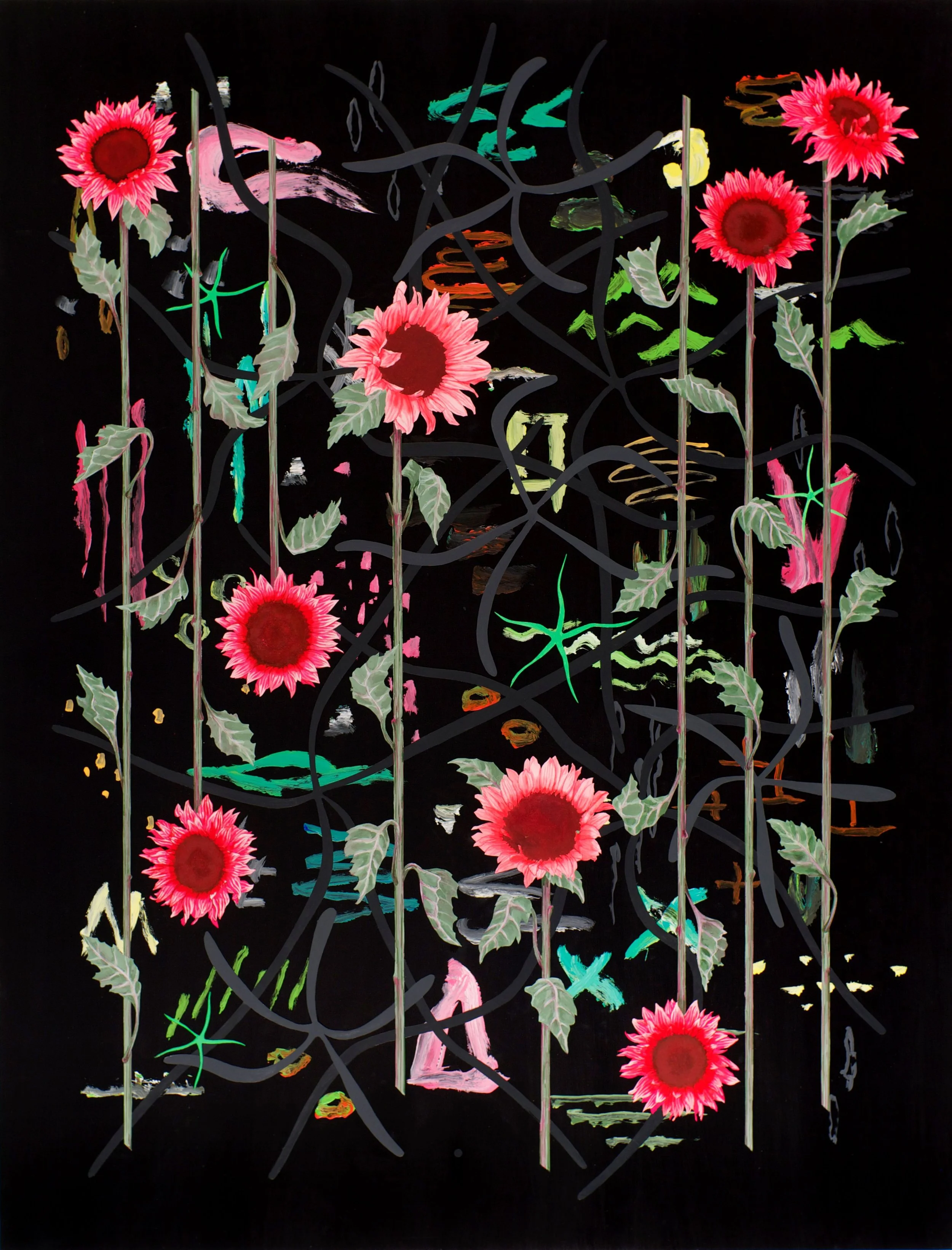
This exhibition focuses on a remarkable development in his final decades: a series of vibrant, dynamic flower paintings that challenge long-standing assumptions about beauty and subject matter in contemporary art. Historically regarded as decorative or peripheral, the motif of the flower becomes, in Reiss’ hands, a site of formal and conceptual innovation. The artist approached these works with full awareness of their cultural baggage, describing the act of painting flowers as requiring “a leap of faith.”

About these paintings Reiss stated, “Flowers are the vehicle for putting everything I have learned about painting into my work.” The resulting paintings move fluidly between abstraction and figuration, combining bold color, gestural energy, and spatial complexity. Rather than depicting flowers, Reiss uses them as a framework for exploring perception, materiality, and the enduring power of visual experience.

The title Unrepentant Beauty reflects the artist’s unapologetic embrace of beauty as both subject and strategy. In contrast to earlier generations for whom beauty was often viewed with suspicion, Reiss’ late work asserts its relevance with clarity and conviction.

At the end of a long and influential career, Reiss produced a body of work that is at once playful, rigorous, and deeply resonant—offering a powerful reconsideration of what painting can be.

Roland Reiss studied at the American Academy of Art, Mount San Antonio College and at UCLA. He taught at UCLA, the University of Colorado, and Claremont Graduate University, where he served as Chair for 30 years, from 1971 to 2001. In 2009 he received the College Art Association Award for the Distinguished Teaching of Art. At CGU he held the Benezet Chair in the Humanities and in 2010 an endowed chair in art was established in his name. He was also the director of The Painting's Edge residency at Idyllwild Arts.

Reiss was the recipient of four N.E.A. grants and of numerous prizes and awards. His work is included in many important public and private collections, such as the Whitney Museum of American Art, Museum of Contemporary Art, Los Angeles, the Los Angeles County Museum of Art, and the Hammer Museum, among others.

Now Representing Roland Reiss

William Turner Gallery is honored to announce our representation of the estate of Roland Reiss (1929–2020), one of the most distinctive and intellectually rigorous voices in postwar American art. This partnership reflects the gallery's commitment to championing significant legacies in contemporary art history and ensuring that Reiss's pioneering body of work continues to reach new audiences.

Though widely celebrated for his miniature tableaux, Reiss was first and foremost a painter whose more than sixty-year career left an indelible mark on the Los Angeles and Southern California art scenes. He was included in the 1975 Whitney Biennial and Documenta 7 in 1982, and received fourteen solo museum exhibitions over the course of his career, including The Dancing Lessons: 12 Sculptures (1977) at LACMA. He also received survey exhibitions at the Pasadena Museum of Contemporary Art (2011–2012) and exhibited at the Hirshhorn Museum and Sculpture Garden in Washington, D.C., and the Nelson-Atkins Museum of Art in Kansas City. A retrospective of his work was mounted at the Los Angeles Municipal Art Gallery in 1991.

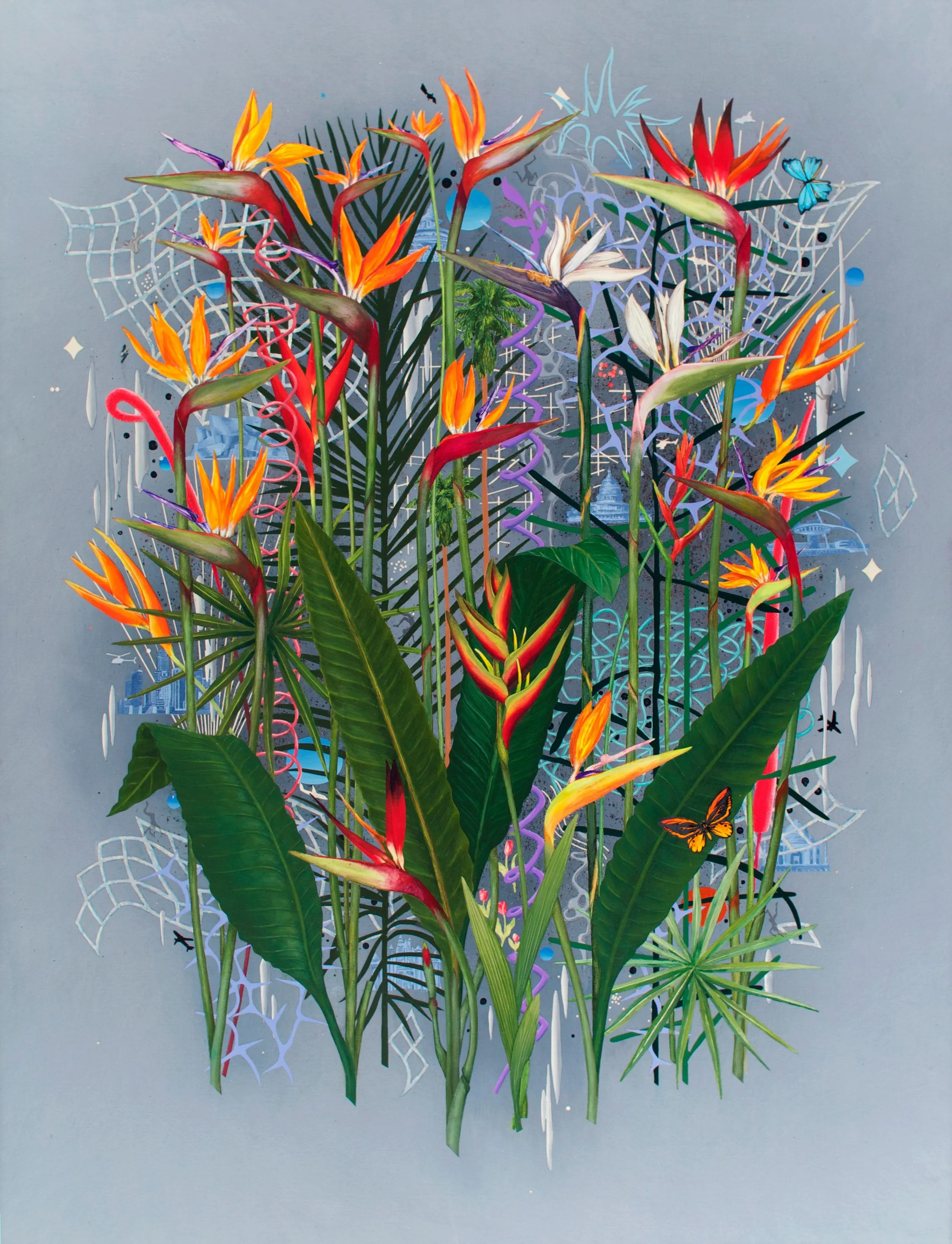
ROLAND REISS, Paradisium, 2009, oil and acrylic on canvas, 68” x 52”

Reiss studied at the American Academy of Art, Mount San Antonio College, and UCLA, graduating with an MA in 1957. He taught at the University of Colorado, UCLA, and Claremont Graduate University, where he chaired the art department for thirty years. In 2009, he received the College Art Association Award for Distinguished Teaching of Art. At CGU he held the Benezet Chair in the Humanities, and in 2010 an endowed chair in art was established in his name. He was also director of The Painting’s Edge residency at Idyllwild Arts.

Reiss received four NEA grants and numerous prizes and awards. His work is held in many significant public and private collections, including the Museum of Contemporary Art, Los Angeles, the Los Angeles County Museum of Art, the Whitney Museum of American Art, the Hammer Museum, Santa Barbara Museum of Art, Palm Springs Art Museum, UC Irvine Langson Orange County Museum of Art, Laguna Art Museum, Benton Museum of Art, Claremont Lewis Museum of Art, and Oakland Museum of California.

Charles Arnoldi in The Hollywood Reporter

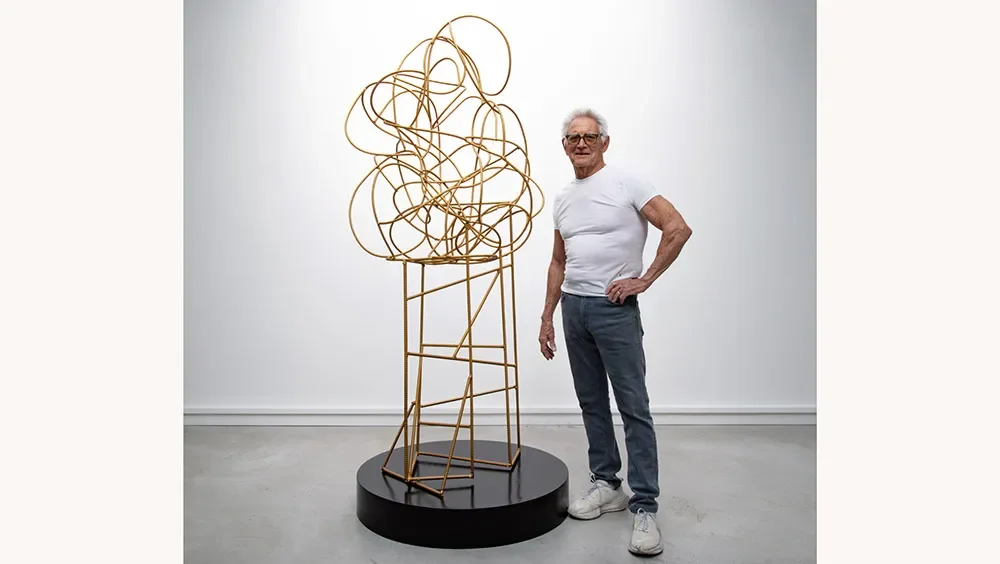
Congratulations to Charles Arnoldi for his recent feature in Michael Slenske's article "Guns and Glitter: How LA's Top Artists Reimagine the Oscar" for The Hollywood Reporter!

Charles Arnoldi

Slenske writes: For this portfolio, [Arnoldi] did something he almost never does: “I don’t really think about the Oscars, and I don’t make figurative work,” he says. “But there’s a human quality to this particular sculpture because it has legs and these morphing human forms. I guess you could say that’s a commentary on the chaos that accompanies the Oscars race every year.”

Read the full article at the link below!

SURFACE TENSION: Focus Los Angeles - Opening Saturday 5-8PM

Surface Tension: Focus Los Angeles Opening February 28 5-8PM

Santa Monica, CA  - William Turner Gallery is pleased to present Surface Tension: Focus Los Angeles, a major group exhibition of West Coast artists, opening February 28, 5-8 PM, and on view through April 11, 2026.

Surface Tension: Focus Los Angeles explores surface as an active site of meaning, sensation, and perception. The exhibition foregrounds how contemporary practices use texture, layering, and materiality to shape visual and sensory experience. Bridging painting, sculpture, and works at their intersection, the featured artists employ materials ranging from pearlescent and pigmented acrylics to urethane, resin, industrial finishes, and etched line-work.

Together, the works reveal surface as a dynamic interface that captures light, depth, and movement while inviting sustained, close looking. Through extended material experimentation and technical refinement, each artist demonstrates a deep attunement to their chosen medium, using surface to generate tension between control and intuition, precision and discovery, all aimed at igniting a spark of heightened perception.

Featured artists: Dawn Arrowsmith, Casper Brindle, Alex Couwenberg, Shingo Francis, Frank Gehry, Jimi Gleason, James Hayward, Eric Johnson, Peter Lodato, Andy Moses, Ed Moses, Roland Reiss, Scot Heywood and Jennifer Wolf.

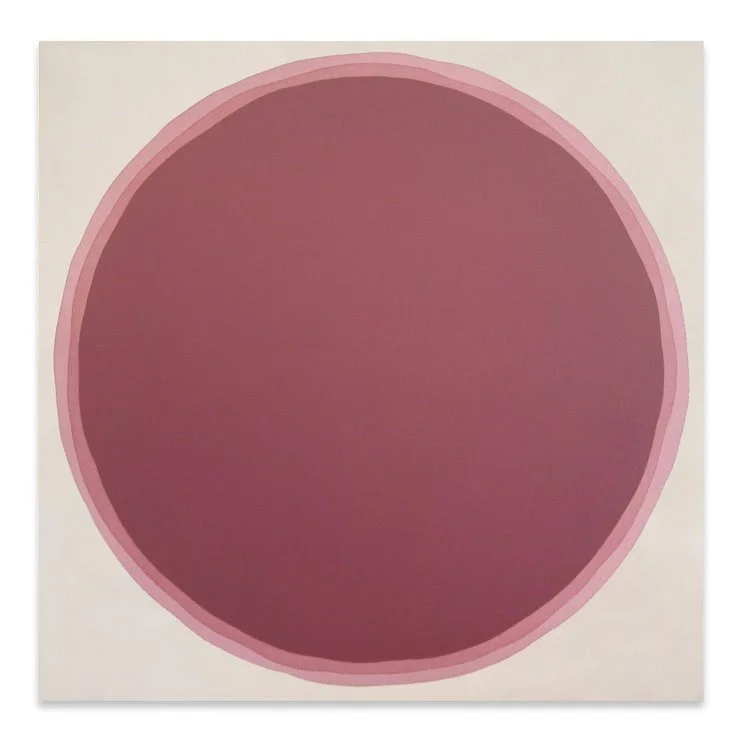
Dawn Arrowsmith, Plum Sienna, acrylic on canvas, 56" x 56"

Dawn Arrowsmith produces meditative, color-driven works informed by Buddhist philosophy and extensive travel. Her paintings appear minimal at first glance, gradually revealing optical shimmer and depth through prolonged viewing.

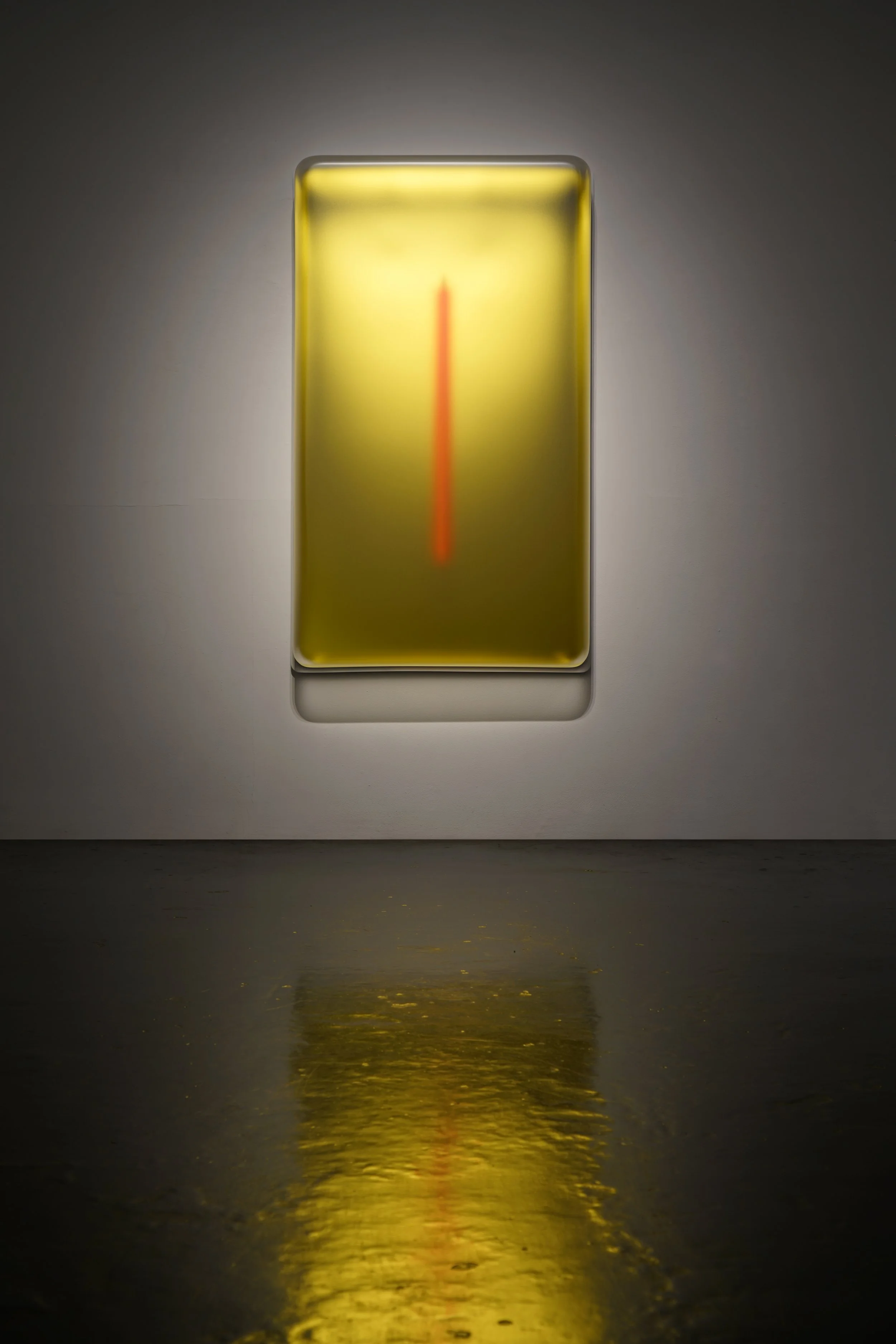
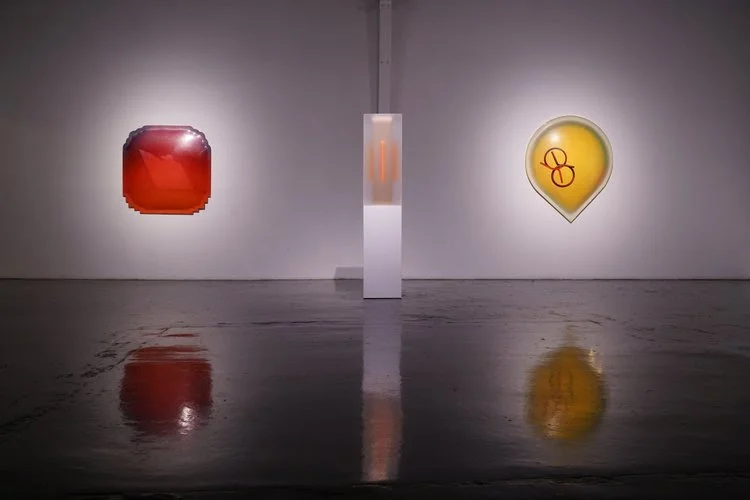
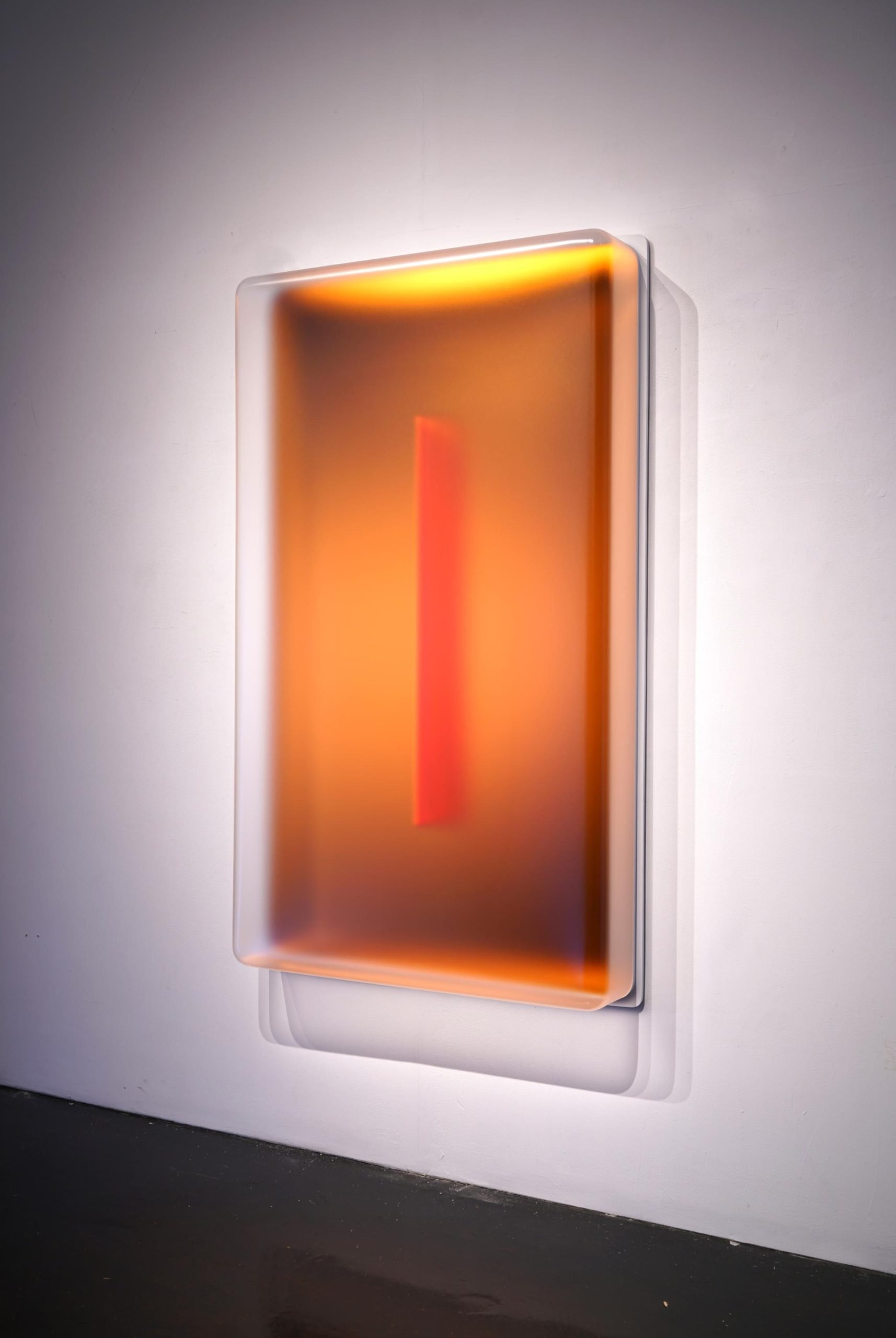
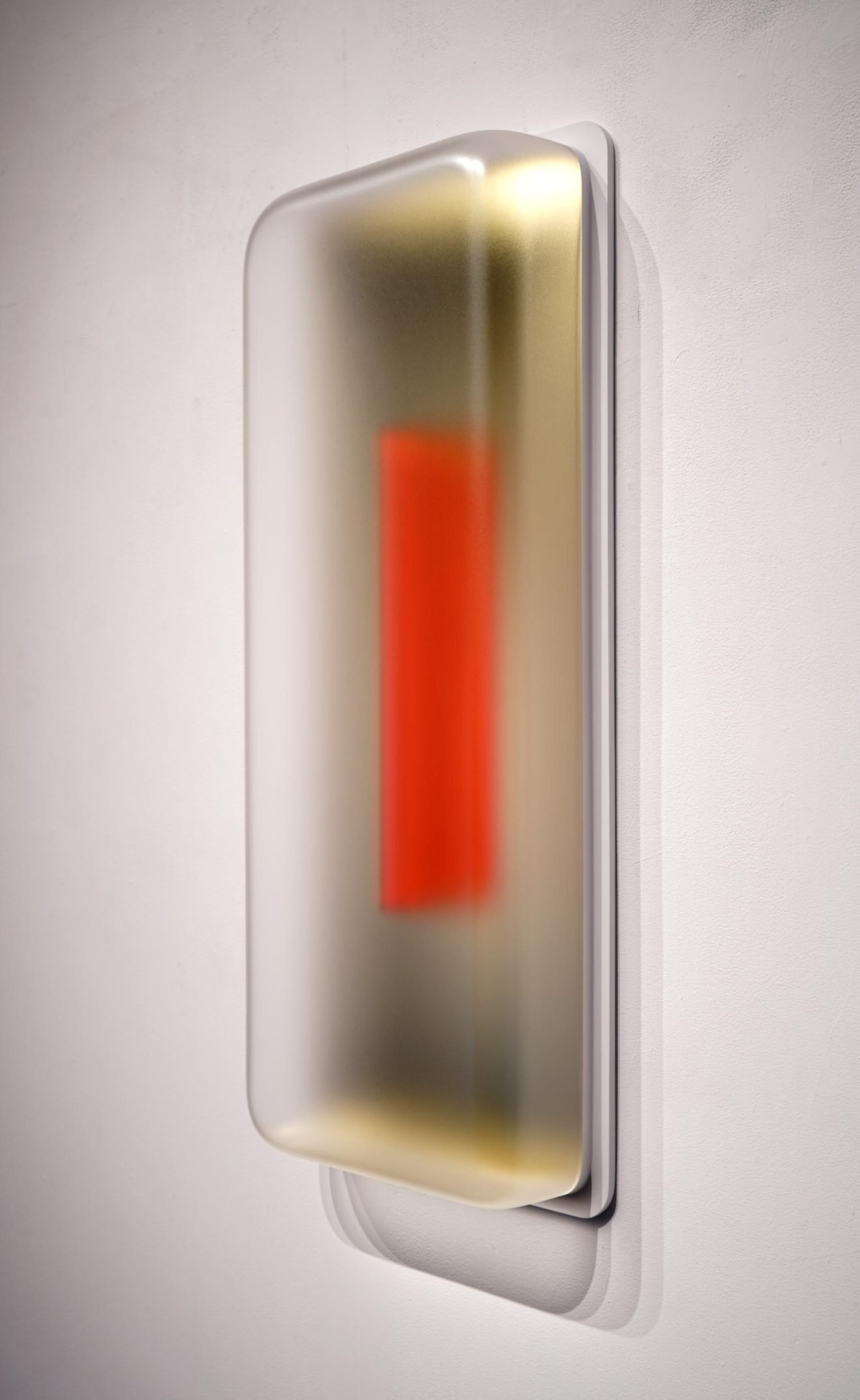
Casper Brindle, LIGHT GLYPH (YELLOW), 2026, VACUUMED FORMED PIGMENTED ACRYLIC

Casper Brindle creates paintings and sculptures that engage light through reflective, industrial materials including resin and automotive paint. His work shifts with the viewer’s movement, emphasizing perception and atmospheric depth.

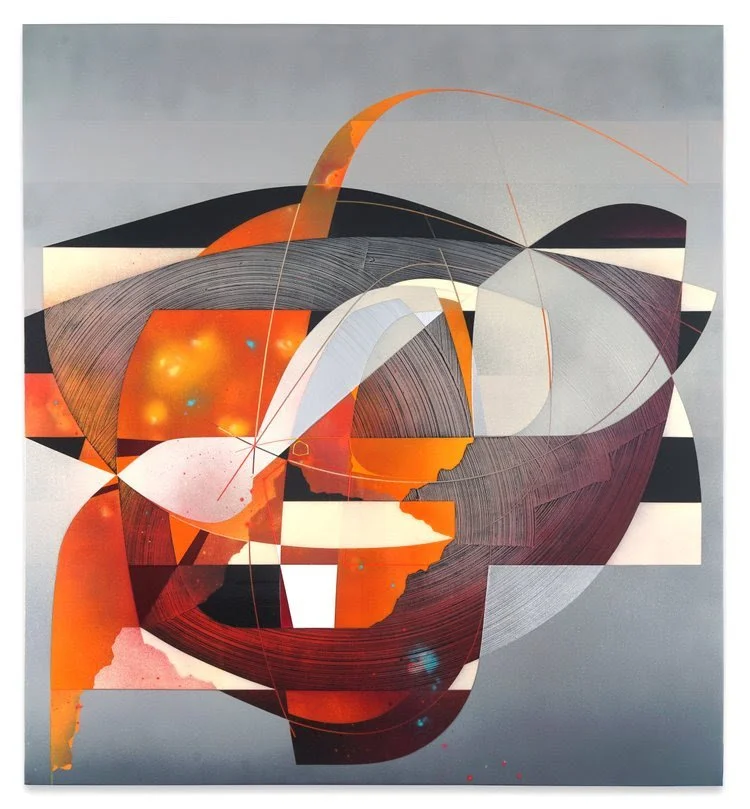
Alex Couwenberg,  Stranded (I’m), 2025, Acrylic & spray on canvas, 72” x 66”

Alex Couwenberg is a Southern California–based painter whose work draws from Los Angeles modernism and mid-century design. His sleek, glossy paintings are influenced by Hard-edge abstraction and Finish Fetish aesthetics.

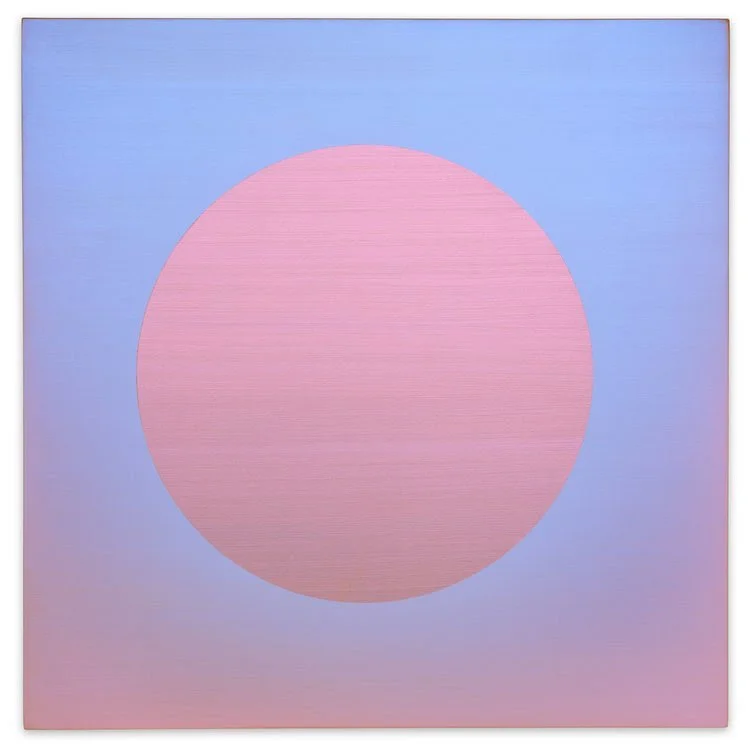
Shingo Francis, Mystery to Explore, 2023, Oil on canvas, 24" x 24"

Shingo Francis creates paintings that shimmer and shift through the use of interference pigments that refract light. Influenced by Southern California’s Light and Space movement and his immersion in LA’s art scene, Francis’s works change with viewer position and lighting conditions.

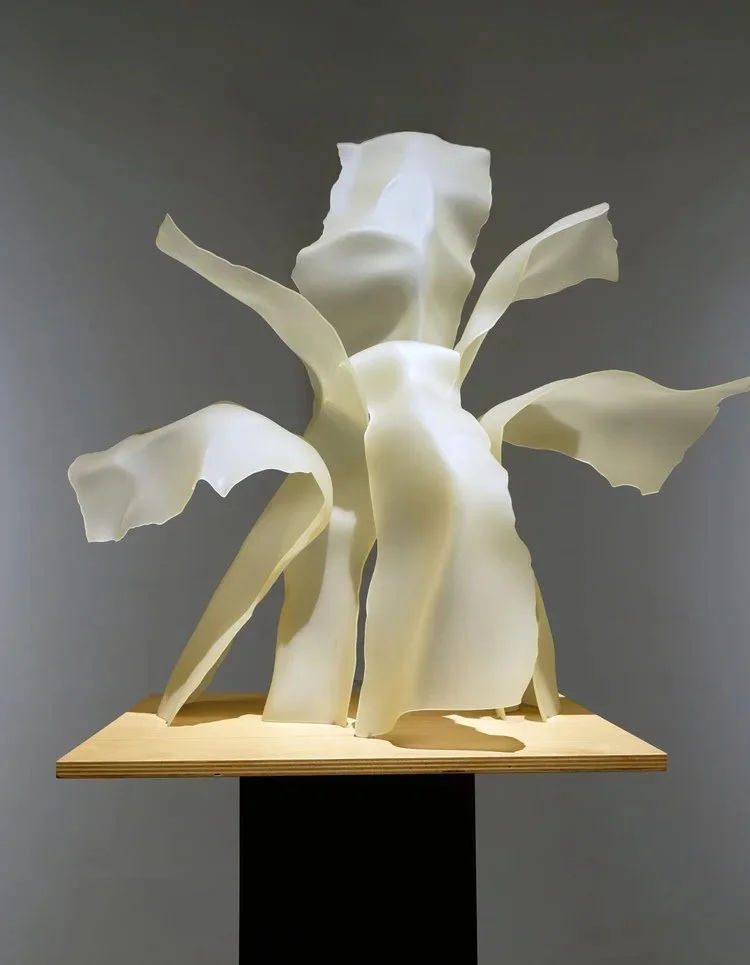
Frank Gehry, Memory of Sophie Calle’s Flower, 2012, Cast urethane with wood pedestal,
24” x 23” x 18”

Frank Gehry (1929–2025) Known for his de-constructivist approach and creative use of materials, Gehry’s buildings share an artist’s sensibility, where surface texture and dynamic form activate his structures. The undulating, curvilinear forms of his architecture are often echoed in the sculptures and drawings he created throughout his long career.

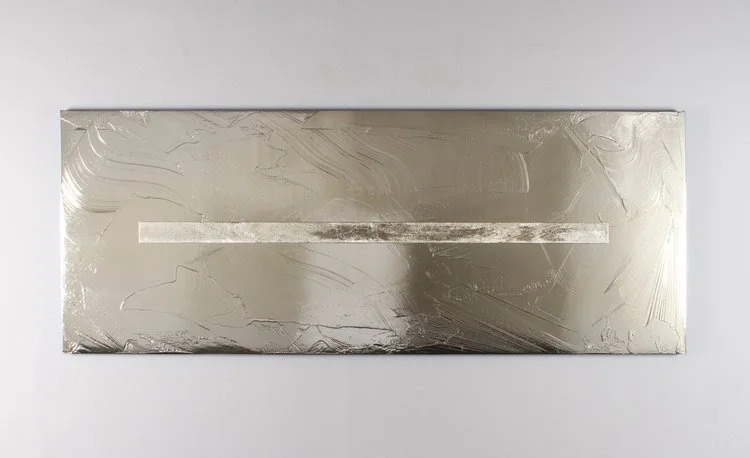
Jimi Gleason, Untitled, 2018, Silver nitrate & acrylic on canvas, 48” x 126”

Jimi Gleason explores the reflective and perceptual properties of light, using materials such as silver nitrate and pearlescent paint. His mirror-like surfaces shift with the viewer and environment, creating interactive, meditative experiences.

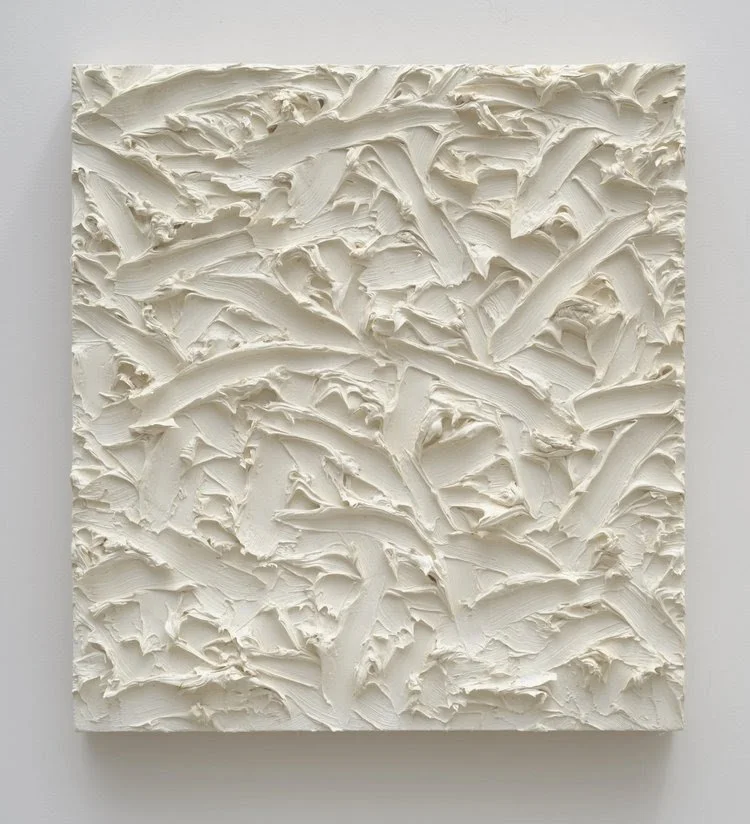
James Hayward, Abstract #247, 2023, Oil on canvas, 25” x 23”

James Hayward paints monochromes that celebrate the nuances of color and sensuality of texture. The surfaces are lavish cake icings of paint, almost daring the viewer to touch, lick, engage. Deft strokes of the artist’s hand remain as deep fissures in the surface, further exciting the senses to embrace their physicality.

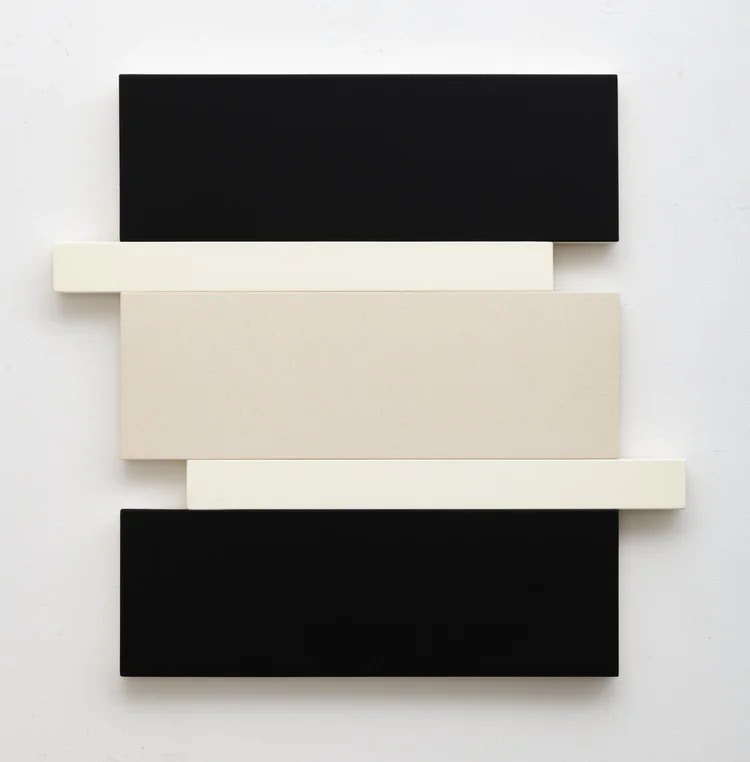
Scot Heywood, Stack - Black, White, Canvas, 2016, Acrylic on canvas, 70” x 74”

Scot Heywood’s works are indebted to the origins of geometric abstraction. Ranging in scale from intimate to encompassing, his paintings consist of multiple, colored canvases, connected in staggered, patchwork patterns, intentionally misaligned to create delightfully disruptive, staccato visual rhythms.

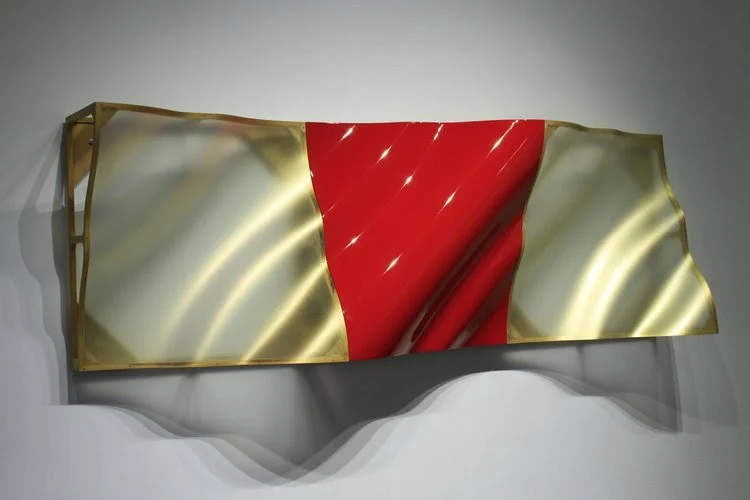
Eric Johnson, Altamira (Triptych), 1992, Composite, wood, & enamel, 40" x 120" x 18"

Eric Johnson creates resin-based sculptures that merge color, form, and structure, drawing from Southern California’s surf, automotive, and aerospace cultures. His works balance polished surfaces with exposed internal architectures, revealing both depth and construction.

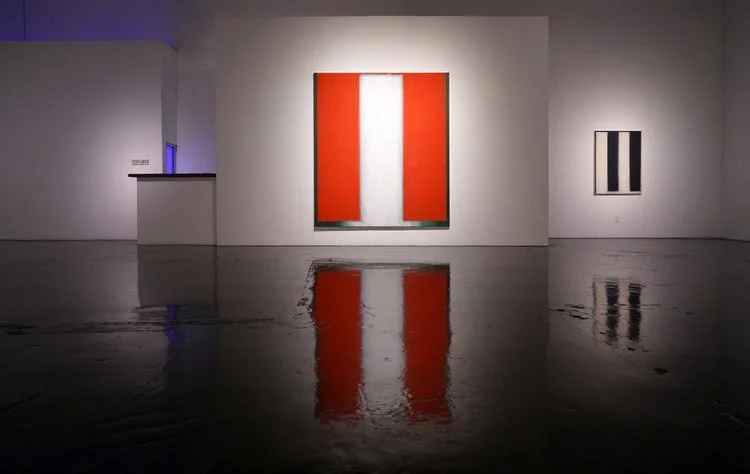
Peter Lodato, Vermilion Green & White, 2023, oil on canvas, 96" x 84"

Peter Lodato (1946–2025) emerged from the Light and Space movement, initially creating immersive light installations before translating perceptual effects into painting. His geometric compositions subtly dissolve through layered brushwork and color vibration, challenging visual certainty.

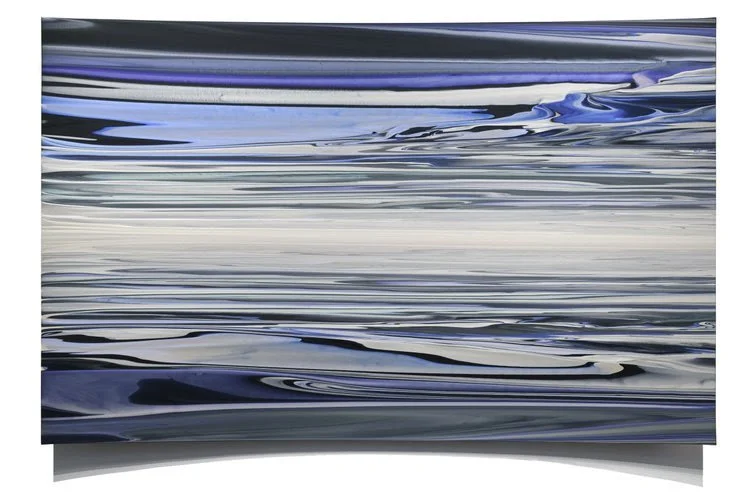
Andy Moses, Geomorphology 1608, 2023, Acrylic on canvas over concave wood panel,
57” x 90” x 5.5”

Andy Moses is known for his intensive exploration of paint’s alchemical properties. Through complex pouring and mixing processes, his luminous abstractions evoke natural forces rather than representational imagery.

Ed Moses, Sato, 2008, acrylic on canvas, 72” x 120”

Ed Moses (1926–2018) was a pivotal figure in postwar Los Angeles abstraction and a core member of the Ferus Gallery circle. Known for his experimental, process-driven approach, Moses continuously redefined painting over a career spanning six decades.

Left: Roland Reiss, Mirage, 1968, Fiberglass & resin, 46" x 46" x 6
Right: Roland Reiss, Conundrum, 1968, Acrylic, fiberglass, resin, & gelatin coat, 67" x 46.5" x 6"

Roland Reiss (1929-2020) played a significant role in the evolution of postwar West Coast abstraction. Moving from Abstract Expressionism through resin experimentation and conceptual inquiry, Reiss has consistently explored painting as an energetic, interactive field.

Jennifer Wolf, Dye Painting #2, 2021, Natural dyes and mineral pigments on silk with canvas on wood panel, 48” x 48”

Jennifer Wolf uses natural dyes and hand-ground pigments sourced from global expeditions to create subtly shimmering, immersive paintings. Her work explores the elemental qualities of color and surface through fluid, layered compositions that evoke natural environments.

SHINGO FRANCIS INTERVIEW - Fondation D'Entreprise HERMÉS

William Turner Gallery is pleased to share a recently released interview with Shingo Francis where he discusses his artwork, influences, and inspirations for the “Interference” exhibition at Maison Hermès Le Forum in 2023. Le Forum is an exhibition space housed in a glass-brick building designed by Renzo Piano. Flooded with natural light that forms an integral part of its identity, it is an oasis of contemplation inviting visitors to discover contemporary art in the heart of Tokyo’s dynamic Ginza neighbourhood. Directed by exhibition curator Reiko Setsuda, Le Forum offers an international programme bringing Japanese artists together with others from all over the world.

In addition to sharing Francis’ newly released interview with Foundation d’enterprise Hermès, William Turner Gallery is thrilled with Francis’ participation in the Japanese Pavilion at the Ōsaka Expo 2025.

Born in Santa Monica, California in 1969, Shingo Francis’ work explores the expansiveness of space and spirituality in painting. Francis has participated in numerous solo and group exhibitions both in Japan and internationally. His works are held in collections such as the JPMorgan Chase Art Collection, Banco de España, the Frederick R. Weisman Foundation, the Mori Art Collection, the Sezon Museum of Modern Art, the Oketa Collection, the Tokyo American Club, the Ueshima Collection, and Tiffany & Co.

INTERVIEW WITH SHINGO AT FONDATION D’ ENTREPRISE HERMÉS

TIME LAPSE OF THE INSTALLATION

Le Forum is an exhibition space housed in a glass-brick building designed by Renzo Piano. Flooded with natural light that forms an integral part of its identity, it is an oasis of contemplation inviting visitors to discover contemporary art in the heart of Tokyo’s dynamic Ginza neighbourhood. Directed by exhibition curator Reiko Setsuda, Le Forum offers an international programme bringing Japanese artists together with others from all over the world.

What is “interference”? Under this title, the first exhibition of 2023 invites the public to find answers through experience. Four artists explore our perceptions through the effects on the body of stimuli such as light, vibrations or soundwaves. Through stripped-back aesthetics, each of these artists highlights the subtle variations caused by the interferences to which our bodies are subjected in everyday life. Visitors are invited to contemplate the nature of perception through deeply felt sensations both physical and unconscious. The title, “Interference”, is borrowed from a series of paintings by artist Shingo Francis (b. 1969, United States): containing pigments that interfere with light, the colours of these canvases shift according to the viewer’s position. Nearby, an installation by Susanna Fritscher (b. 1960, Austria) immerses the viewer in a sensory experience of vibrations and pulsations beyond the frequencies that we are capable of hearing. Finally, Bruno Botella (b. 1976, France) presents pieces that stimulate our subconscious perception through tactile sensation, while Aiko Miyanaga (b. 1976, Japan) invites visitors to embark on a cosmic journey – the ultimate sensation, transcending time and space – through a tea ceremony shared online.


JIMI GLEASON: Vapor Wave - Digital Exhibition Catalog

Santa Monica, CA - William Turner Gallery is pleased to present Vapor Wave, a solo exhibition by Jimi Gleason,  opening April 5 and running through May 31, 2025.

Vapor Wave is Jimi Gleason’s most ambitious body of work to date. Utilizing a rich vocabulary of materials and styles, Gleason has built up gossamer thin layers of iridescent paint to create a series of paintings that are engagingly enigmatic. They confirm an artist at the height of his talent, confidently exploring the power of nuance and understated expression.

In this new series, vaporous ribbons of color play across lustrous surfaces that morph and shift as one engages them. The effect elicits a sense of unexpected revelry - much like the kind one might experience gazing across a lake in a predawn moment, captivated by the growing light as it caresses and undulates across the water’s surface.

And like water, Gleason’s surfaces are quietly in motion, their iridescent paints subtly shifting in hue as light plays across them. In some of the canvases, sharp diagonals bifurcate the compositions, providing dramatic structural rifts to these ethereal surfaces. The effect is a hypnotic and prismatic visual structure, where light, color and form intersect in ever-changing play. Gleason has a uniquely personal connection to water: he grew up surfing, and took up rowing in college. When he talks about his work he also talks about, “the way the light looks underwater,” and early mornings rowing when the calm water reflects the sky at dawn. 

Like many artists working in the Light and Space arena, materials and their catalytic visual effects are essential to their work. In Gleason’s case, he employs silver nitrate and pearlescent paints to activate his surfaces, which catch and reflect surrounding light, further engaging one’s sense of the surrounding space. Gleason is a leader in that next generation of Southern California artists to work in the Light and Space ethos, carrying the dialogue forward and using his work of art to explore the phenomenological properties of perception.

Born in Newport Beach, CA, Gleason received his BA from UC Berkeley in 1985. He studied printmaking at the San Francisco Art Institute before relocating to New York City, where he worked as a photo assistant and technician. Returning to California, Gleason was employed in the studio of Ed Moses for five years. Combining the disparate technical and compositional skills developed during his exposure to printmaking, photography and mixed media painting, Gleason is now the subject of considerable curatorial and critical attention. 

Gleason’s work is exhibited in significant public institutions, including the Hammer Museum, the Frederick R. Weisman Foundation, the Long Beach Museum, the Seattle Art Museum, and the Tucson Museum of Art.The artist’s paintings are actively collected by a growing number of major public and private collections around the world.

PETER LODATO: DIAMONDS/DIVISIONS/VOIDS - Exhibition Catalog Now Available

Santa Monica, CA - William Turner Gallery is pleased to present, solo exhibition of exceptional new works by Peter Lodato, opening  January 13th, 2024. 

Peter Lodato’s (b. 1946) artistic journey reflects an evolution, from immersive light installations, to captivating paintings that explore the complexities of human perception over the course of his six decade-long career. In addition, Lodato would himself influence a number of artists, teaching Art History at Art Center in Pasadena, and University of California Irvine with notable students such as James Turrell and Chris Burden.

His initial foray into art consisted of environmental light installations,  characteristic of the West Coast's Light and Space movement in the 1960’s, which sought to transform physical spaces into immersive experiences for viewers. He credits the Roman Pantheon’s oculus for his interest in interpreting his experience. This body of work led to his inclusion in the 1981 Whitney Biennial.

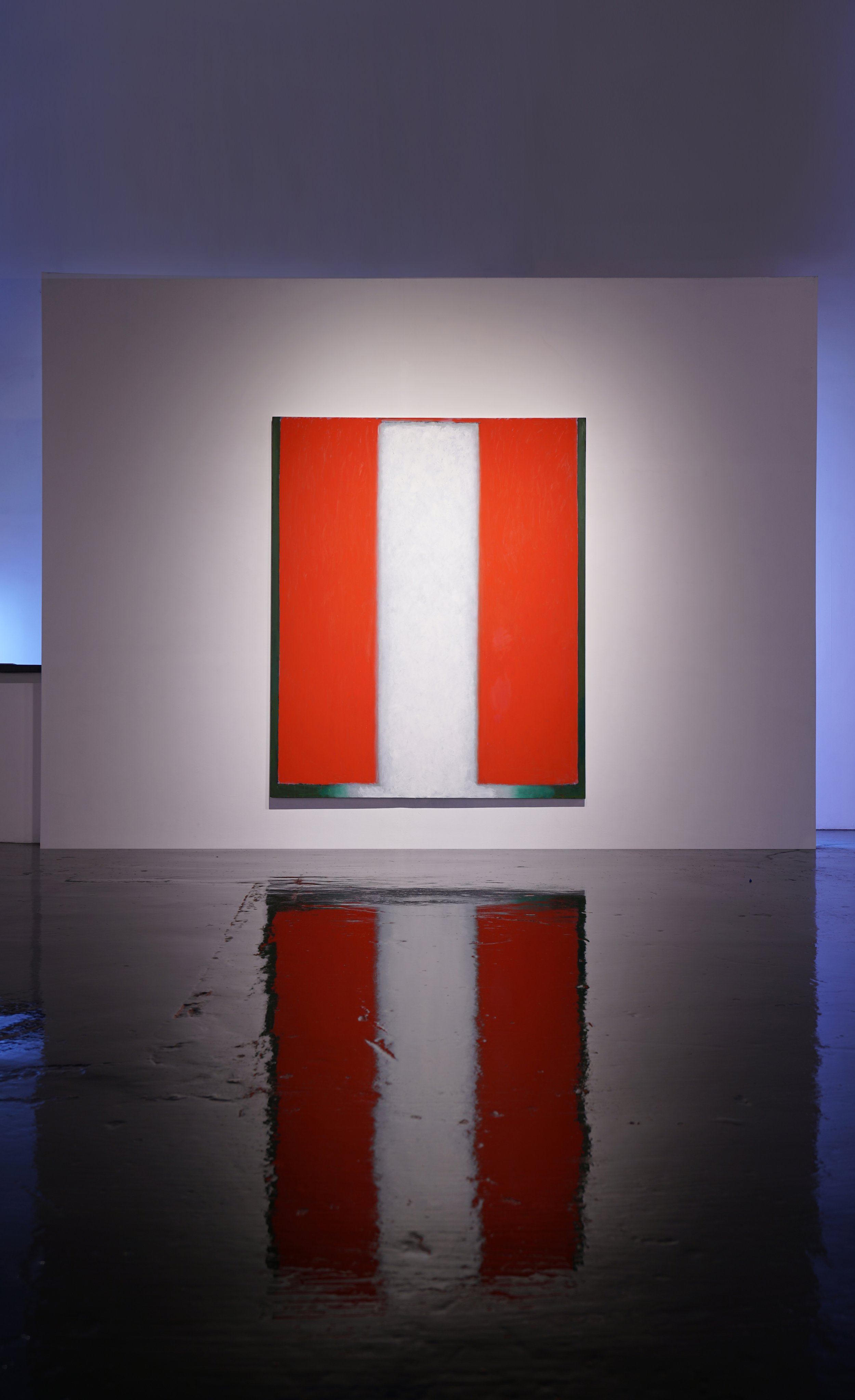
As Lodato transitioned back to painting, he carried forward his fascination with perception, creating works that initially appear as austere, geometric abstractions but upon closer inspection, reveal layers, brushstrokes, and vibrant colors that play with space and depth. The dichotomy of vision—its capacity to both reveal and conceal—serves as a thematic cornerstone in Lodato's artistry. His reductive compositions, often featuring divided forms and bold colors, engage viewers in a visual dialogue between simplicity and complexity. Inspired by the Abstract Expressionist’s Mark Rothko and Barnett Newman, Lodato's use of vertical bands of color draws viewers into the canvas, inviting them to experience the artwork both physically and transcendentally. Hard edges feather out into diaphanous atmospheric vapors, creating luminous, Color-field suspensions floating on a colored ground– the formal consequences appear to both recede and project, dematerializing the art object and simultaneously constructing a void of flat, hard-edge, matted pigment. The artists hand is evident in the textural materialization of paint executed with an expert hand. In reasserting the picture plane in favor of the flat form, the abstractions are not in fact “subjectless”, regardless of their  reductive nature, they are intended to elicit a deep emotional response and expose the paradoxical nature of human perception.   

Informed in part by Eastern philosophy, Lodato’s palette observes the color schema assigned to the various corporeal chakras and their corresponding color assignments. Red for example symbolizes the root chakra at the base of the spine, characterizing strength and vitality, whilst white on the other end of the spectrum, illustrates the crowning light of spiritual wisdom.    

Embed Block
Enter a valid embed URL or code.

Lodato holds a Graduate degree from California State University. His artistic contributions have been recognized through a solo retrospective curated by the Frederick Weisman Foundation (2000), and exhibitions at prestigious institutions such as PS1 in New York City (1978), Whitney Museum of American Art’s Biennial (1981), the Museum of Contemporary Art in Los Angeles, and the Los Angeles County Museum of Art. His works grace esteemed collections in various public and private institutions, including the Brooklyn Museum, the Seattle Art Museum, the Dallas Museum of Art, and the San Diego Museum of Contemporary Art. This extensive presence in renowned collections underscores the impact and significance of Lodato's artistic vision within the realm of contemporary art. He lives and works in Venice, California.

Opening Tomorrow, Saturday, January 13 from 5-8PM - Peter Lodato: Diamonds/Divisions/Voids & Koji Takei: Intertwined

Vermillion Green & White, 2023, oil on canvas, 96” x 84”

PETER LODATO

Lodato holds a Graduate degree from California State University. His artistic contributions have been recognized through a solo retrospective curated by the Frederick Weisman Foundation (2000), and exhibitions at prestigious institutions such as PS1 in New York City (1978), Whitney Museum of American Art’s Biennial (1981), the Museum of Contemporary Art in Los Angeles, and the Los Angeles County Museum of Art. His works grace esteemed collections in various public and private institutions, including the Brooklyn Museum, the Seattle Art Museum, the Dallas Museum of Art, and the San Diego Museum of Contemporary Art. This extensive presence in renowned collections underscores the impact and significance of Lodato's artistic vision within the realm of contemporary art. He lives and works in Venice, California.    


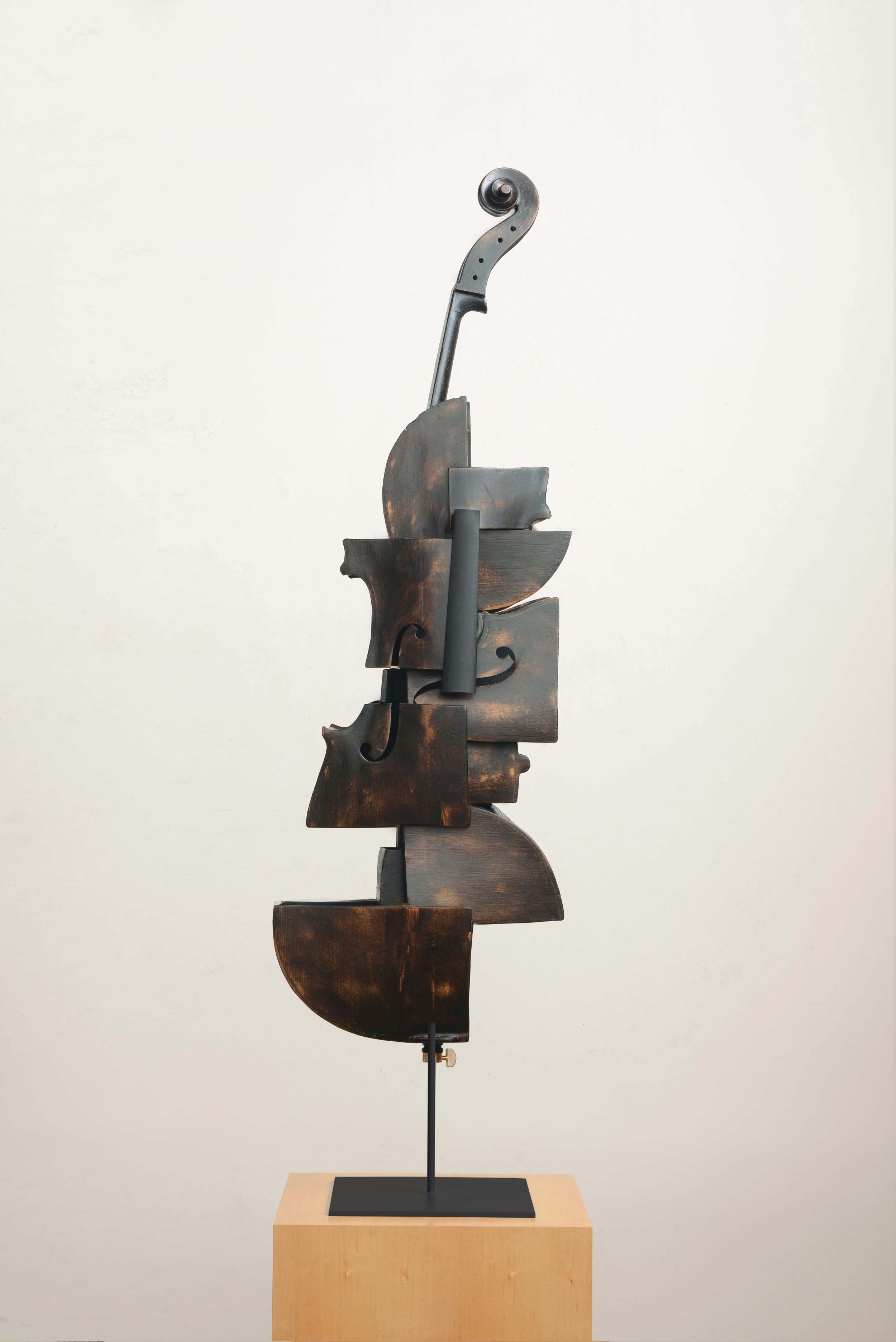
Cello, wood, stains & varnish on metal stand, 53” x 14” x 7”

Through his background in photography and graphic design, Takei first began piecemealing his disparate photographs (pre-Photoshop) and constructing them into sculptures to be photographed. This in turn, led to Takei becoming a sculptor.

Drawing from the discourse of Picasso, Braque and the Surrealists, Takei’s sculptures reference, yet expand upon these oeuvres in a playful syncretism of the two. His work transcends the cacophony often associated with Cubism, offering a vocabulary suffused with irony. that engages in the contemplation of diverging vantage-points in-the-round. The minimal yet commanding presence of his pieces draws parallel to the interlocking sculptures of the late Isamu Noguchi, echoing a profound artistic resonance. Through Intertwined, Koji Takei continues to redefine the boundaries of Cubism. As much as Takei’s pieces are Cubist in nature there is also an unmistakable Asian influence in the working method of the Japanese native.

As a Japanese-American residing in Los Angeles, Takei's influence extends far beyond his innovative work. He has taught at the California Institute of the Arts in Valencia, California; Otis College of Art & Design in Los Angeles, and is currently a faculty member at the Art Center College of Design in Pasadena and Academy of Art University in San Francisco. This underscores his commitment to shaping the next generation of artistic visionaries.

VISUAL ATELIER 8 - An interview with Casper Brindle, Master of Light, Color, and Sensory Exploration

VISUAL ATELIER 8

An interview with Casper Brindle, Master of Light, Color, and Sensory Exploration

Image: Rob Brander for William Turner Gallery

Exploring the enchanting world of Casper Brindle
Jaimy Favela Le

Casper Brindle, a contemporary artist rooted in the 1960s & 70s Light and Space movement, explores the expressive possibilities of color, light, and form in his paintings. From vibrant technicolor to subtle monochromatic hues, Casper Brindle’s work consistently features a central focus, drawing viewers into enigmatic spaces of perception. Influenced by the Finish Fetish and Light and Space movements, he masterfully employs color reminiscent of Mark Rothko and Jules Olitski, creating immersive fields that evoke deep emotional responses.

Casper Brindle’s paintings, influenced by Southern California’s car culture, utilize airbrushed sprays for atmospheric depth, demonstrating a synthesis of diverse artistic sensibilities. Born in Toronto in 1968, Brindle, now based in Los Angeles, has exhibited internationally and is held in prestigious collections like the Frederick R. Weisman Art Foundation.

It is an incredible occasion to be able to chat with Casper Brindle about his awe-inspiring and sensory artwork! We would love to know what you think your child-self would think of you now as such an accomplished artist? What do you think little Casper would say to you? And what would he think about your expansive body of work? Is he glowing with pride?

Thank you for the kind words. I think Little Casper would be happy with my accomplishments so far. There is something innately childish about being a professional artist. Experimenting and “playing” with the materials in front of you. I could compare it to the feeling of playing with toys in the preschool sandbox. I am forever grateful to have had such a supportive mother, a terrific illustrator and designer in her own right. I’m deeply fortunate that I am able to make a living doing what I’m very passionate about.

What a wild trip it is to take in your illuminating works that seem to unfold more of themselves, the more you spend time with them and interact with the space them. We would love to know more about how you went from utilizing LED tubes for lighting up a painting to now being able to skillfully achieve an effect of illumination by using only color. What was the process like for you personally?

Yes, for years I was incorporating and embedding LED lights into my paintings and never really found what I was looking for. I was yearning for a certain magic, a more organic quality which the artificial light provided by the LEDs could never achieve. What most interests me is the manipulation of light, whether it be with refraction in an encapsulated form, such as the light glyphs, or using paints that intentionally transform as you walk around the works. Materiality is a primary principle of my practice as I have spent years experimenting with the applications of different materials.

Your work speaks to the auras felt when perceiving colors, light, a core, and atmospheric spaces. Contemplation about perception and connecting with the presence are a couple things that come from immersing oneself in your body of work. Do you think your work reflects these experiences from the living world or is it its own concentration of sensory conjuration?

Both. I think the materials are a grounding force for the pieces, whereas the treatment and color perception of the materials allow for the pieces to become almost otherworldly. However, the orchestrated fabrication of the pieces reflects the organized chaos of both the natural and the built environment that surrounds us.

What dream settings do you envision your colorful works in? Are there particular places in the world that you hope to bring your art to?

Of course, artists are always fantasizing about ideal settings for our work – Museums, major collections, within prominent public and architectural venues. I am no different and have been thrilled to have my work acquired and shown by museums, like the Weisman Museum, The Luckman, Lancaster Museum of Art, the new Frank Gehry hotel in LA and by a number prominent collectors. Looking ahead, I have an exhibition planned in Brussels at Gallery La Patinoire Royale, Valerie Bach, in April of 2024 and will be showing new paintings and sculpture that I am presently working on and excited about.

Soon following, I will be focused on my Los Angeles exhibition in September at the William Turner Gallery. Possibly less traditionally, I’d love to explore placing my work in “atypical” settings: a foggy forrest, a beach, a desert. Changing the context changes the piece. A glowing object in the middle of nowhere tells a much different story than a painting hung on a white wall of a gallery. Hmm, could this be a short film? You’ve got the wheels turning!

We also know that you are also a sculptor. Can you divulge a bit about how this way of creating your art differs in from how you approach making your paintings? Taking something that you typically form on a 2D surface to a 3D realm?

The three dimensional work is more of an elaborate, organized process, compared to the typical trance I’m in while I’m painting. With my paintings, I’m just going on rapid fire instincts in a meditative state. With the sculptural work it’s about logical problem solving. Like a puzzle. The Light Glyph sculptural works are expanded iterations of the Portal Glyph paintings -They just extend into three dimensions. Both explore the same theory, but within different mediums and materialities.

Maybe a comparable example is the painter as an actor and the sculptor as the director in theater or film. The actor is always reacting to a situation in front of them instinctively, but the director (sculptor) is planning the entire vision out before the production has begun. Two different processes for me, neither better than the other. Although, I enjoy the visceral process of painting more, both outcomes are equally fulfilling.

What does abstraction mean to you? Describe to us the way you philosophize the human senses in response to abstract visualizations that imbue a particular experience.

I’m in search of something beyond, something that can be truly simple and complex. Making my work is a selfish act, as I’m making the painting or sculpture solely for myself, to release it from my mind, without thinking about how they will be seen or felt. It’s a place where I can be hyper focused yet, in a meditative state. The artwork may be used as a conduit for the viewers own experiences, but I would never force a narrative onto them. Abstraction to me is being free of story telling or narration. To create a work based on raw emotions or even lack of emotions. Free of rules. The freedom to dance any way you like.

What does the process of dreaming up a painting or sculpture look like for you? Is it the case that the end result always matches the first drop of inspiration?

My paintings or sculptural works come to me usually in solitude, whether that be just before bed or alone in my studio. With my paintings, I may have an idea to explore, but rarely do they end up visually resembling my initial thoughts. I find in painting the decisions are made quickly and based on instinct. Sculpture for me is a much more thought out concept as you are dealing with construction and fabricating a well explored object with prototyping all while aiming to achieve the concept that was originally in my head.

What has been a major highlight for you as an artist so far? What sort of new things are you seeking to further your creative endeavors? Any personal revelations that you wish to share over the years?

My highlights constantly change as I grow, but a recent noteworthy highlight was working with Mika Cho who curated my Museum exhibition at The Luckman space at California State University Los Angeles. It was a phenomenal show and experience. Cho’s execution
and presentation were terrific. Constantly thinking of new ideas, projects, materials and collaborations, I know there is always something inspiring around the corner. It’s important to do the work you enjoy as opposed to chasing trends. I believe that if you do your own thing, a thing you are truly passionate about, everything will eventually fall into place.