MARK STEVEN GREENFIELD: About "We Will Not Be Erased"

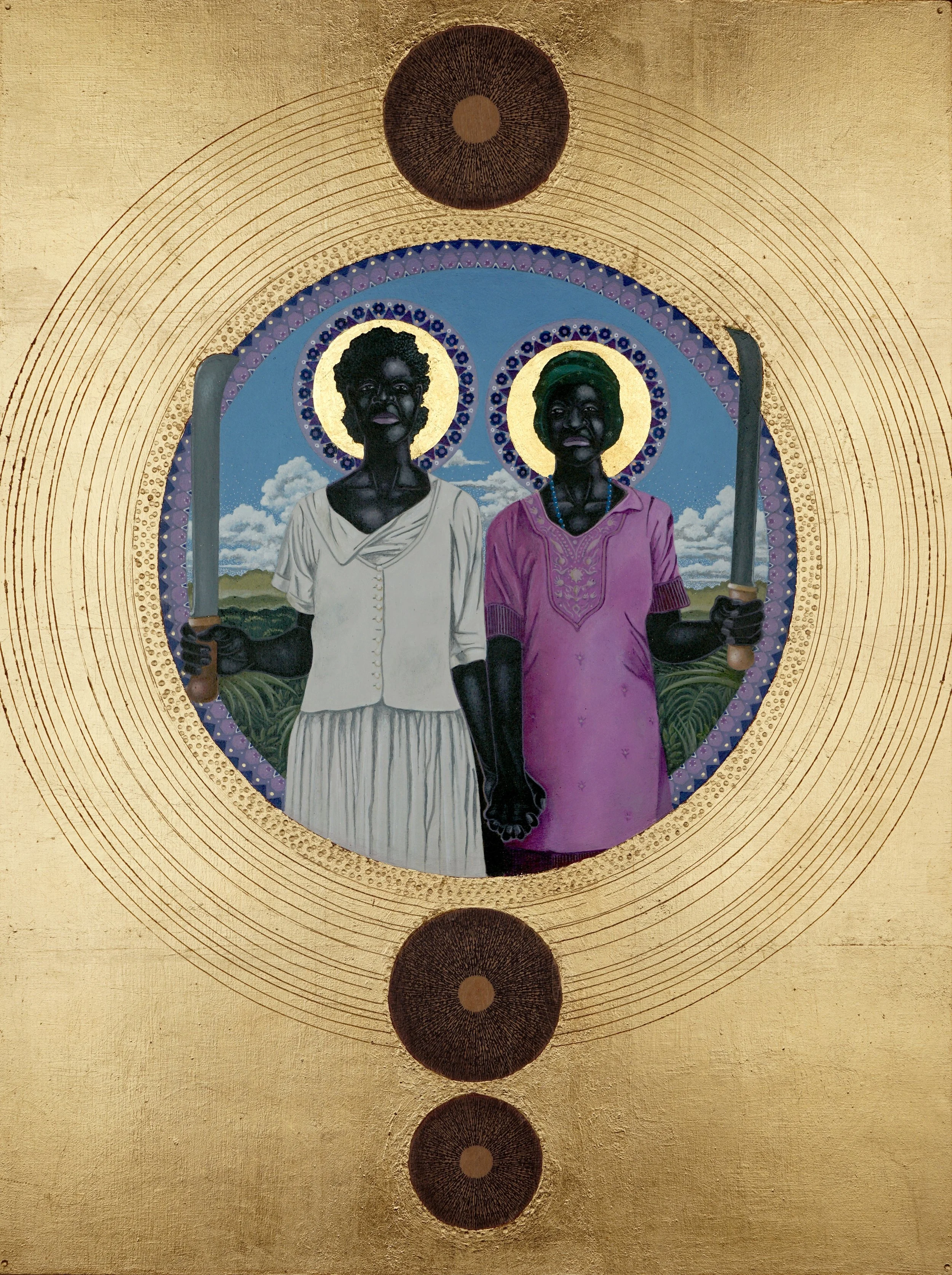
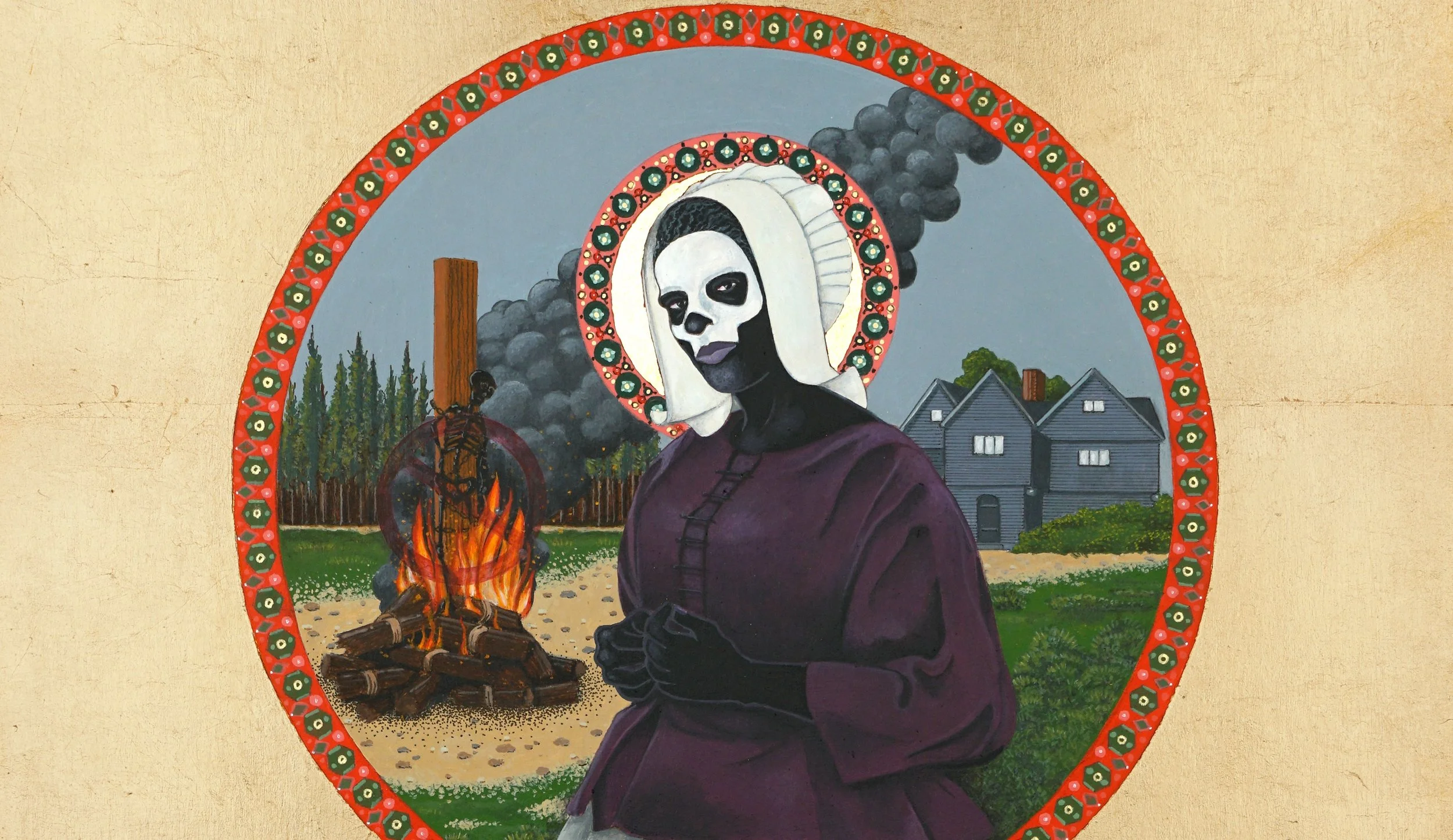
CARLOTA & FERMINA, 2025, Acrylic and gold leaf on panel, 24" x 18"

CARLOTA & FERMINA

Carlota and Fermina are associated with the Lucumi people of West African Yoruba ancestry in Cuba. Their birthplaces and dates remain uncertain. They are remembered as leaders in the resistance surrounding the 1843 uprisings and the repression known as La Escalera, involving enslaved people, free people of color, and white opponents of colonial rule. The Triunvirato rebellion began on Carlota’s plantation and spread to neighboring properties, including Acana, where she and Fermina assumed leadership roles. Two Lucumi men later implicated Carlota in the killing of a white overseer’s daughter. Her body was found the morning after the rebellion; the circumstances of her death remain unknown. Fermina escaped Acana and reportedly used a hammer to break shackles and free other enslaved people. Testimony from two women who witnessed her attack on a white overseer contributed to her capture. After months of imprisonment, she was executed in 1843 at approximately 24. The rebellion emerged from a wider climate of abolitionist and anticolonial resistance and is remembered as part of the struggle that preceded Cuba’s wars of independence. Carlota and Fermina’s leadership challenges histories that cast enslaved women chiefly as victims, restoring their role as organizers and active participants in collective liberation.

Santa Monica, CA — William Turner Gallery is proud to present We Will Not Be Erased, an exhibition of new paintings by Mark Steven Greenfield and his third solo presentation with the gallery. Continuing his acclaimed Halo series, Greenfield brings extraordinary Black lives out of history’s margins and into the luminous foreground. At a moment when the telling of Black history is itself under attack, these paintings assert an unequivocal refusal: these lives mattered. Their stories will not be erased.
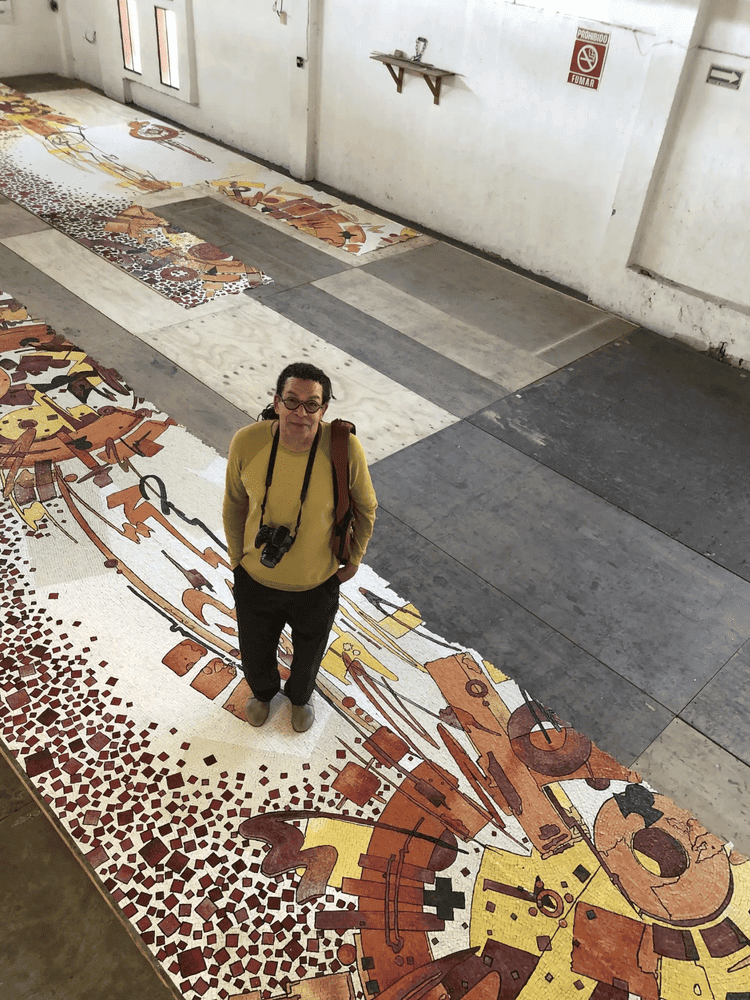
Mark Steven Greenfield with his public arts commission “Red Car Requiem” now permanently installed in the historic Broadway Station (Los Angeles).

The exhibition advances an artistic inquiry that has acquired increasing urgency across three successive exhibitions. In the fall of 2020, following the murder of George Floyd and the nationwide Black Lives Matter protests, Greenfield’s Black Madonna exhibition made a sensational debut at the gallery. His paintings placed a Black Virgin Mary and Christ child at the sacred center of compositions whose backgrounds delivered biting reversals of white supremacist violence. Serene devotion and sharp satire shared the same pictorial space, challenging entrenched assumptions about race, power, and who is entitled to reverence.
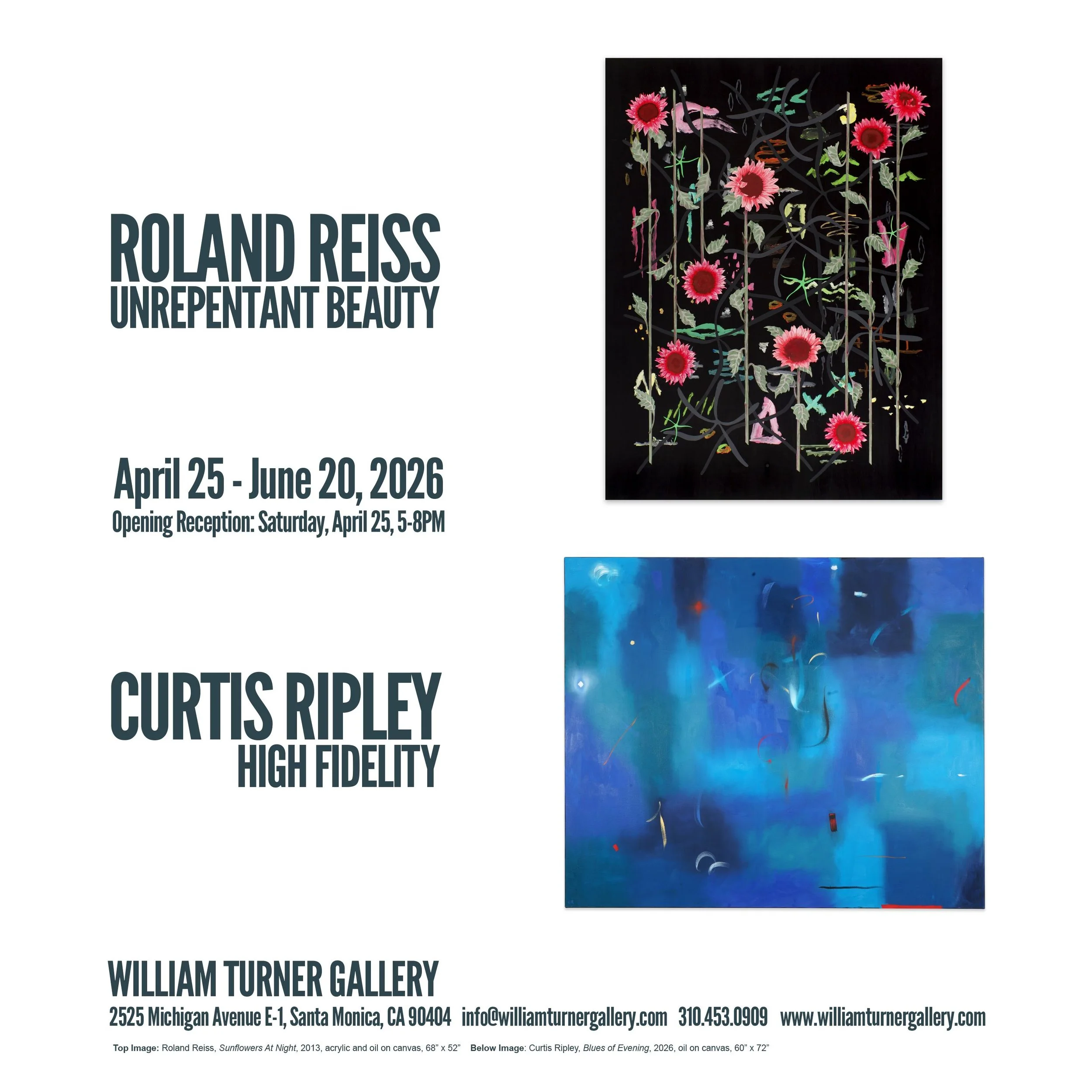
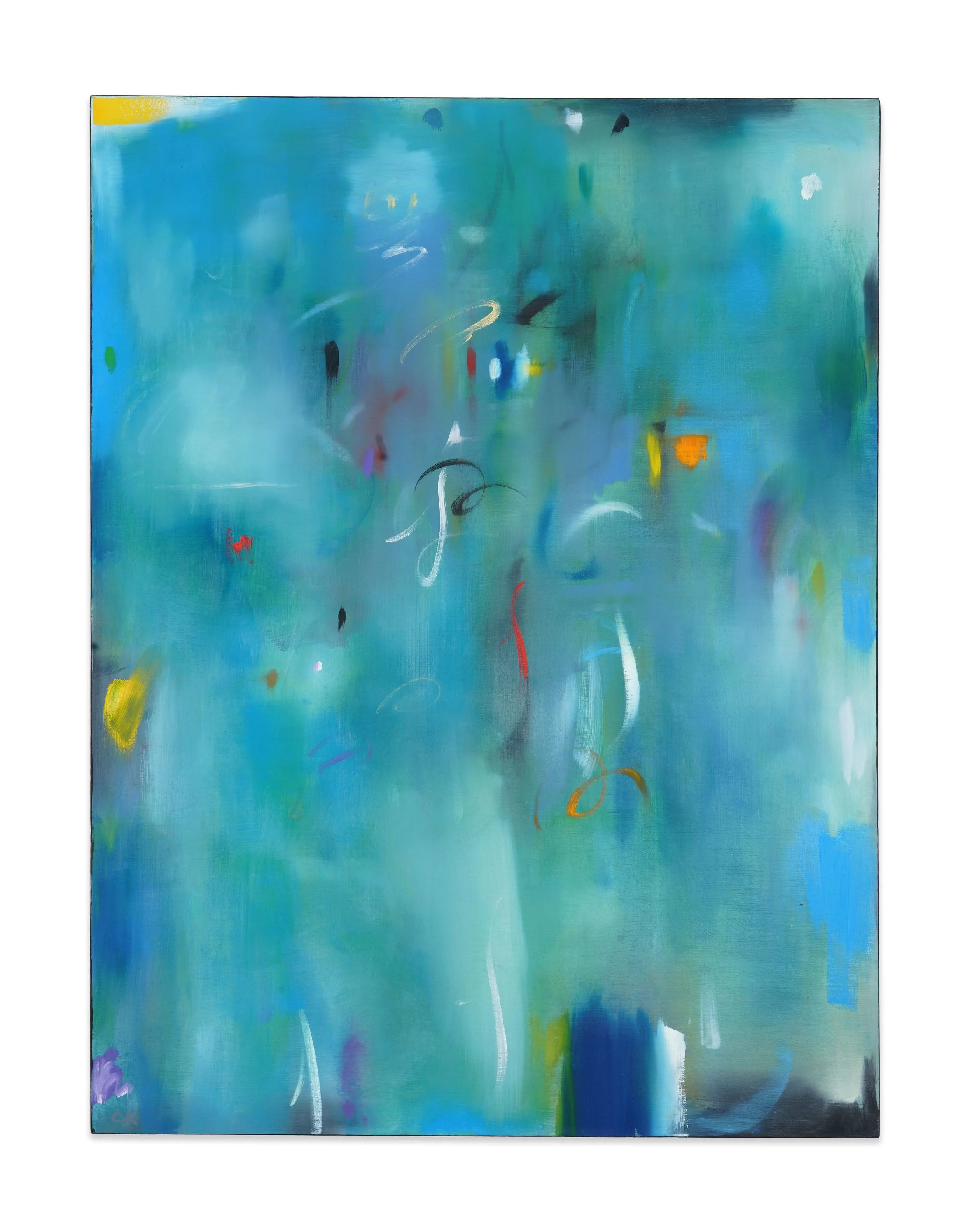
Curtis Ripley: High Fidelity Opening

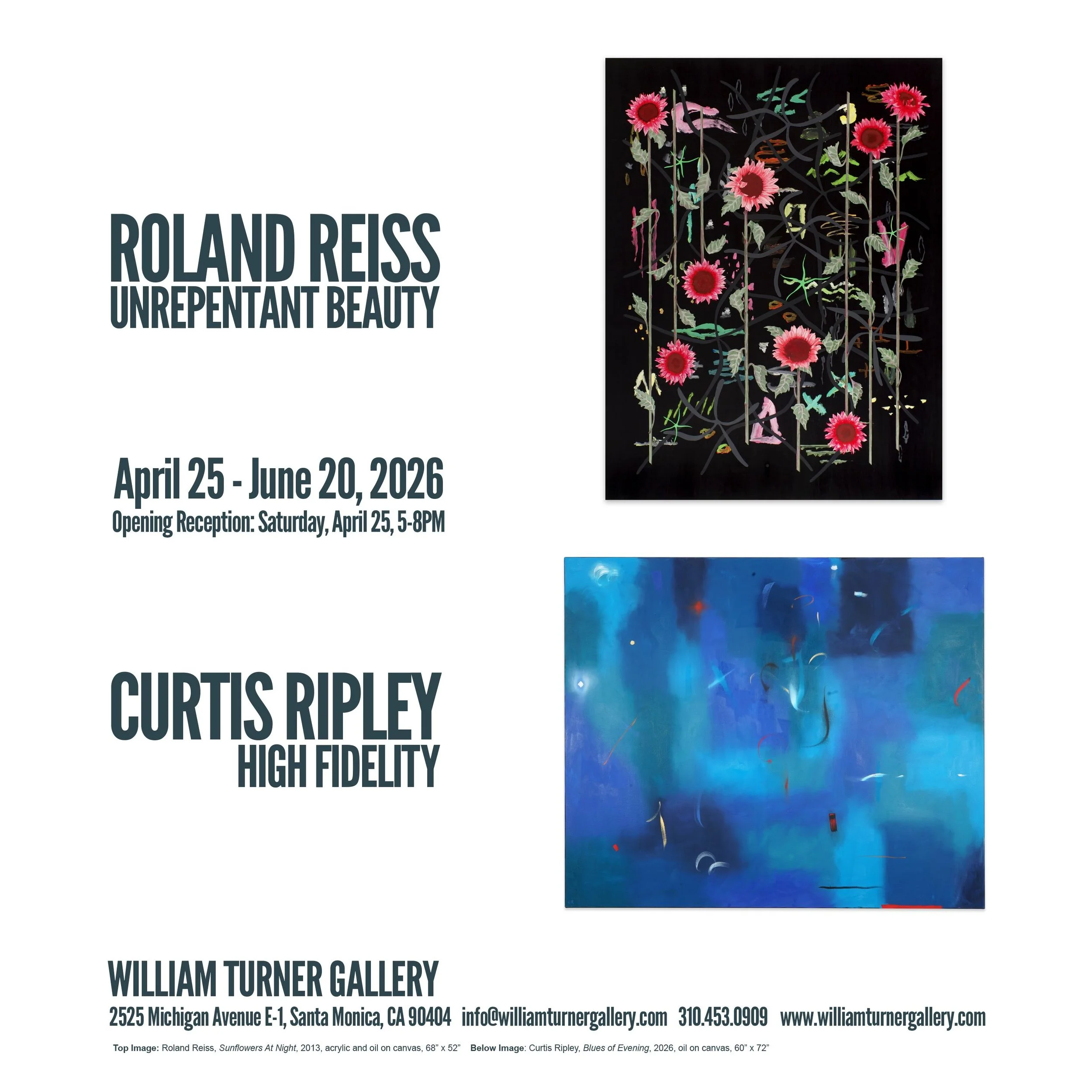
Santa Monica, CA - William Turner Gallery is pleased to present Curtis Ripley: High Fidelity, an exhibition of new paintings by Curtis Ripley opening April 25, 5-8 PM, and on view through June 20, 2026. The exhibition unfolds as a visual composition: lyrical, atmospheric, and finely attuned to the rhythms of perception.

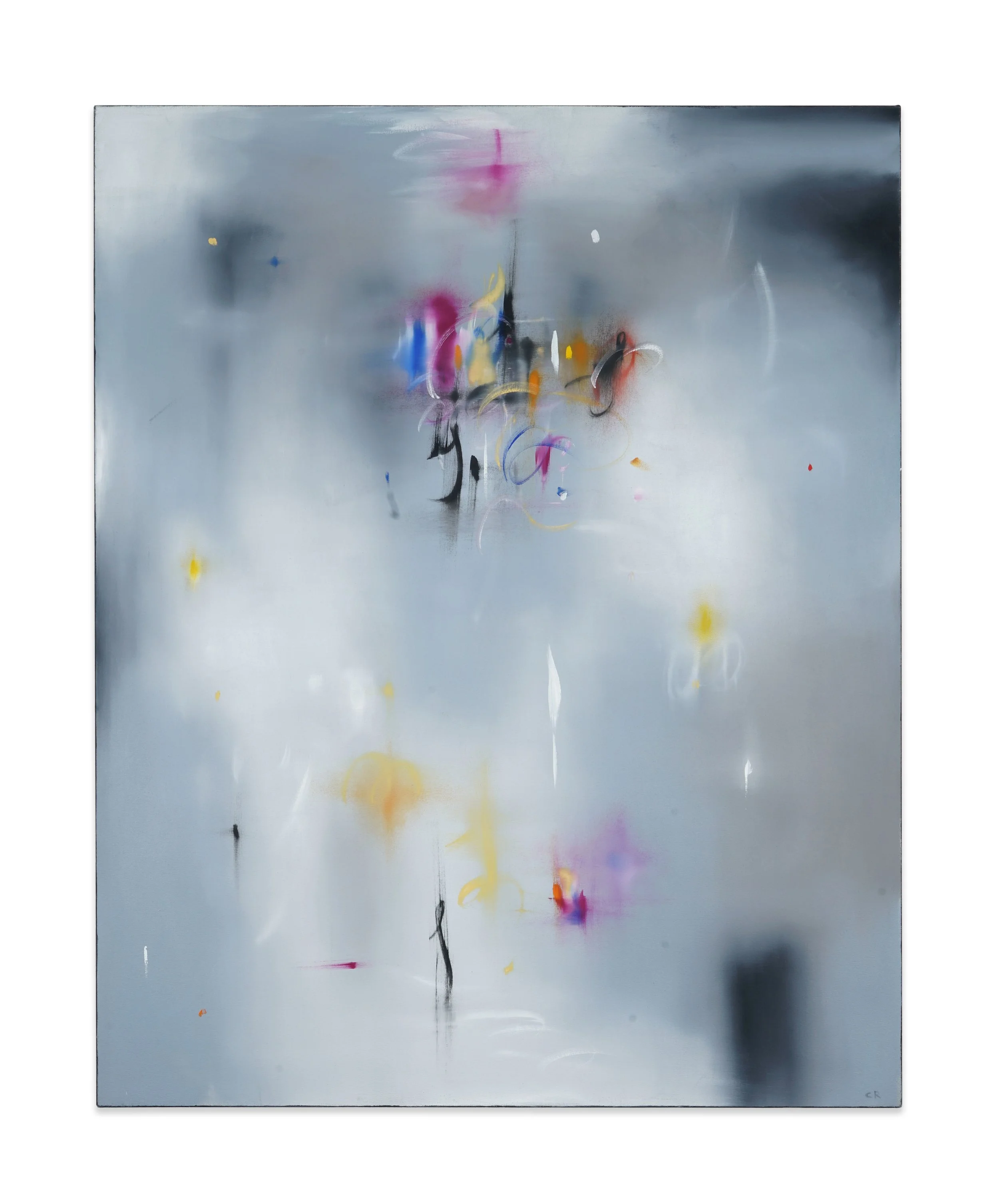
In Ripley’s paintings, glimmers of paint flicker and flare across darkened grounds, activating the surface with a sense of movement and light. Gestural curls and swirls interact with lines and dashes that guide the viewer’s eye in a choreographed passage across the picture plane. These marks are not merely expressive—they are structural, establishing a sense of tempo and poetic cadence that gives each work its internal coherence.

Forms in Ripley’s work do not resolve immediately. They hover, coalesce, and dissolve, shifting in and out of focus as the viewer’s attention lingers. Color behaves similarly: shapes emerge from the ground only to recede again, creating a continuous interplay between presence and disappearance.

Curtis Ripley, Dreaming in Color, 2026, oil on canvas, 40 x 30”.

The result is a dynamic tension between flatness and depth that remains deliberately unsettled. This instability gives rise to a pronounced sense of atmosphere. Gestural forms drift across layered fields of tone, while Ripley’s palette moves between moments of luminous intensity and expanses of saturated darkness. Subtle gradations of color produce fleeting effects — recalling distant light, reflective shimmer, or the charged stillness of a landscape at dusk. The paintings unfold perceptually, revealing themselves over time rather than at a glance.

Ripley’s practice occupies a space between the gestural immediacy of Abstract Expressionism and the immersive chromatic sensibility of Color Field painting. His work synthesizes these traditions into a contemporary language grounded in process, layering, and revision. While resonant with historical explorations of light and atmosphere, his paintings remain distinctly present—open-ended, responsive, and experiential.

Curtis ripley, Silver Springs, 2026, oil on canvas, 60” x 48

Presented concurrently with Unrepentant Beauty by Roland Reiss, High Fidelity offers a complementary approach to perception—one grounded not in constructed illusion, but in painterly sensation and temporal experience.

Throughout a career spanning more than four decades, Curtis Ripley has exhibited nationally and internationally, with an extensive record of solo exhibitions. Born in Lubbock, Texas in 1949, he received his MFA from the University of Wisconsin, Madison in 1975.

Roland Reiss: Unrepentant Beauty Opening

Santa Monica, CA  - William Turner Gallery is pleased to present Roland Reiss: Unrepentant Beauty, an exhibition of late paintings by Roland Reiss (1929–2020), opening April 25, 5-8PM and on view through June 20, 2026.

A pioneering figure in postwar American art, Reiss spent more than six decades redefining the possibilities of painting. From his early explorations of abstraction and representation to his groundbreaking sculptural works and miniature environments, his practice consistently expanded the boundaries of the medium.

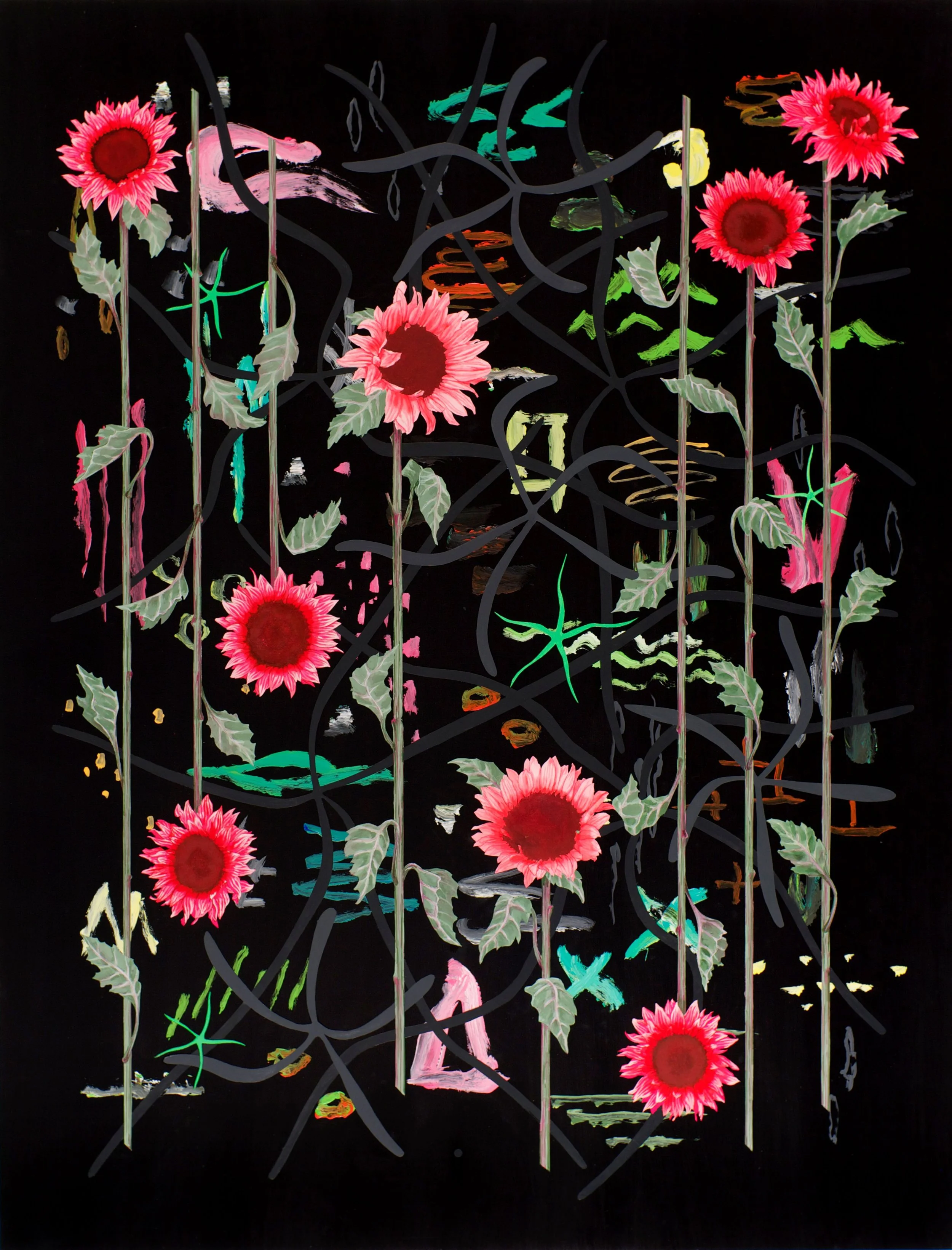
This exhibition focuses on a remarkable development in his final decades: a series of vibrant, dynamic flower paintings that challenge long-standing assumptions about beauty and subject matter in contemporary art. Historically regarded as decorative or peripheral, the motif of the flower becomes, in Reiss’ hands, a site of formal and conceptual innovation. The artist approached these works with full awareness of their cultural baggage, describing the act of painting flowers as requiring “a leap of faith.”

About these paintings Reiss stated, “Flowers are the vehicle for putting everything I have learned about painting into my work.” The resulting paintings move fluidly between abstraction and figuration, combining bold color, gestural energy, and spatial complexity. Rather than depicting flowers, Reiss uses them as a framework for exploring perception, materiality, and the enduring power of visual experience.

The title Unrepentant Beauty reflects the artist’s unapologetic embrace of beauty as both subject and strategy. In contrast to earlier generations for whom beauty was often viewed with suspicion, Reiss’ late work asserts its relevance with clarity and conviction.

At the end of a long and influential career, Reiss produced a body of work that is at once playful, rigorous, and deeply resonant—offering a powerful reconsideration of what painting can be.

Roland Reiss studied at the American Academy of Art, Mount San Antonio College and at UCLA. He taught at UCLA, the University of Colorado, and Claremont Graduate University, where he served as Chair for 30 years, from 1971 to 2001. In 2009 he received the College Art Association Award for the Distinguished Teaching of Art. At CGU he held the Benezet Chair in the Humanities and in 2010 an endowed chair in art was established in his name. He was also the director of The Painting's Edge residency at Idyllwild Arts.

Reiss was the recipient of four N.E.A. grants and of numerous prizes and awards. His work is included in many important public and private collections, such as the Whitney Museum of American Art, Museum of Contemporary Art, Los Angeles, the Los Angeles County Museum of Art, and the Hammer Museum, among others.

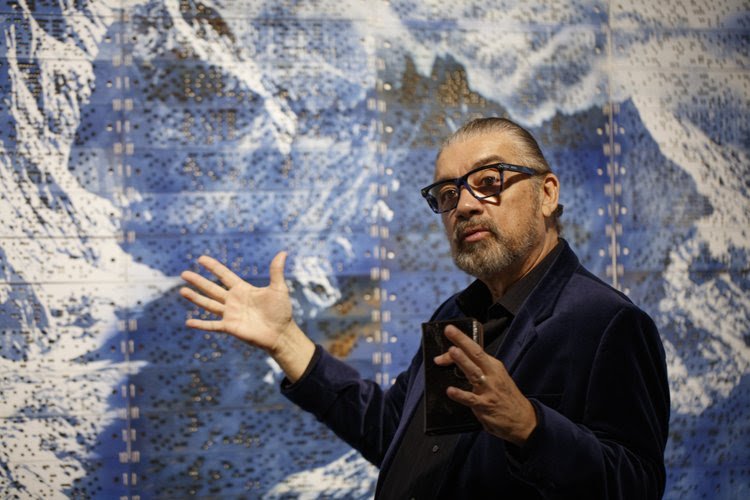
Guillermo Bert's Upcoming Solo Show at the Museum of Latin American Ar

Congratulations to Guillermo Bert on his upcoming solo show, Techno-Empathy, opening at the Museum of Latin American Art on March 29.

This exhibition shows the Chilean-born artist Guillermo Bert bringing the two together in novel and powerful ways. He uses three principal tools, all of them uncommon in most art production: QR codes, 3-D imaging, and laser engraving. In the Encoded Textiles series, weavings include QR codes that literally embed the story of the weaver into the work so that anyone with a smartphone can see and hear them. Through 3-D imaging, the artist creates life-size images of workers whom he has met, allowing us also to meet them face to face from a unique perspective. Media images today often show migrants and refugees, but Bert uses laser engraving to transfer them onto unusual surfaces, such as wood panels that mimic the look of some of the earliest “high technology:” the rectangular panels that encoded instructions for the first mechanical looms in the 19th century.

Guillermo Bert At William Turner Gallery

COAGULA Curatorial Reviews Alex Couwenberg: HIGHLINE

Coagula Curatorial

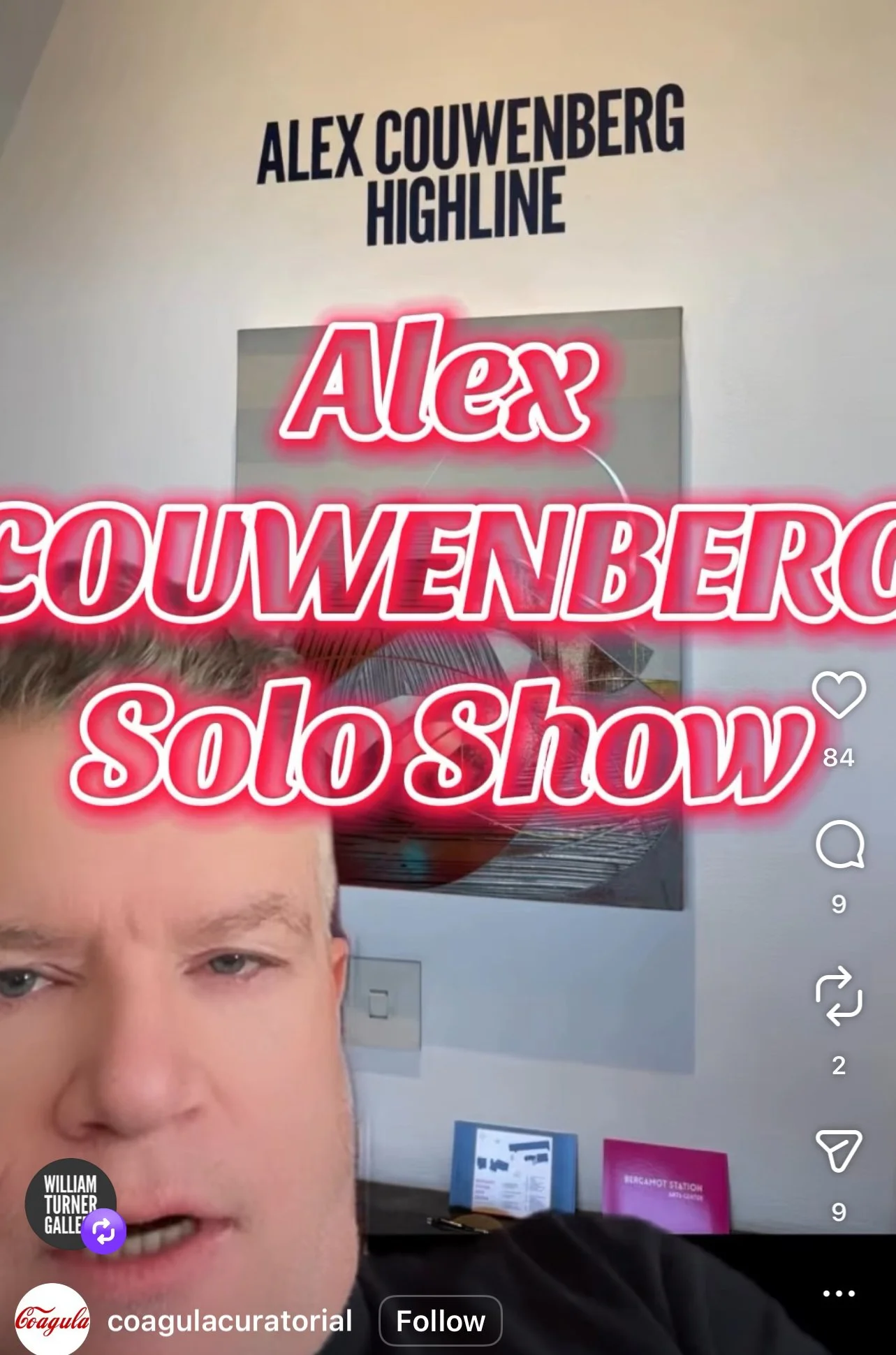
Mat Gleason founder of Coagula Curatorial reviews Alex Couwenberg’s exhibition Highline that closed at the gallery November 8.

View the catalog for this important exhibition by clicking HERE. You can view the instagram reel review of Highline by clicking the image or the button below.