
Opening reception: Saturday November 21, 5-8PM
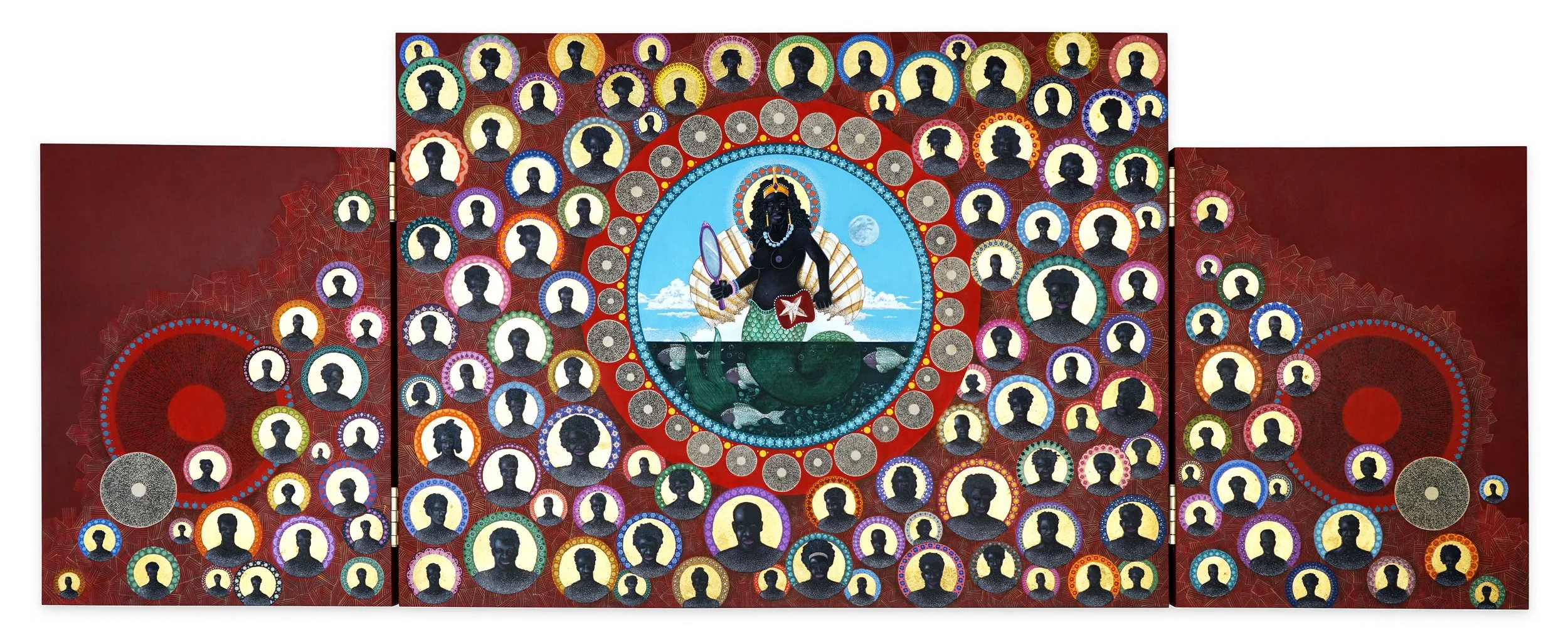
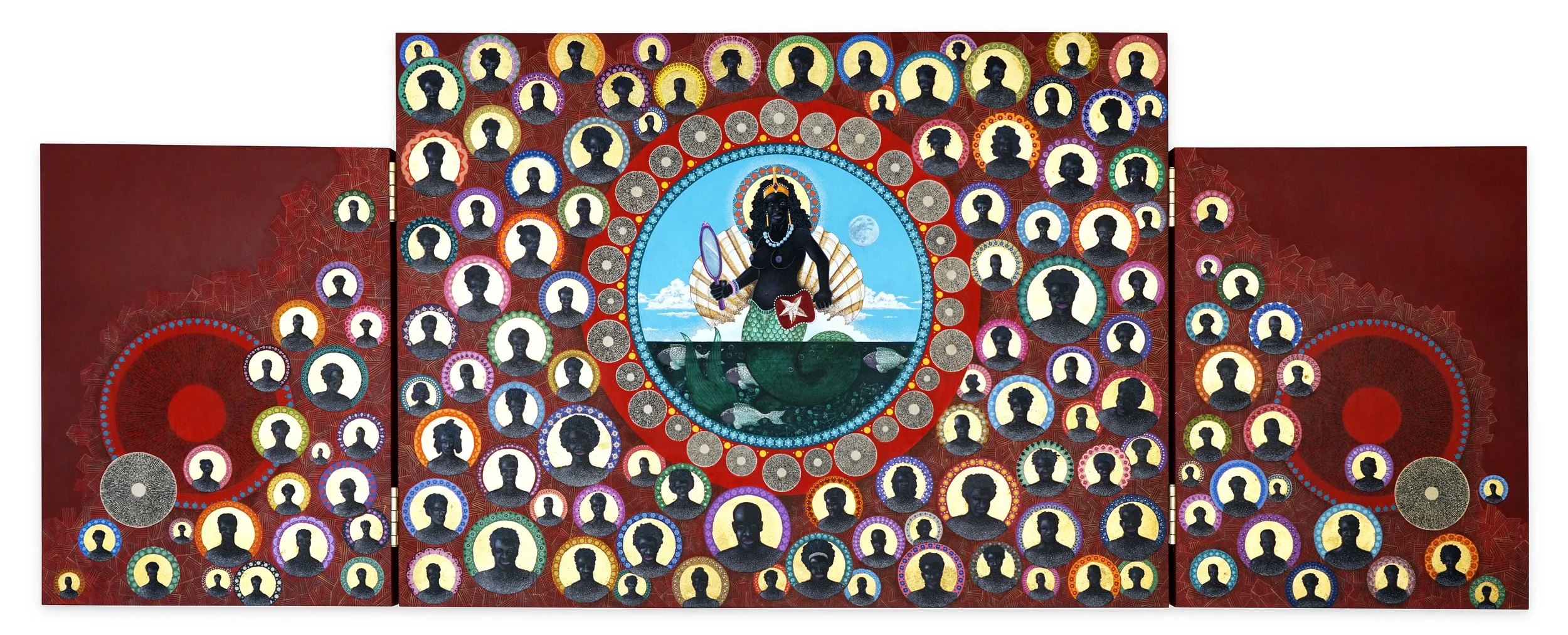
Santa Monica, CA — William Turner Gallery is proud to present We Will Not Be Erased, an exhibition of new paintings by Mark Steven Greenfield and his third solo presentation with the gallery. Continuing his acclaimed Halo series, Greenfield brings extraordinary Black lives out of history’s margins and into the luminous foreground. At a moment when the telling of Black history is itself under attack, these paintings assert an unequivocal refusal: these lives mattered. Their stories will not be erased.
The exhibition advances an artistic inquiry that has acquired increasing urgency across three successive exhibitions. In the fall of 2020, following the murder of George Floyd and the nationwide Black Lives Matter protests, Greenfield’s Black Madonna exhibition made a sensational debut at the gallery. His paintings placed a Black Virgin Mary and Christ child at the sacred center of compositions whose backgrounds delivered biting reversals of white supremacist violence. Serene devotion and sharp satire shared the same pictorial space, challenging entrenched assumptions about race, power, and who is entitled to reverence.
With Halo in 2022, Greenfield extended that challenge into the historical record. Bestowing halos upon Black figures whose lives and achievements had been marginalized, distorted, or omitted, Greenfield reclaimed the visual language of sainthood to honor people denied their place in collective memory. Spanning 500 hundred years of enslavement, Greenfield’s historical subjects appear alongside figures of legend, expanding the inquiry to encompass the stories through which cultures imagine themselves.
We Will Not Be Erased carries this work forward with renewed resolve. The title speaks directly to the struggle over whose histories are preserved, whose contributions are acknowledged, and who holds the power to decide. As museums, monuments, and classrooms become contested ground, Greenfield’s paintings insist upon the presence of people who have too often disappeared under dominant narratives.
Greenfield’s subjects include Black folk saints, freedom fighters, survivors, spiritual visionaries, and figures whose remarkable lives have become intertwined with accounts of miracles and legend. Drawn from different centuries and geographies, they reveal the breadth and complexity of Black experience beyond the confines of familiar historical narratives. Their stories encompass enslavement and resistance, faith and self-determination, persecution and astonishing accomplishment.
“I am reimagining what a saint is,” Greenfield says. “Maybe in studying their stories, they can inform us on better ways to live.”
Rendered in rich detail within circular tondos, the figures emerge against lustrous gold-leaf grounds. Drawing upon Byzantine devotional imagery, Greenfield gives each subject the concentrated attention and visual authority traditionally reserved for sacred icons. The gold catches the eye; the individual holds it. Beauty becomes a means of encounter, drawing viewers toward lives they may never have been taught to recognize.
Among those lives is Harry Washington’s. Enslaved by George Washington, he escaped and joined British forces during the American Revolution in pursuit of his own freedom. His story unsettles the familiar national account: a man held in bondage by a champion of liberty had to flee that champion to claim liberty for himself. His depiction shares space with “Zong”, where Greenfield paints the imagined faces of over 134 anonymous souls, whose stories we’ll never know, thrown overboard to their deaths from the slave ship Zong - to conserve rations for the crew. Historians cite the ensuing uproar as the catalyst for ending the slave trade in Great Britain.
Throughout his career, Greenfield has examined the forces that shape representations of Black identity, exposing stereotypes and the enduring violence of omission. Here, that inquiry takes the form of an assembly of commanding individual presences. Each painting invites recognition, curiosity, and a reckoning with the circumstances that pushed its subject to the margins.
The stakes extend beyond recovering the past. Decisions about whom we commemorate shape our understanding of who belongs in the present and whose future deserves protection. Efforts to sanitize history make these acts of recognition newly urgent.
With We Will Not Be Erased, Greenfield turns the language of reverence into an act of resistance. Each halo stakes a claim upon collective memory. Together, these paintings give the exhibition’s declaration a human presence. We were here. We shaped this world. We will not be erased.
ABOUT MARK STEVEN GREENFIELD
Mark Steven Greenfield is a Los Angeles–born artist whose work examines Black identity, cultural memory, and the power of representation. Across a career spanning more than five decades, he has confronted racial stereotypes and historical omissions through an evolving visual language that encompasses abstraction, satire, portraiture, and sacred imagery.
The son of a Tuskegee Airman, Greenfield spent much of his early childhood on military bases abroad before returning to Los Angeles at age ten. He studied with John Riddle and Charles White through classes at Otis Art Institute, formative encounters that helped establish his lifelong commitment to art. He earned a bachelor’s degree in art education from California State University, Long Beach, in 1973 and an MFA in painting and drawing from California State University, Los Angeles, in 1987.
Greenfield’s work has received significant museum recognition, including a comprehensive survey at the California African American Museum in 2014 and Mark Steven Greenfield: A Survey, 2001–2021, presented at the Museum of Art and History in Lancaster in 2022. In 2023, the Monterey Museum of Art presented Hagiography, bringing together paintings from his Black Madonna and Halo series. The International African American Museum acquired two paintings from his Halo series, and featured them in their 2025 exhibition re/Defined: Creative Expressions of Blackness from the Diaspora, in Charleston, South Carolina.
Greenfield’s work is also held in the collections of the Crocker Art Museum, Los Angeles County Museum of Art, California African American Museum, Monterey Museum of Art, and Lancaster Museum of Art and History, among others.
An influential participant in Los Angeles’s cultural life, Greenfield served as director of the Watts Towers Arts Center and later the Los Angeles Municipal Art Gallery. His honors include fellowships from the City of Los Angeles and the California Community Foundation, along with artist residencies at Instituto Sacatar in Brazil, the McColl Center for Art + Innovation, and Loghaven.
We Will Not Be Erased is Greenfield’s third solo exhibition at William Turner Gallery, following Black Madonna (2020) and Halo (2022).