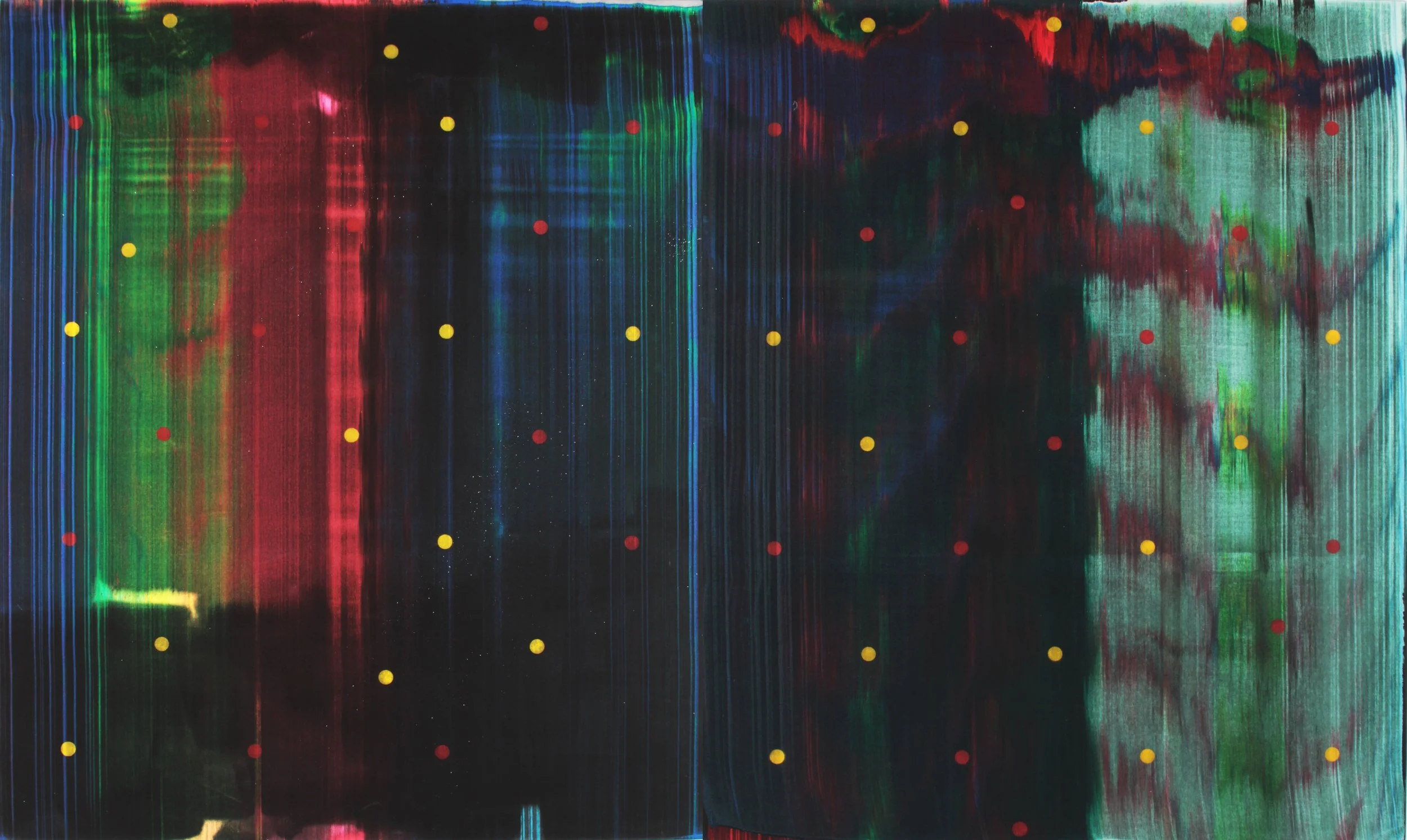
EXPO 2025 - JAPAN PAVILION - A Creator’s Vision - Artist Shingo Francis

Fleeting Colors in Transition and a Circle Symbolizing Circulation

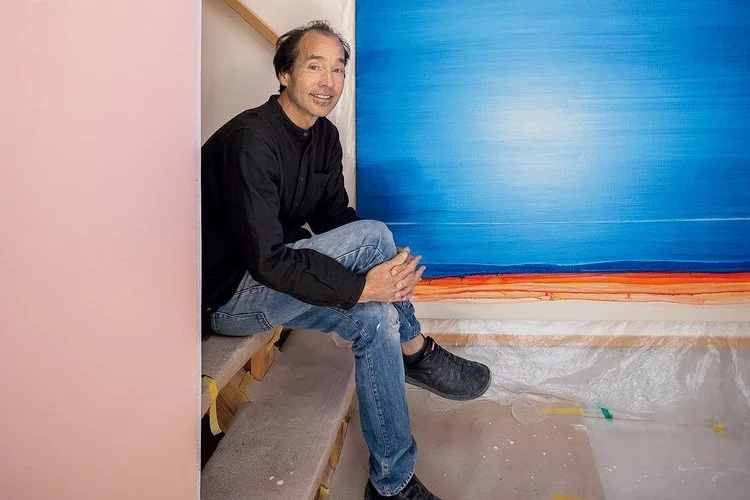
I believe my decision to become a painter was greatly influenced by my parents and my early environment. My father is American, my mother is Japanese, and I lived in Japan until I was 12 before moving to the United States to live with my father. My father was an abstract painter, and my mother was a video artist. Many of their friends were also artists, and they would often gather at our home or in studios, passionately discussing their works and creative processes. Interestingly, my first interest in artistic expression wasn’t painting — it was words. While browsing my father’s bookshelf filled with poetry collections, I became inspired to write my own poems and essays. By the time I was about 15, I discovered William Blake, the English poet and painter, which encouraged me to start adding illustrations to my poetry. Whenever I returned to Japan, my mother would take me to galleries in Tokyo. I remember being amazed by the diverse range of artistic expression — intriguing objects, sound installations, and more — which opened my eyes to the fascinating and expansive world of art.

At university, I studied traditional techniques like croquis, but I soon realized that faithfully reproducing what I saw in front of me wasn’t my strength. Instead, I became more focused on expressing what I felt in my heart. One of the turning points in my life came when I studied abroad in Florence. During that time, I had the opportunity to interact with Joan Mitchell, a friend of my father and an abstract expressionist artist. Upon seeing my work, she immediately urged me to “invent your own way of painting.” Her words were a wake-up call — lines, colors, shapes, depth, techniques, and processes should all be uniquely mine; no one else could express what I wanted to create. That encounter made me seriously reflect on how to translate my inner visions into paintings. Through much exploration, I eventually arrived at the layering technique that I still use today. By building up layers, light, shadow, and depth emerge naturally, revealing a sense of presence. This approach reflects my fascination with the fleeting beauty of light within darkness, much like the world depicted in Junichiro Tanizaki’s In Praise of Shadows. It’s this delicate balance — the interplay of light and shadow — that continues to inspire my work.

I was deeply shocked when I heard a curator say they made all their curation decisions solely through social media, without ever seeing the actual artworks. To me, art is something you must experience with your own eyes — it’s only through that direct encounter that emotions are stirred and a dialogue with the work begins. Sharing space with an artwork and observing it firsthand carries profound meaning. Reflecting on this idea led me to create this series. In these paintings, the colors shift depending on the viewer’s position and the angle of the light, much like a butterfly’s wings or the iridescent patterns of a jewel beetle. The pigments, which include mica, reflect light in a way that alters the visual tone. One of the key themes of this series is the awareness of one’s own physical presence — an invitation to reconnect with the act of seeing through the senses.

When creating abstract paintings, I make a conscious effort to focus on my own awareness. Being fully present in the “here and now” is incredibly challenging, yet I find constant inspiration in Zen philosophy. One particularly memorable experience was a Zen training session I attended at Tōfuku-ji Temple in Kyoto when I was 17. For about ten days, we practiced meditation from early morning until night, sitting in zazen and focusing solely on our breathing. At first, I struggled to concentrate — my mind kept racing with thoughts and memories, like a mental carousel spinning endlessly. The frustration was intense, but by the fifth or sixth day, my chaotic thoughts gradually began to settle. Then, about a week in… it happened — just for a brief moment. Everything before me — the stones and trees in the garden, the monk sitting beside me, and even myself — seemed to merge into one. It was an indescribable sensation, as if I had transcended my physical senses. That fleeting moment of connection has stayed with me ever since.

Throughout my artistic journey, I’ve explored various themes, but it was around 2021 — when I moved to Kamakura — that the circle became a central motif in my work. I see the circle as the simplest yet most powerful symbol of cycles — the endless loop of life and death, the changing of seasons, and the flow of time itself. Kamakura has a remarkably slow pace of life, surrounded by rich nature. Compared to Los Angeles, where I used to live — a place with little sense of seasonal change — I now feel much more attuned to the rhythms of nature and the passage of time. The abundance of temples and shrines here has also been a source of inspiration for my work. On a side note, I recently learned about Ensō, a Zen painting by Sengai Gibon, a monk and artist from the Edo period. In his famous work ○△□, some interpret the circle as symbolizing “nature,” the square as “humanity,” and the triangle as “the universe.” I find that perspective fascinating — another beautiful reflection of interconnected cycles.

Born in Santa Monica, California in 1969, Shingo Francis is an artist based in Los Angeles and Kamakura. His work explores the expansiveness of space and spirituality in painting. Francis has participated in numerous solo and group exhibitions both in Japan and internationally, including at the DIC Kawamura Memorial DIC Museum of Art (2012), the Durst Organization (2013), the Sezon Museum of Modern Art (2018), the Martin Museum of Art (2019), Ginza Maison Hermès Le Forum (2023), and the Chigasaki City Museum of Art (2024). His works are held in collections such as the JPMorgan Chase Art Collection, Banco de España, the Frederick R. Weisman Foundation, the Mori Art Collection, the Sezon Museum of Modern Art, the Oketa Collection, the Tokyo American Club, the Ueshima Collection, and Tiffany & Co.

JIMI GLEASON: Vapor Wave - Digital Exhibition Catalog

Santa Monica, CA - William Turner Gallery is pleased to present Vapor Wave, a solo exhibition by Jimi Gleason,  opening April 5 and running through May 31, 2025.

Vapor Wave is Jimi Gleason’s most ambitious body of work to date. Utilizing a rich vocabulary of materials and styles, Gleason has built up gossamer thin layers of iridescent paint to create a series of paintings that are engagingly enigmatic. They confirm an artist at the height of his talent, confidently exploring the power of nuance and understated expression.

In this new series, vaporous ribbons of color play across lustrous surfaces that morph and shift as one engages them. The effect elicits a sense of unexpected revelry - much like the kind one might experience gazing across a lake in a predawn moment, captivated by the growing light as it caresses and undulates across the water’s surface.

And like water, Gleason’s surfaces are quietly in motion, their iridescent paints subtly shifting in hue as light plays across them. In some of the canvases, sharp diagonals bifurcate the compositions, providing dramatic structural rifts to these ethereal surfaces. The effect is a hypnotic and prismatic visual structure, where light, color and form intersect in ever-changing play. Gleason has a uniquely personal connection to water: he grew up surfing, and took up rowing in college. When he talks about his work he also talks about, “the way the light looks underwater,” and early mornings rowing when the calm water reflects the sky at dawn. 

Like many artists working in the Light and Space arena, materials and their catalytic visual effects are essential to their work. In Gleason’s case, he employs silver nitrate and pearlescent paints to activate his surfaces, which catch and reflect surrounding light, further engaging one’s sense of the surrounding space. Gleason is a leader in that next generation of Southern California artists to work in the Light and Space ethos, carrying the dialogue forward and using his work of art to explore the phenomenological properties of perception.

Born in Newport Beach, CA, Gleason received his BA from UC Berkeley in 1985. He studied printmaking at the San Francisco Art Institute before relocating to New York City, where he worked as a photo assistant and technician. Returning to California, Gleason was employed in the studio of Ed Moses for five years. Combining the disparate technical and compositional skills developed during his exposure to printmaking, photography and mixed media painting, Gleason is now the subject of considerable curatorial and critical attention. 

Gleason’s work is exhibited in significant public institutions, including the Hammer Museum, the Frederick R. Weisman Foundation, the Long Beach Museum, the Seattle Art Museum, and the Tucson Museum of Art.The artist’s paintings are actively collected by a growing number of major public and private collections around the world.

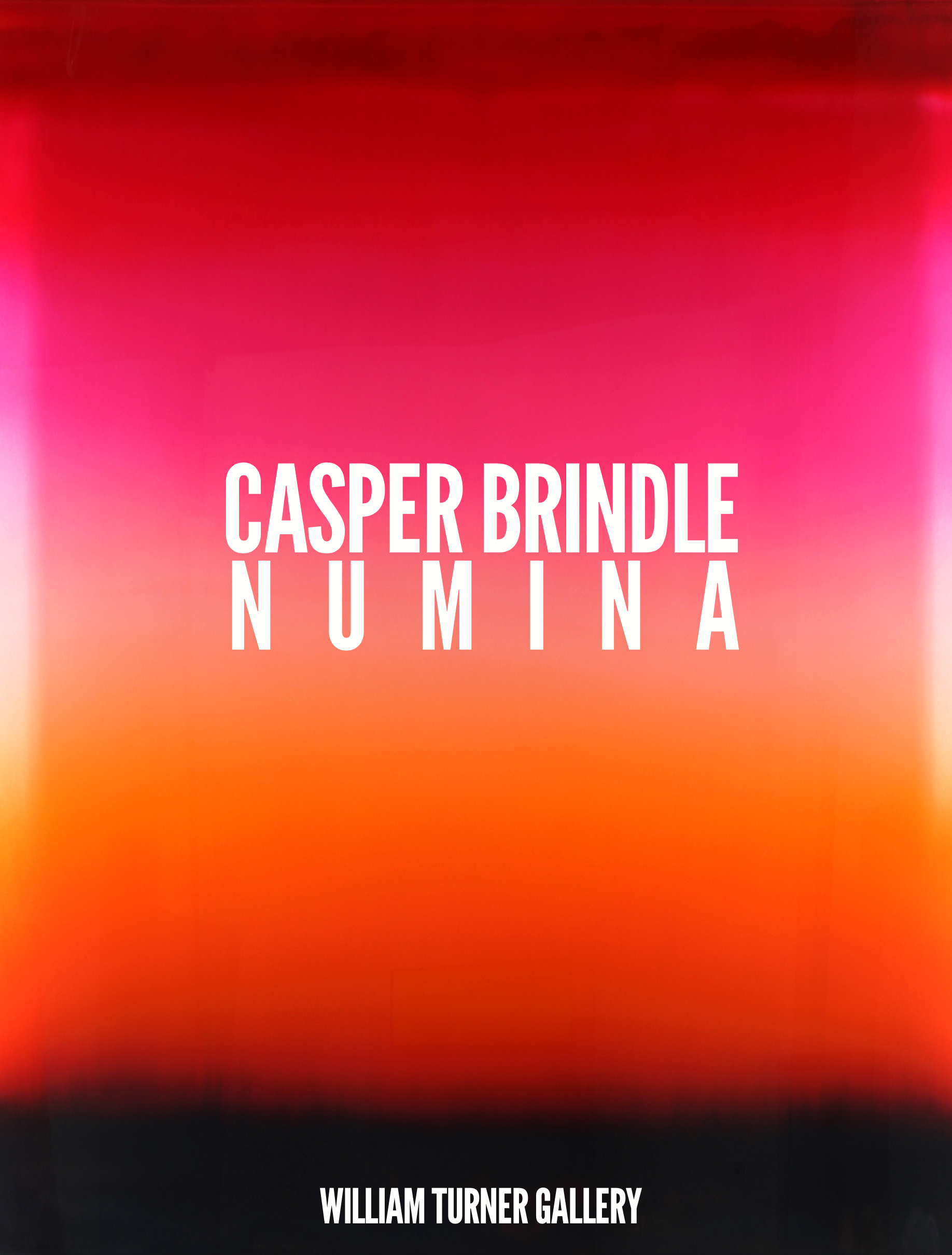
CASPER BRINDLE: NUMINA DIGITAL CATALOG IS NOW AVAILABLE

Santa Monica, CA - William Turner Gallery is pleased to present the exhibition catalog for Numina, Casper Brindle’s first solo exhibition at the gallery in four years. In the interim, Brindle has had numerous national and international exhibitions, including an extensive exhibition in 2022 at The Luckman Gallery, Cal State LA. Numina will run from January 25 - March 22, 2025.

Numina, presents two bodies of work, Light Glyphs and Veils, each of which involve dramatic investigations into light, color and the fluid, ever shifting nature of perception.  The exhibition ranges from painting to sculpture, and exemplifies Brindle’s restless experimentation and evolving modes of expression. The works are poetic, sensual and spatially dynamic. Utilizing automotive paints and pigmented acrylic, Brindle has created works that reflect and diffuse light in ways that are nuanced and engaging. 

A printed copy of the book will be available in either soft cover or in a limited edition hard cover. For information regarding obtaining a printed copy of the book please contact us via email.

The Frederick R. Weisman Art Foundation & William Turner Gallery Present A Frieze Weekend Celebration

The Frederick R. Weisman Art Foundation & William Turner Gallery look forward to your joining us for a special evening celebrating Frieze Art Fair and Casper’s Brindle’s stunning solo exhibition, Numina, with cocktails, music & hors d’oeuvres, Friday, February 21, 2025, 5:30 - 7:30 PM at William Turner Gallery. 

The Frederick R. Weisman Art Foundation is renowned for their exceptional collection and preservation of art by some of the 20th Century’s most beloved artists. Currently, under the direction of Billie Milam Weisman, the Foundation continues to make the collection available through loans to museums worldwide, docent tours at the Los Angeles estate, exhibitions in public-art venues, and the funding of several art museums.

Kindly RSVP Here

CASPER BRINDLE: NUMINA - Exhibition Postponed until January 25, 2025

CASPER BRINDLE: NUMINA
JANUARY 25 - MARCH 22, 2025
Opening Reception:
Saturday, January 25, 5-8PM

William Turner Gallery would like to extend our heartfelt sympathies to everyone impacted by the devastating fires in Los Angeles.

In light of these events, our upcoming exhibition, Casper Brindle: Numina, will now open 5-8 PM on January 25, 2025, a week later than originally scheduled. The gallery will continue to remain open during normal business hours,11AM-6PM Tuesday- Saturday, subject to safety advisories from The City of Santa Monica. Go to santamonica.gov or lafd.org for the latest fire & safety  information.

To our wonderful community of artists, patrons, partners, clients, neighbors, we hope you're staying safe and look forward to seeing you soon.

Resources and support for those who need it can be found at the following link:
https://www.lahsa.org/news?article=1014-resources-to-support-those-during-the-l-a-fires


Exhibition Catalog for PHENOMENA is NOW AVAILABLE!

The catalog from the latest show at William Turner Gallery, PHENOMENA, is out now! The catalog is available on the official William Turner Gallery website and includes images and insights from PHENOMENA. The exhibition is part of the Getty presented event PST Art, Art & Science Collide. PST Art is the largest event in the United States, featuring over 800 artists at over 70 institutions in Southern California. PHENOMENA showcases art by Charles Arnoldi, Natalie Arnoldi, Ryland Arnoldi, Kelsey Brookes, Alex Couwenberg, Franco DeFrancesca, Lawrence Gipe, David Lloyd, Ed Moses, Jeff Overlie, Melanie Pullen, and Jennifer Wolf.

PHENOMENA - PST ART: Art and Science Collide - Saturday 4-8PM

Kelsey Brookes, Mescaline (cobweb formation), 2019, acrylic on canvas, 96” x 72”

Charles Arnoldi
Natalie Arnoldi
Ryland Arnoldi
Kelsey Brookes
Alex Couwenberg
Franco DeFrancesca
Lawrence Gipe
David Lloyd
Ed Moses
Jeff Overlie
Melanie Pullen
Jennifer Wolf

William Turner Gallery, - is pleased to present Phenomena, the second of two exhibitions in partnership with the Getty initiative PST ART: Art & Science Collide, which explores the intersections and influences between art and science.The exhibition will run from November 16, 2024 - January 11, 2025.

Art and science both originate from an intrinsic curiosity about the natural world. Historically, artistic depictions of natural phenomena, whether through meticulous observation, or fantastical interpretation, have often highlighted the delicate balance between the forces of nature to both inspire and to imperil. This dual narrative continues to resonate today, as contemporary artists and thinkers explore themes of the environment, climate change, and humanity's role in shaping the Earth’s future.

Phenomena features a range of work, from representational depictions to abstract expressions,  celebrating the power and visual splendor of the natural world as a resource for creative expression and investigation. For centuries, artists have pictorially documented their observational studies of natural phenomena and the world around us. Manuscripts such as Natural History (77 CE) by Pliny the Elder and The Book of Miracles (1552), chronicled divine wonders and horrors in illustrations, often serving as warnings of the consequences of human deeds upon their environment and the mysteries of the natural world. Utilizing these extraordinary codexes as a genesis for Phenomena, the exhibition explores related themes.

In the 16th century, “cabinets of curiosities” or “wonder rooms” in Europe served as spaces to showcase collections curated for the artistic and scientific interests of their patrons and served as precursors to museums. With missions to both amuse and enlighten, “cabinets of curiosities” functioned as sources for entertainment and educational resources, thus intersecting art and science. In the late 19th century, scientific inquiry shifted from museums to university laboratories bifurcating the two discourses. Phenomena merges the two disciplines as they once had been integrated in the cabinets of curiosities.

Artists in Phenomena: Charles Arnoldi, Natalie Arnoldi, Ryland Arnoldi, Kelsey Brookes, Alex Couwenberg, Franco Defrancesca, Lawrence Gipe, David Lloyd, Ed Moses, Jeff Overlie, Melanie Pullen, Jennifer Wolf

Charles Arnoldi, Rare Breed, 2024, acrylic on canvas, 80" x 63”

Charles Arnoldi (b. 1946), has long drawn on nature for his many and varied series of abstract works. Fire-blackened tree branches, lush Hawaiian foliage and the stone walls of Machu Picchu - all inspired important bodies of work. Emphasizing flattened forms of often brilliant color and pattern, Arnoldi interprets nature through a fauvist palette. Natural objects are rendered in terms of riotous colors, textures and shapes, suppressing a sense of atmosphere or literal figuration, to create wonderfully complex and compelling compositions.

With a career that has spanned over forty years, Arnoldi is one of the most prominent painters in southern California. Arnoldi’s work resides in numerous collections and museums throughout the United States, including the Museum of Modern Art, the Metropolitan Museum of Art, The Los Angeles County Museum of Art, the Smithsonian American Art Museum, and the Guggenheim, Bilbao, Spain. Born in Dayton, Ohio, Arnoldi lives and works in Los Angeles, California.

Ryland Arnoldi (b.1988), an emerging artist based in Venice, California, engages in large-scale acrylic painting as a means of autobiographical exploration, examining and reinterpreting past impressions. His work draws heavily on iconic imagery of landscapes and natural forms, aiming to evoke the tranquility and introspective quality of time spent immersed in the natural environment. Arnoldi employs vibrant, contrasting color palettes to construct abstract yet dynamic compositions, meticulously balancing organic intricacy inherent in the surrounding natural world. Ryland Arnoldi lives and works in Venice, California.

Natalie Arnoldi (b. 1990) grew up in Malibu, California, where she developed a passion for the ocean, which became the inspiration for both her scientific and artistic pursuits. While conducting a full-time career as an artist, Arnoldi simultaneously achieved a PhD in Marine Ecology at Stanford University, where she also received Bachelor’s and Master's degrees.

As a painter, Arnoldi works prolifically, when not engaged in research in places like Palau, and other far reaches of the ocean. Her compositions are ambitious, often quite large in scale, and evoke the vastness, power and mystery of nature, while driven by overarching environmental narratives and concerns. This duality of science and art was well represented, and received, in her two recent solo museum exhibitions, at the Bakersfield Museum and the Pacific Grove Museum of Natural History, in Bakersfield and Pacific Grove, California.

Natalie Arnoldi, Splinter, 2015, oil on canvas, 92" x 80”

Kelsey Brookes (b. 1978) utilizes Heinrich Klüver's concept of "Form Constants" referring to universal patterns in visual perception that recur during altered states of consciousness, such as those induced by substances like mescaline, or during near-death experiences. Klüver identified four basic patterns: tunnels, spirals, lattices, and cobwebs, which he believed were deeply embedded in the human psyche, possibly linked to the collective unconscious. In these works, the merging of science, psychology, and art offers a fascinating glimpse into the mechanics of the brain's visual processing during altered states, where abstract mental "cobwebs" are rendered in intricate, mesmerizing forms. These paintings explore how the mind perceives reality differently under the influence of psychoactive substances and how these ancient, deep-seated visual templates emerge from the brain's inner workings.

Brookes has had solo exhibitions in La Jolla, Los Angeles, New York, Detroit, London and Berlin. His work was featured as the cover art for the Red Hot Chili Peppers’ 2012 “I’m With You” record and The Flaming Lips’ 2013 “Stone Roses” LP. KELSEY BROOKES: Psychedelic Space is the first monograph of the artist’s artwork and examines three years of work and four solo exhibitions. Brookes has work in the permanent collections of the Museum of Contemporary Art, San Diego, the Crystal Bridges Museum of American Art, and the Frederick R. Weisman Foundation, and in many important private collections. Brookes currently lives and works in Southern California.

Alex Couwenberg, Satellite, 2024, acrylic & spray on canvas, 72” x 66”

Alex Couwenberg (b. 1967) is a Southern California-based artist whose paintings are deeply influenced by the rich cultural and visual environment of Los Angeles. Drawing inspiration from modernist philosophies, his work reflects the mid-century aesthetics and design principles that defined the region, particularly between the 1950s and 1980s. Couwenberg's art pays tribute to key movements like Hard-edge abstraction, the "Finish Fetish" (known for its slick, polished surfaces), all prominent in the post-war Southern California art scene. In Satellite Couwenberg references the spacecrafts which emerged during the Cold War in the Space Race. These objects which orbit the Earth, document it and its relation to the solar system and the universe at large.   

A graduate from Art Center College of Design and The Claremont Graduate School, Couwenberg’s paintings have been shown in numerous solo and group exhibitions throughout the United States, Canada, Europe, and Asia.  His work can be found in public, private and museum collections around the world, which include the Frederick R. Weisman Foundation, the Long Beach Museum of Art; Lancaster Museum of Art and History; Laguna Art Museum; Crocker Museum of Art, and the Daum Museum in Missouri.  In 2007 Couwenberg was awarded the prestigious Joan Mitchell Foundation Award for his achievements in painting. Couwenberg lives and works in Southern California.

Franco DeFrancesca (b. 1967) is a multidisciplinary artist who explores the intersections of art, science and technology through his work. He employs digital imaging techniques to bridge the gap between photography and painting, creating vibrant, colorful, and minimalist compositions. Quoting from electro-optic modulations of atom crystal structures, DeFrancesca blends traditional art forms with modern technological processes.

The artist’s work has exhibited in Canada and the United States and is included in various private and corporate collections throughout North America. An attendant of OCAD and University of Guelph, DeFrancesca has exhibited in Canada and the United States and his work can be found in corporate and public collections world-wide, including Cenovus Energy Inc.; Repsol, Encana and Enbridge Inc. (Calgary, AB); Rodin Law Firm Litigation Counsel (Calgary, AB), amongst others.

Larry Gipe, In Commemoration of Gardi Sugdub (Vanishing Islands), 2024, oil on canvas, 96” x 72”

Lawrence Gipe’s (b.1962) painted image of the vanishing island Gardi Sugdub Island (crab island) is a composite of three different drone photographs taken by news media. While some buildings remain constant, between the three images (taken only a year or two apart at most) there's a notable shuffle between structural shapes and colors, which have shifted... for 100 years it's been the home of the fiercely independent Guna people. The victim of climate change, overpopulation, and its own basic remoteness, Gardi Sugdub is a canary in a coal mine.

Born in Baltimore, Gipe has had 70 solo exhibitions in galleries and museums in New York, San Francisco, Chicago, Los Angeles, Miami, Munich, Berlin, Düsseldorf (Kunstverein Düsseldorf.) Currently, he splits his time between his studio in Los Angeles, CA, and Tucson, AZ, where he is an Associate Professor of Studio Art at the University of Arizona. Gipe has received two NEA Individual Fellowship Grants (Painting, 1989 and Works on Paper, 1996.) A mid-career survey, 3 Five-Year Plans: Lawrence Gipe, 1990-2005, was organized in 2006 by Marilyn Zeitlin at the University Art Museum, Tempe, Arizona. 

David Lloyd (b. 1955) is a Los Angeles artist who describes his current work as exploring the sublime and the ridiculous in equal parts, a combination of “serious mysticism and f-d up pseudo-science” that comments on the overabundance of competing didactic languages in our current social and political landscape. Though primarily known as a painter, Lloyd incorporates a wide range of media in pursuit of his conceptual goals, ranging from collage, fiberglass and resin, various kinds of paint, xerox transfer, water based medium, spar varnish, dirt, and used synthetic boat sails.  

Lloyd graduated with a BFA from CalArts in 1985, and began his career with a series of intelligent, near-humorous abstractions, turning towards the incorporation of imagistic referents several years later. Lloyd is included in the collections of the Orange County Museum of Art; the Los Angeles County Museum of Art; the Museum of Contemporary Art, San Diego and the Getty, the Orange County Museum of Art, Otis College of Arts and Design; has exhibited at Margo Leavin Gallery, Gallery Paule Anglim in San Francisco, Metro Pictures, and Milk Gallery in New York. Lloyd lives and works in Culver City, CA.

Ed Moses, Redyps, 2002, acrylic on canvas, 96” x 60”

Ed Moses (1926-2018) is a key figure in the postwar Southern California art scene, recognized for his innovative and experimental approach to abstract painting. As a member of the "cool school" of artists, Moses approached painting as an ongoing process of exploration, constantly seeking new forms, techniques, and expressions.His career began in the late 1950s, and he was one of the early artists exhibited at the legendary Ferus Gallery in Los Angeles—a hub for contemporary artists at the time. His art, spanning decades, reflects a continual evolution and has been showcased in galleries and museums across the world, solidifying his reputation as a pioneer of abstract painting.

He was the subject of a major retrospective at MOCA Los Angeles in 1996, and in 2014 he showed at University of California Irvine where he had taught in the seventies. On the occasion of his 2015 drawing show at LACMA of works from the 1960s and 70s, organized by Leslie Jones, director Michael Govan commented, “Ed Moses has been central to the history of art making in Los Angeles for more than half a century.” Moses’ work is included in the collections of the Los Angeles County Museum of Art, Museum of Contemporary Art, The Hammer Museum, San Francisco Museum of Modern Art, Whitney Museum of American Art, and The Museum of Modern Art in New York.

Jeff Overlie’s (b. 1968) Cellulae series is inspired by the exquisite forms that exist in science and nature, at levels often invisible to the human eye. Over twenty years ago, Overlie created pieces based on pollen slides prepared by his grandfather, botanist Dr. Wendell Bragonier. Today, he collects digital images taken by powerful electron microscopes. In them, he finds forms and archetypal shapes which he interprets into sculpture. After dimensional conceptualization, Overlie creates engineered studies that allow him to qualify the works for large-scale 2D and 3D forms. From there, he utilizes years of experience in production and art fabrication to paint or sculpt in stainless steel, aluminum, or carbon steel, wielded into the final realization. The sculptures invite interaction as fun and fascinating objects first, and as symbols of the beauty and wonder of science and nature second. Sensitive to sustainability and conservation issues, the works contain 70-80 percent recycled materials.

Overlie’s work has been shown internationally at galleries and museums such as the Riva Yares Gallery, in Santa Fe, NM; the Museum of Contemporary Art in Laguna Beach, California and the Contemporary Arts Forum, Santa Barbara, California. He received a National Endowment for the Arts grant in 1995 and completed fellowships with Beverly Pepper and Japanese master carver Takio Ogai at The Carving Studio in Vermont. He was born in Ft. Collins, Colorado, and lives and works in Southern California.

Melanie Pullen, Select Agent #3 (Biowarfare Anthrax Series), 2008, archival print, light box, 48.5” x 72.5” x 5” Ace Gallery Installation

Melanie Pullen’s (b. 1975) photographs of the deadly bacterium Anthrax are from her Violent Times series, entitled Biochemical Warfare. In this series, the micro-organisms of this potential war-agent are enlarged to a macro scale, and are depicted in beautiful technicolor hues, which belie their devastating capacity. Pullen utilizes her lens to contrast the beauty of the form with the lethality of the function, in a manner that emphasizes the irony of these qualities, as is so often the case at the intersections of man and nature.  

Pullen’s photography has been exhibited widely in major museums and galleries, both nationally and internationally. Her work is in prominent public and private collections including: Museum of Contemporary Art (MOCA), Jacksonville, FL; The Frederick R. Weisman Museum of Art, Los Angeles, CA; Museo Jumex, Mexico City, Mexico; Howard Stein & the Forward Thinking Collection, New York, New York; Walker Art Center Museum, Minneapolis, Minnesota; The Rand Collection, Santa Monica, CA; The Getty Museum, Los Angeles, CA. 

Jennifer Wolf (b. 1972) utilizes natural dyes and minerals in her paintings, often making them from materials collected on expeditions to various and distant locales. Wolf deftly unites natural dyes and hand ground pigments into transcendent compositions that capture a unique essence of the environments she has explored.  “It is my color palette, and focus on the fluid reactions of the paint that sets me apart and gives my work a naturally distinct feel at a time when the majority of colors come out of a tube.”

Unabashedly beautiful, Wolf’s paintings explore the elemental nature of color and texture. Wolf keenly controls the flow of her hand-made paints, isolating areas of lacy, textural pattern that overlap spaces of vivid color which blossom across the surface in energetic washes. Wolf’s compositions allude to the natural world in a manner that is both veiled and complex. Henry David Thoreau remarked in 1853 - “I have a room all to myself; it is nature,” - Wolf’s paintings feel like Thoreau’s room: immersive spaces that embrace the viewer in environments that could be under the sea, encased in clouds or inside the faceted walls of a gemstone. Jennifer Wolf is from Ventura, California where she lives and works. She received her BA in Art History from UCLA and her MFA from Otis College of Art and Design. She has had numerous solo exhibitions at William Turner Gallery.

LIGHT MATTER a TOP PICK by FITZ & CO

PST ART: Art & Science Collide is now in full swing.

Now in its third edition, Pacific Standard Time in Los Angeles brings together over 800 artists, 70 exhibitions, and institutions throughout all of Southern California with one central theme: the collision of art and science. The landmark arts event brings the community together to spark meaningful conversations on today’s most urgent issues. Project topics range from climate change and environmental justice to the future of AI and alternative medicine.

“Los Angeles right now is the most creative city on earth at any time in history,” says Michael Govan, the CEO and Wallis Annenberg Director of participating museum LACMA.

Swipe through to see some of our top picks for PST ART, on view across California.

1. ‘Fred Eversley: Cylindrical Lenses’ at David Kordansky Gallery | Installation view of ‘Cylindrical Lenses,’ 2024. Image courtesy of David Kordansky Gallery.

2. ‘Lia Halloran: Night Watch’ at Luis De Jesus Los Angeles | ‘Lia Halloran: Night Watch.’ Image courtesy of Luis De Jesus Los Angeles.

3. ‘Lita Albuquerque: Earth Skin’ at Michael Kohn Gallery | Installation view of ‘Earth Skin,’ 2024. Image courtesy of Michael Kohn Gallery.

4. ‘Light Matter’ at William Turner Gallery | Casper Brindle, “Cuboid 4,” pigmented acrylic, 36 x 15 x 15 inches. Image courtesy of William Turner Gallery.

5. 'Los Angeles Water School (LAWS)' at Morán Morán | Installation view of ‘Los Angeles Water School (LAWS), 2024. Image courtesy of Morán Morán.

6. ‘Max Hooper Schneider - The Unknown Masterpiece’ at the Virginia Robinson Gardens. Presented by Del Vaz Projects, Francois Ghebaly Gallery, and Marc Selwyn Fine Art | Robinson Gardens Pool Pavilion. Image courtesy of Robinson Gardens.

7. ‘Shirazeh Houshiary: The Sound of One Hand’ at Lisson Gallery | Shirazeh Houshiary, “Aurora,” 2023, Pigment and pencil on Aquacryl on canvas and aluminum, 190 x 190 x 5 cm, © Shirazeh Houshiary, courtesy Lisson Gallery.

8. ‘Helen Lundeberg: Inner/Outer Space’ at Louis Stern Fine Arts | Helen Lundeberg, “Cloud Shadows,’ 1966. Acrylic on canvas, 153 x 152.4 cm, courtesy of Louis Stern Fine Arts.

About Fitz & CO…
A growing global footprint continues to make FITZ & CO. a serious player for arty clients with worldwide profiles. About to enter its 25th year, Sara Fitzmaurice’s 20-person agency still reps Art Basel; Gagosian; Storm King Art Center; and brands like BMW and eBay, for whom FITZ & CO. builds artist partnerships. Equinox just tapped the firm to get closer to (real) art/culture influencers, and Mastercard engaged FITZ & CO to extend its Priceless campaign into the cultural sphere. Also in the agency’s collection: ultra-blue-chip international gallery Almine Rech; Dubai’s Alserkal Avenue arts/culture district; Denmark’s ARoS Aarhus Art Museum; ART021 Shanghai Contemporary Art Fair; and the Faurschou Foundation, which operates spaces in Copenhagen, Beijing and NYC.

HYPERALLERGIC Names Mark Steven Greenfield a top 10 show to see in October

Mark Steven Greenfield, “Saartjie Baartman” (2020), gold leaf and acrylic on wood panel, 24 x 24 inches (~61 x 61 cm) (photo by Rob Brander, courtesy William Turner Gallery)

Auras features two bodies of paintings by Mark Steven Greenfield — Black Madonna (2020) and HALO (2022) — that reconsider the breadth of the Black experience in the Americas by excavating and reframing contested histories. HALO comprises portraits of influential Black figures, from the revered to the lesser-known, including Haitian Revolution leader Toussaint Louverture, famed magician Black Herman, and silhouette artist Moses Williams — formerly enslaved by Charles Willson Peale — portrayed as saintly icons surrounded by gold leaf. Black Madonna depicts a beatific ebony Madonna and child, while Ku Klux Klan members and monuments to white supremacy are vanquished and toppled in the background.


LIGHT MATTER - PST ART: ART & SCIENCE COLLIDE - Exhibition Catalog Now Available

William Turner Gallery is pleased to present Light Matter, the first of two exhibitions, in partnership with the Getty’s PST ART: Art & Science Collide, which explore the intersections and influences between art and science.

Light Matter showcases the influences of scientific research on artistic process and intention, and builds on a collaborative experiment that began with LACMA’s innovative Art & Technology program, a collaboration between artists and industry that ran from the late 60s to early 70s.  As part of this initiative, Robert Irwin and James Turrell collaborated with NASA scientist and psychologist Ed Wortz at the Garrett Corporation. Together they developed a series of art and science-based investigations into the dynamics of perception, with a special emphasis on sensory deprivation. This intrigued Irwin and Turrell, who began to notice that perceptions were heightened after sessions in sensory deprivation tanks. Perhaps, they reasoned, the purpose of the work of art wasn’t as much about the work, as it was about the experience of perceiving the work.  Enter Light & Space in Southern California, where the emphasis shifted from looking at art as “object”, to art as “experience”.

Artists in Light Matter continue to expand on this notion, experimenting with the possibilities of their materials, often through scientific research and innovation, to achieve heightened visual effects that engage the viewer in the wonder of the phenomenology of perception. They utilize materials and approaches that  inspire the viewer to reflect - not only on “what” they are perceiving, but “how”. Many of the pieces require the viewer to interact with the works in unexpected ways - either by encouraging unusually active movement around, or stillness before, their works. The act of viewing engages the senses and heightens our sense of perception.

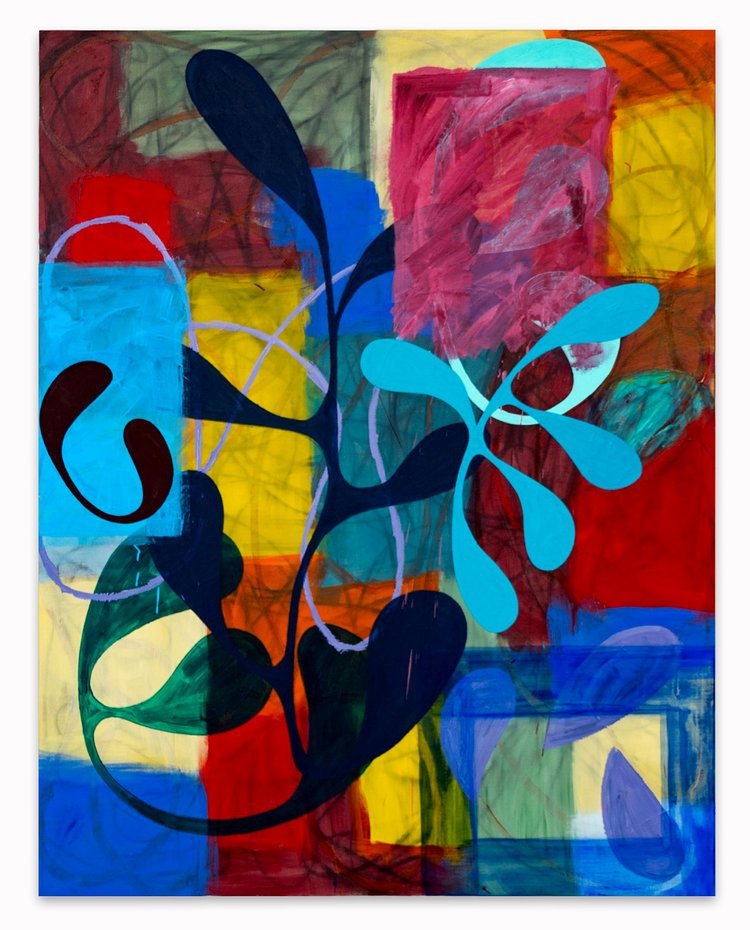
Light Matter includes work by Dawn Arrowsmith, Larry Bell, Casper Brindle, Shingo Francis, Jimi Gleason, Eric Johnson, Jay Mark Johnson, Peter Lodato, Andy Moses, and Roland Reiss.

Mark Steven Greenfield Opening Tomorrow at the Ronald H. Silverman Gallery at Cal State LA

AURAS: New Icons by Mark Steven Greenfield
in collaboration with William Turner Gallery
curated by Mika M. Cho
 
August 19 – October 22, 2024
Artist Reception:
Saturday, August 24, 2024, 5 - 8 PM

Ronald H. Silverman Fine Arts Gallery

5151 State University Dr, Los Angeles CA 90032
MAP

Francisco Manicongo, 2024, Acrylic and Gold Leaf on Wood Panel, 20 x 16 in.

My work concerns itself with the complexities of the African American experience, both historically and in contemporary society. The work often revolves around a number of themes which include subjects as diverse as African American stereotypes, spiritual practices, social justice, meditative practices and abstraction based on my interpretation of the process by which images are formed in the subconscious.” – Mark Steven Greenfield
 
Mark Steven Greenfield is a painter of phenomenal insight, exemplified by his upcoming exhibition “AURAS: New Icons by Mark Steven Greenfield.” The majority of his paintings in this exhibition are presented for the first time at the Ronald H. Silverman Fine Arts Gallery. These images draw upon issues that have been at play regarding the black identity and black history in the United States. These two series are reflective of the spirituality that permeates the black psyche and reach back into the earliest of experiences of their presence on the American continent or even before, as well as their exposure to the European narratives and their appropriations by the Christianized Blacks. Haloconveys the black spiritual experience through various social, political, and religious signs and symbols by appropriating the icons of the colonizing Europeans.

AURAS, 2024, Acrylic and Gold Leaf on Wood Panel, 30 x 40 in

AURAS: New Icons by Mark Steven Greenfield

ARTIST RECEPTION
Saturday, August 24, 2024, 5 - 8 PM

Conversation between Artist, Mark Steven Greenfield and Art Critic, Shana Nys Dambrot
September 28, 2024, 2 - 4 PM

5151 State University Dr, Los Angeles CA 90032
MAP

Scot Heywood Exhibition

SCOT HEYWOOD

Born in Los Angeles in 1951, Scot Heywood has been investigating geometric abstraction for over forty years. “I painted flat from the get-go,” Heywood says, who has explored abstraction throughout the course of his artistic career. A self-taught artist, Heywood’s works are indebted to the origins of geometric abstraction. In the late 1970s, Heywood fell in love with the paintings of Piet Mondrian and John McLaughlin; since then, he has been translating the austere philosophy of geometric abstraction into his own monochromatic works. 


Ranging in scale from intimate to encompassing, his paintings consist of multiple, colored canvases, connected in staggered, patchwork patterns. In a seemingly endless array of variations, he inserts thin strips between, or attaches them to the sides of, square and rectangular canvases, intentionally misaligning them to create delightfully disruptive, staccato visual rhythms. Heywood is interested in the relationship between wall, work, and viewer, and in the rich dialogue between color and form.


Heywood has shown extensively in Southern California since the late 1970’s at such as significant galleries as Patricia Faure Gallery, Frank Lloyd Gallery, ACE Contemporary Exhibitions and Subliminal Projects Gallery. His work has been featured in dozens of solo shows, and is often included in significant group exhibitions at The Los Angeles Institute of Contemporary Art, San Francisco Art Institute and Otis College of Art & Design. Heywood’s work has been featured in publications such as the Los Angeles Times, Art in America, Art Slant, LA Weekly and Artweek. His paintings are also represented in numerous public and private collections, including the Frederick Weisman Foundation. He currently lives and works in Los Angeles, California.

Melanie Pullen + Shana Nys Dambrot - INCONVERSATION - June 19 @ 7PM

Please join us Wednesday, June 19, 2024 at 7PM for a conversation between art writer Shana Nys Dambrot and photographer Melanie Pullen.  Doors open at 6PM and the talk will begin at 7PM.  There will be refreshments served complimentary of the gallery and signed copies of Melanie’s exhibition catalog VOYEUR will be available for purchase.  

Shana Nys Dambrot is an art critic, curator, and author based in Downtown LA. Formerly the Arts Editor at the L.A. Weekly, she is the co-founder of 13ThingsLA, and a contributor to the Village Voice, Flaunt, Artillery, and other culture publications. She studied Art History at Vassar College, and is the recipient of the Rabkin Prize for Art Criticism, the Mozaik Future Art Writers Prize, and the LA Press Club National Arts & Entertainment Journalism Critic of the Year award. Her surrealist novel Zen Psychosis (Griffith Moon) was published in 2020.

Melanie Pullen’s (b. 1975) photography has been shown in major museums and galleries internationally and is permanently in the holdings of many of the most prominent public and private collections around the world including: Colección Jump, Mexico City, Mexico; Museum of Contemporary Art (MOCA), Jacksonville, Florida; The Frederick R. Weisman Museum of Art, Pepperdine University, Malibu, California; Nasher Museum of Contemporary Art, North Carolina; Howard Stein & the Forward Thinking Collection, New York, New York; Walker Art Center Museum, Minnesota; The Rand Collection, Santa Monica, California. Most recently the Getty Museum acquired several pieces from her High Fashion Crime Scenes which now reside in their permanent collection after being included in their exhibition: Icons of Style: 100 Years of Fashion Photography.

Her work has been featured in a number of publications including: The New York Times T Magazine; Los Angeles Times; Vogue; Esquire Magazine; ELLE; London’s Independent; Spin Magazine; W Magazine; Flaunt Magazine; 1814 Magazine; Rolling Stone Magazine and Vanity Fair. Pullen has published three photography books. Melanie was awarded the D&D Yellow Pencil Award. She currently lives and works in Los Angeles, California.

Pullen has published numerous books of her photography with notable fine-art publishers such as: Nazraeli Press and most recently in 2020 with Kodansha Press, in Japan.

Melanie Pullen: Voyeur Digital catalog is now available to view

"The best fashion photographs can remind us of other works of art or expand the boundaries of the genre, redefining what a fashion photograph is supposed to do or be. 

The photographs that do both are the ones that excite me the most. For example, the work of Melanie Pullen (b. 1975) represents a relatively new type of fashion photograph — one that was made for artistic reasons and celebrated by the fashion press after the fact. Based on crime-scene photographs that she found in police archives in Los Angeles and New York City, Pullen’s work reverses the aspirational nature of most fashion photographs, celebrating instead the darkly romantic idea of dying young, beautiful, and well dressed. As an image of suicide, Half Prada flies in the face of the industry’s claim: buy our products and your life will improve. The waist-down cropping keeps what would have been the picture’s most disturbing aspect out of the frame, while the undone shoe strap becomes, in Roland Barthes’ terminology, 'the punctum disrupting the perfection of the image.' The viewer is simultaneously attracted to and repelled by an image that is virtually impossible to forget."

Paul Martineau 
Curator of Photography 
The J. Paul Getty Museum 


MELANIE PULLEN: VOYEUR

Voyeur marks Melanie Pullen’s first solo exhibition at William Turner Gallery of large-scale photographs from her highly acclaimed High Fashion Crime Scenes and Voyeur series’. 

Born in New York City in 1975, Melanie Pullen is a self-taught fine-art photographer raised in a family of photojournalists, publishers, and artists. Growing up within the halls of the famed Hotel Chelsea, Pullen was immersed in this avant-garde setting, which greatly informed her artistic practice. Bi-coastal from an early age, Melanie spent her formative years between New York City and Los Angeles.

Pullen’s work focuses extensively on both social values and taboos while purposely taking aim at the media’s exploitation of sex, gender, and violence. Pullen herself has noted that she targets society’s obsessive glamorization by literally re-dressing what are deeply disturbing events, forcing the viewer to question their own values and observations.

Her photography has been shown in major museums and galleries internationally: it is permanently in the holdings of many of the most prominent public and private collections around the world: Museum of Contemporary Art (MOCA), Jacksonville, Florida; The Frederick R. Weisman Museum of Art, Pepperdine University, Malibu, California; Museo Jumex, Mexico City, Mexico; Howard Stein & the Forward Thinking Collection, New York, New York; Walker Art Center Museum, Minneapolis, Minnesota; The Rand Collection, Santa Monica, California. 

Most recently the Getty Museum acquired several pieces from her High Fashion Crime Scenes which now reside in their permanent collection after being included in their exhibition: Icons of Style: 100 Years of Fashion Photography.

Pullen’s work has been featured in a number of publications including: The New York Times, T Magazine; Los Angeles Times; Vogue; Esquire Magazine; ELLE; London’s Independent; Spin Magazine; W Magazine; Flaunt Magazine; 1814 Magazine; Rolling Stone Magazine and Vanity Fair. 

Melanie was awarded the prestigious D&D Yellow Pencil Award in 2007 and has published three photography books, two with Nazraeli Press, the other with Kodansha.  She currently lives and works in Los Angeles, California.

Embed Block
Add an embed URL or code.

Shingo Francis - NY Times Style

STEP INTO COLOR

“‘Color itself has space,’ says Shingo Francis. We spoke to him about the opening of his first retrospective exhibition in Japan, which focuses on the themes of color and space, which he has continued to explore.”

BY NAOKO ANDO, PHOTOGRAPHS BY YASUYUKI TAKAGI 

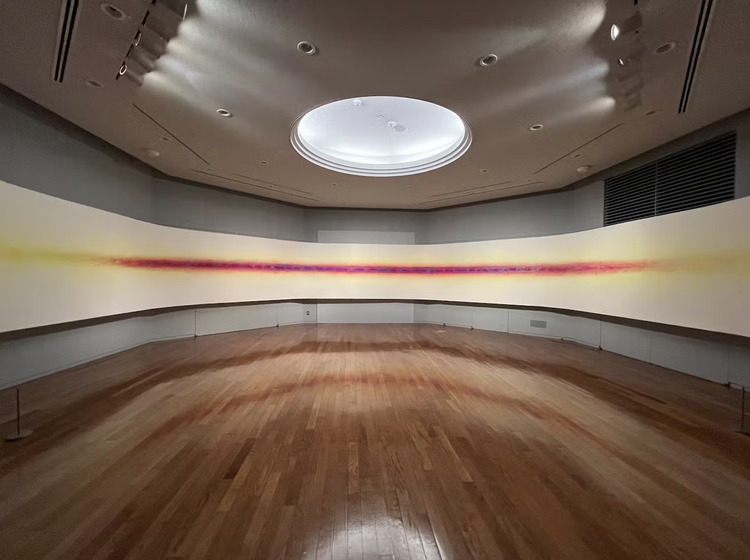
“Born in Santa Monica, California in 1969 he currently resides between Los Angeles, California and Kamakura, Japan. In 2023, he participated in the Ginza Maison Hermès Forum ‘Interference’ exhibition and created a 6 x 7 meter mural. His works are in the collections of many museums, corporations, and private collections.

The ‘Interference’ series that Shingo Francis has been working on since 2017 has now come to be identified as his masterwork.

This work is unique in that it is painted using pigments containing fine mica that reflects light, and the color changes as the angle of incidence of light changes. The color changes as the angle of the light that hits it changes, and if you change the position you stand in front of the work, the color changes as water refracts light in a rainbow.

In 2023 Ginza Maison he also took on the challenge of creating a huge mural at the ‘Interference’ group exhibition at the Hermès Forum. The Renzo Piano designed building's glass-block exterior allows light to enter the building, constantly changing the work.”

“This series started with the idea that there might be something called geometric portraits. We believe that portraits are not limited to portraits of organic creatures such as humans and animals. ‘My idea was to draw a rectangular motif, but as I spent more time reflecting on myself during the Covid pandemic. The motif naturally turned to a circle, which is dedicated to the cycle of life and the seasons as well as shrines. This also applies to the sacred mirrors held in the temples and the round windows in temple buildings.

’The production process is very stoic. First, I apply a white base coat to the canvas, and once it dries I sand it to make the surface even. When you touch it, the difference between before and after sanding is like that of rough unglazed pottery and smooth porcelain. On top of that, the motif and surrounding areas are painted using pigments containing mica. This pigment takes a long time to dry, and one can't move on to the next step until it is completely dry. Especially when painting the edges, I have to be very careful not to let it ooze out or bleed.’

If there is anything you are not satisfied with, you will have to start over from the beginning. The explanation of the process is like listening to a craftsperson such as a potter or lacquer painter. The works are not simply finished in a flat manner; when viewed up close, traces of hand movements such as brush-strokes remain, which further pleases the viewer's eyes. It is important to judge whether the timing is good or bad.

‘No matter how many photos I take, I can't capture it. Unless you actually stand in front of the work, you won't understand the reality. When confronted with this work, which can be described as a quiet challenge to the SNS age, the dialogue with the work naturally shifts to a dialogue with oneself. Each viewer is able to see themselves in the work. I would like to take a closer look at such works at this exhibition.’

Shingo Francis was raised in the United States and Japan, the son of Sam Francis, a master of French informel (atypical avant-garde art) and American abstract Expressionism, and the media artist Mako Idemitsu. When he was young, his father would draw with him at his own desk and art supplies in his studio. My father often told me, ‘Don't let it turn brown.’ I remember this very well. The pure clarity that his works exude may have been cultivated from an early age.’”
CHIGASAKI CITY MUSEUM
1 Chome-4-45 Higashikaigankita, Chigasaki, Kanagawa 253-0053, Japan
March 30th (Sat) - June 9th (Sun)

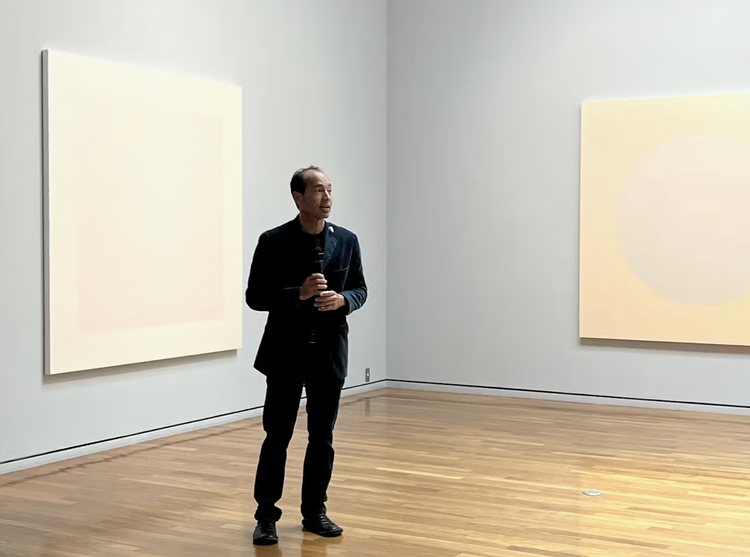
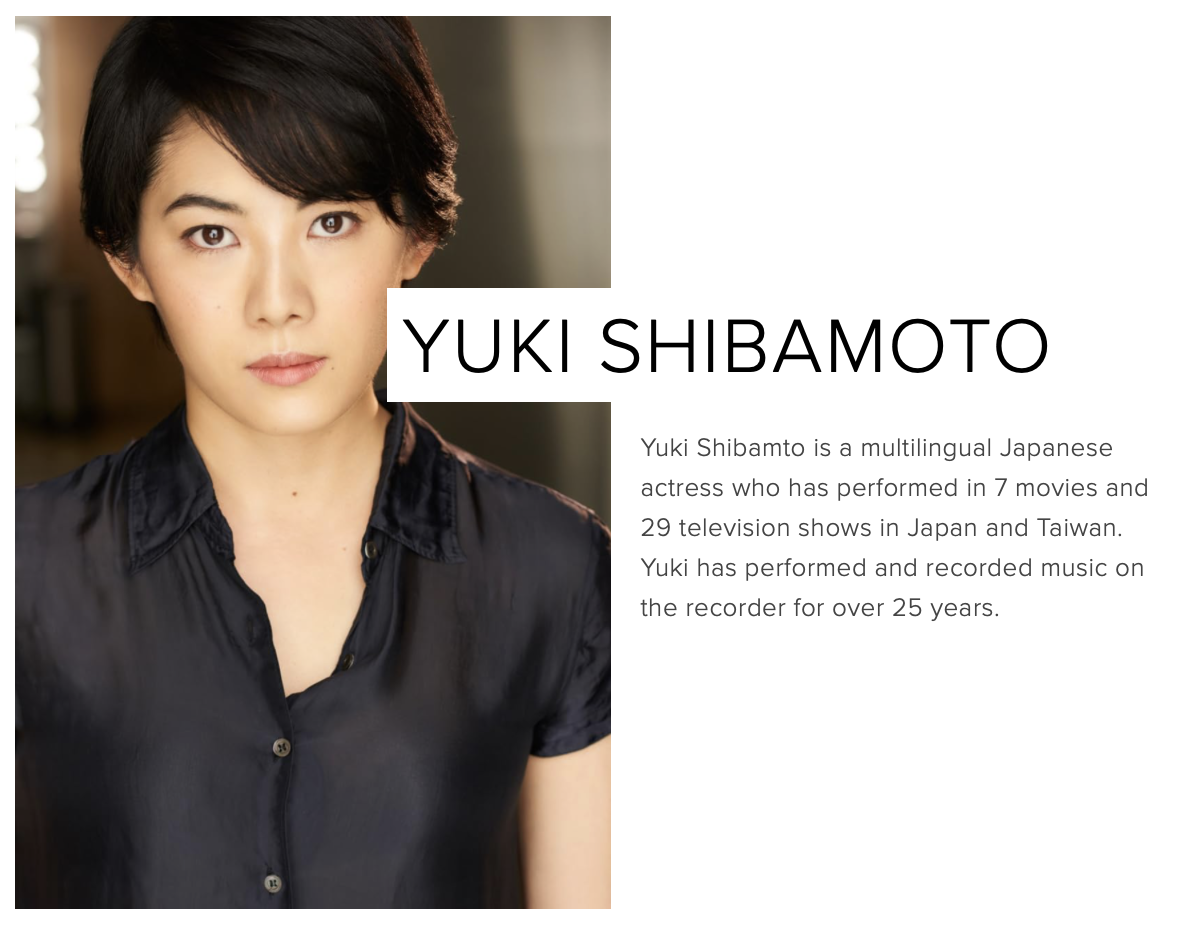
Today at 3PM - Peter Lodato Show Walk Through with Yuki Shibamoto

Please join us today at 3pm for a short musical performance by Yuki Shibamoto followed by an exhibition walkthrough by internationally renowned artist Peter Lodato. Following the talk we will be serving refreshments from 3-6pm. We welcome you to join us for this special event.

Peter Lodato holds a Graduate degree from California State University. His artistic contributions have been recognized through a solo retrospective curated by the Frederick Weisman Foundation (2000), and exhibitions at prestigious institutions such as PS1 in New York City (1978), Whitney Museum of American Art’s Biennial (1981), the Museum of Contemporary Art in Los Angeles, and the Los Angeles County Museum of Art. His works grace esteemed collections in various public and private institutions, including the Brooklyn Museum, the Seattle Art Museum, the Dallas Museum of Art, and the San Diego Museum of Contemporary Art. This extensive presence in renowned collections underscores the impact and significance of Lodato’s artistic vision within the realm of contemporary art. He lives and works in Venice, California.

3:00 PM - MUSICAL PERFORMANCE BY YUKI SHIBAMOTO
3:30 PM EXHIBITION WALK THROUGH WITH PETER LODATO
3:00 - 6:00 PM WINE & REFRESHMENTS

PETER LODATO: DIAMONDS/DIVISIONS/VOIDS - Exhibition Catalog Now Available

Santa Monica, CA - William Turner Gallery is pleased to present, solo exhibition of exceptional new works by Peter Lodato, opening  January 13th, 2024. 

Peter Lodato’s (b. 1946) artistic journey reflects an evolution, from immersive light installations, to captivating paintings that explore the complexities of human perception over the course of his six decade-long career. In addition, Lodato would himself influence a number of artists, teaching Art History at Art Center in Pasadena, and University of California Irvine with notable students such as James Turrell and Chris Burden.

His initial foray into art consisted of environmental light installations,  characteristic of the West Coast's Light and Space movement in the 1960’s, which sought to transform physical spaces into immersive experiences for viewers. He credits the Roman Pantheon’s oculus for his interest in interpreting his experience. This body of work led to his inclusion in the 1981 Whitney Biennial.

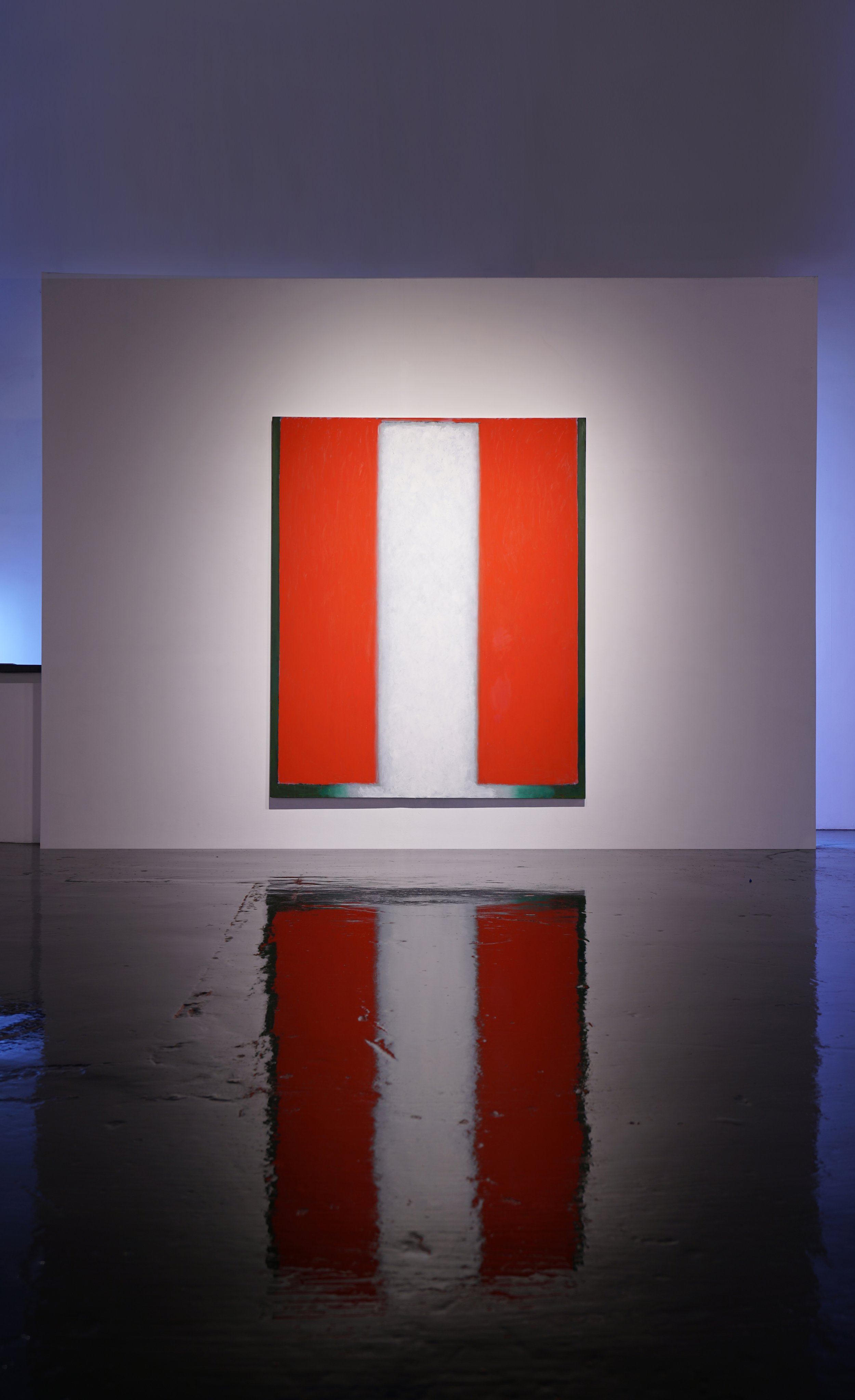
As Lodato transitioned back to painting, he carried forward his fascination with perception, creating works that initially appear as austere, geometric abstractions but upon closer inspection, reveal layers, brushstrokes, and vibrant colors that play with space and depth. The dichotomy of vision—its capacity to both reveal and conceal—serves as a thematic cornerstone in Lodato's artistry. His reductive compositions, often featuring divided forms and bold colors, engage viewers in a visual dialogue between simplicity and complexity. Inspired by the Abstract Expressionist’s Mark Rothko and Barnett Newman, Lodato's use of vertical bands of color draws viewers into the canvas, inviting them to experience the artwork both physically and transcendentally. Hard edges feather out into diaphanous atmospheric vapors, creating luminous, Color-field suspensions floating on a colored ground– the formal consequences appear to both recede and project, dematerializing the art object and simultaneously constructing a void of flat, hard-edge, matted pigment. The artists hand is evident in the textural materialization of paint executed with an expert hand. In reasserting the picture plane in favor of the flat form, the abstractions are not in fact “subjectless”, regardless of their  reductive nature, they are intended to elicit a deep emotional response and expose the paradoxical nature of human perception.   

Informed in part by Eastern philosophy, Lodato’s palette observes the color schema assigned to the various corporeal chakras and their corresponding color assignments. Red for example symbolizes the root chakra at the base of the spine, characterizing strength and vitality, whilst white on the other end of the spectrum, illustrates the crowning light of spiritual wisdom.    

Embed Block
Enter a valid embed URL or code.

Lodato holds a Graduate degree from California State University. His artistic contributions have been recognized through a solo retrospective curated by the Frederick Weisman Foundation (2000), and exhibitions at prestigious institutions such as PS1 in New York City (1978), Whitney Museum of American Art’s Biennial (1981), the Museum of Contemporary Art in Los Angeles, and the Los Angeles County Museum of Art. His works grace esteemed collections in various public and private institutions, including the Brooklyn Museum, the Seattle Art Museum, the Dallas Museum of Art, and the San Diego Museum of Contemporary Art. This extensive presence in renowned collections underscores the impact and significance of Lodato's artistic vision within the realm of contemporary art. He lives and works in Venice, California.

Opening Tomorrow, Saturday, January 13 from 5-8PM - Peter Lodato: Diamonds/Divisions/Voids & Koji Takei: Intertwined

Vermillion Green & White, 2023, oil on canvas, 96” x 84”

PETER LODATO

Lodato holds a Graduate degree from California State University. His artistic contributions have been recognized through a solo retrospective curated by the Frederick Weisman Foundation (2000), and exhibitions at prestigious institutions such as PS1 in New York City (1978), Whitney Museum of American Art’s Biennial (1981), the Museum of Contemporary Art in Los Angeles, and the Los Angeles County Museum of Art. His works grace esteemed collections in various public and private institutions, including the Brooklyn Museum, the Seattle Art Museum, the Dallas Museum of Art, and the San Diego Museum of Contemporary Art. This extensive presence in renowned collections underscores the impact and significance of Lodato's artistic vision within the realm of contemporary art. He lives and works in Venice, California.    


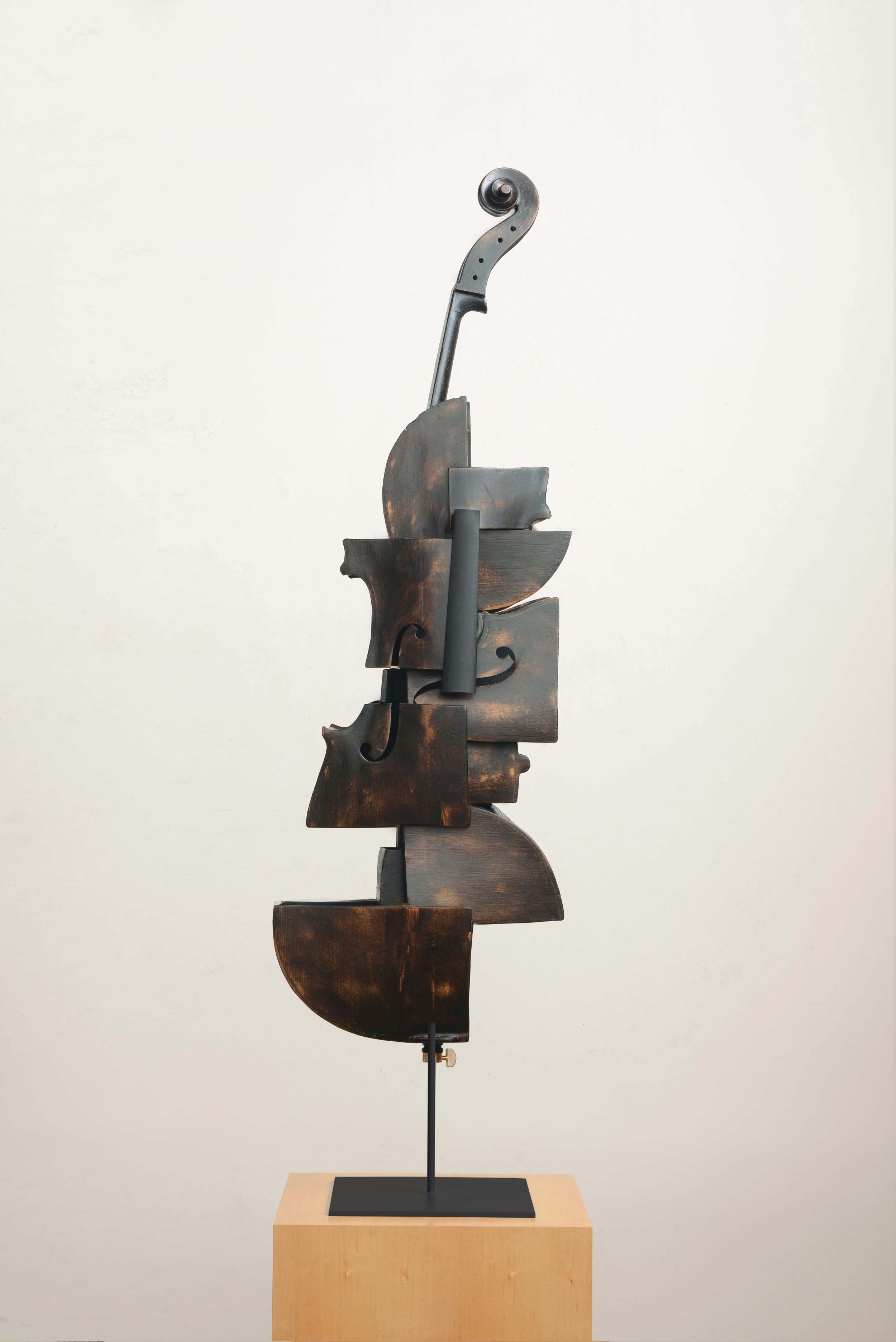
Cello, wood, stains & varnish on metal stand, 53” x 14” x 7”

Through his background in photography and graphic design, Takei first began piecemealing his disparate photographs (pre-Photoshop) and constructing them into sculptures to be photographed. This in turn, led to Takei becoming a sculptor.

Drawing from the discourse of Picasso, Braque and the Surrealists, Takei’s sculptures reference, yet expand upon these oeuvres in a playful syncretism of the two. His work transcends the cacophony often associated with Cubism, offering a vocabulary suffused with irony. that engages in the contemplation of diverging vantage-points in-the-round. The minimal yet commanding presence of his pieces draws parallel to the interlocking sculptures of the late Isamu Noguchi, echoing a profound artistic resonance. Through Intertwined, Koji Takei continues to redefine the boundaries of Cubism. As much as Takei’s pieces are Cubist in nature there is also an unmistakable Asian influence in the working method of the Japanese native.

As a Japanese-American residing in Los Angeles, Takei's influence extends far beyond his innovative work. He has taught at the California Institute of the Arts in Valencia, California; Otis College of Art & Design in Los Angeles, and is currently a faculty member at the Art Center College of Design in Pasadena and Academy of Art University in San Francisco. This underscores his commitment to shaping the next generation of artistic visionaries.