MOSES@100 - ED MOSES: A CENTENNIAL EXHIBITION


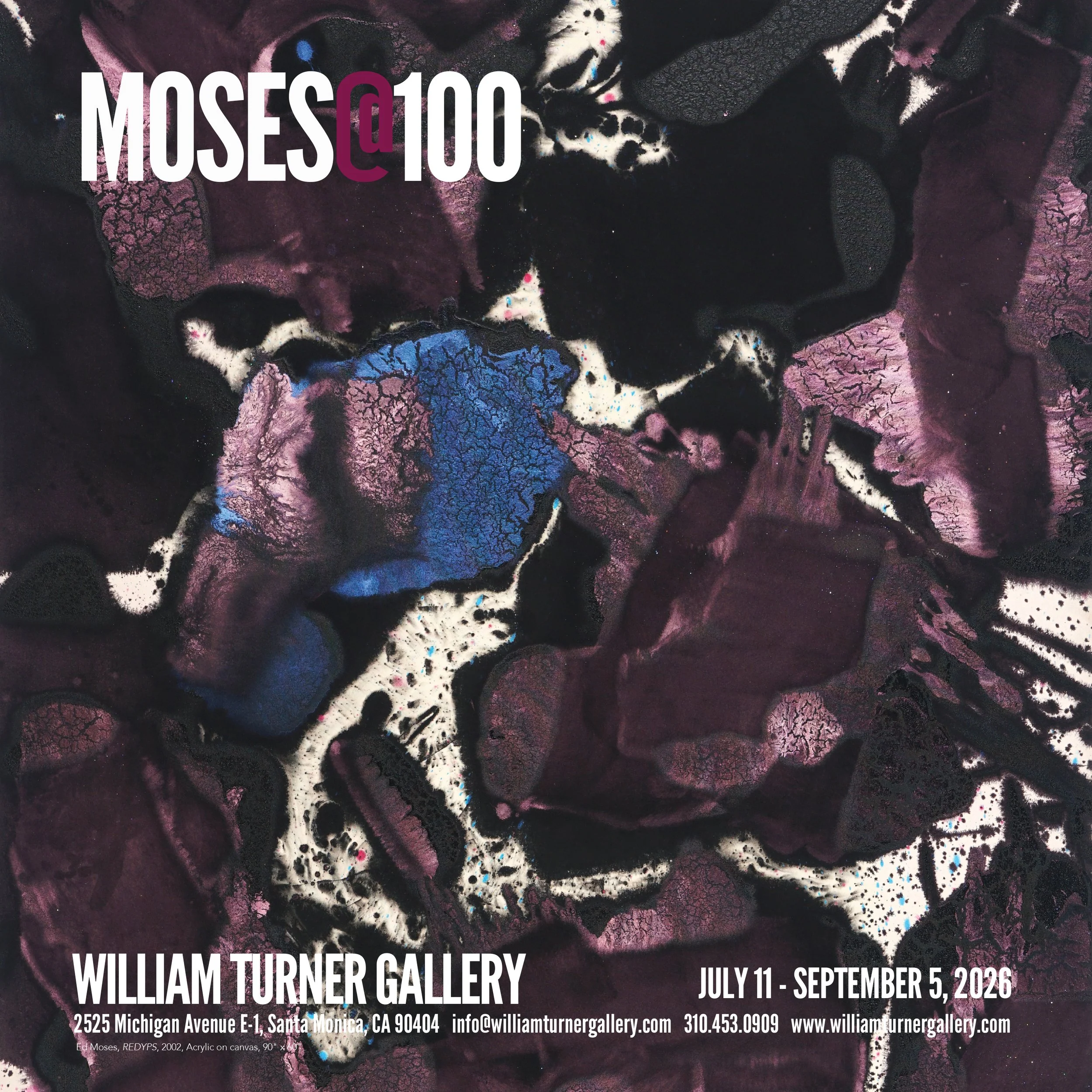
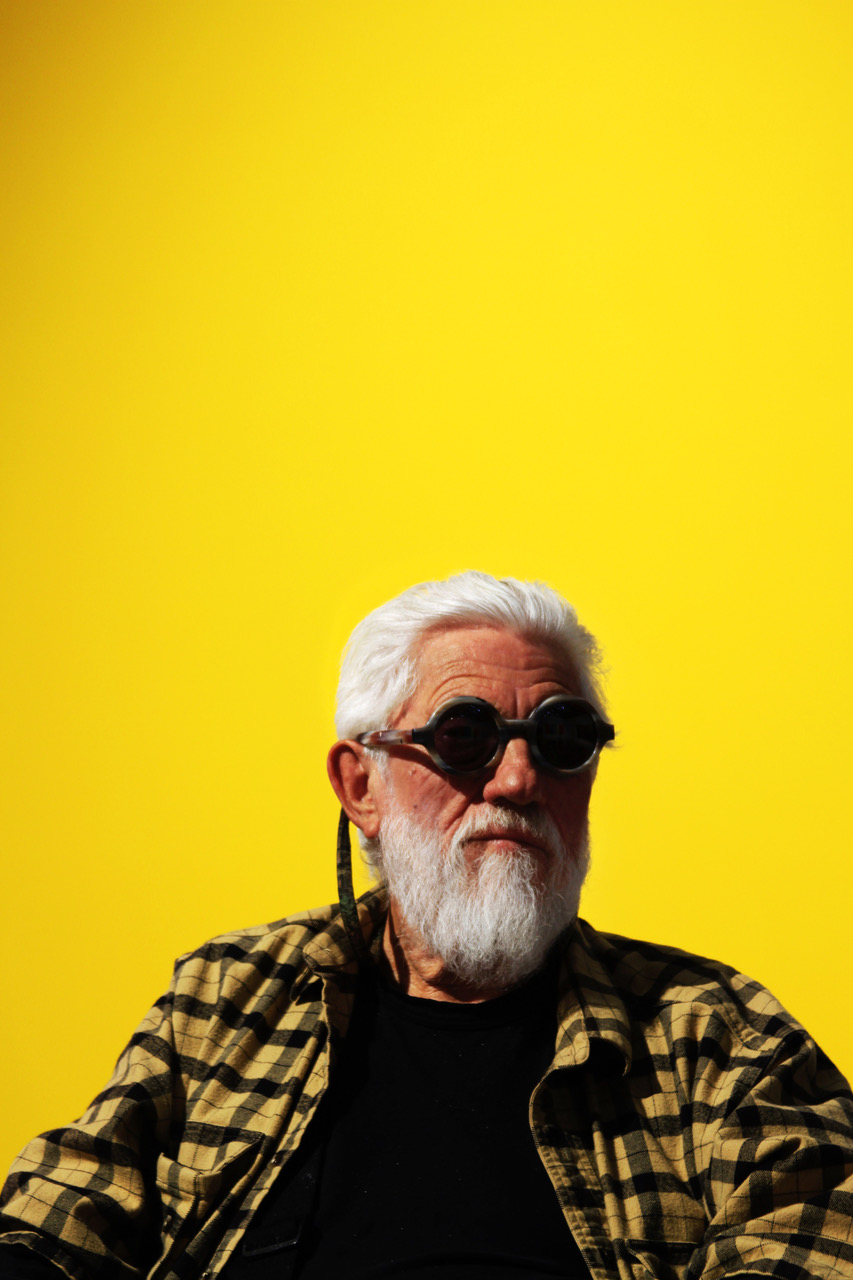
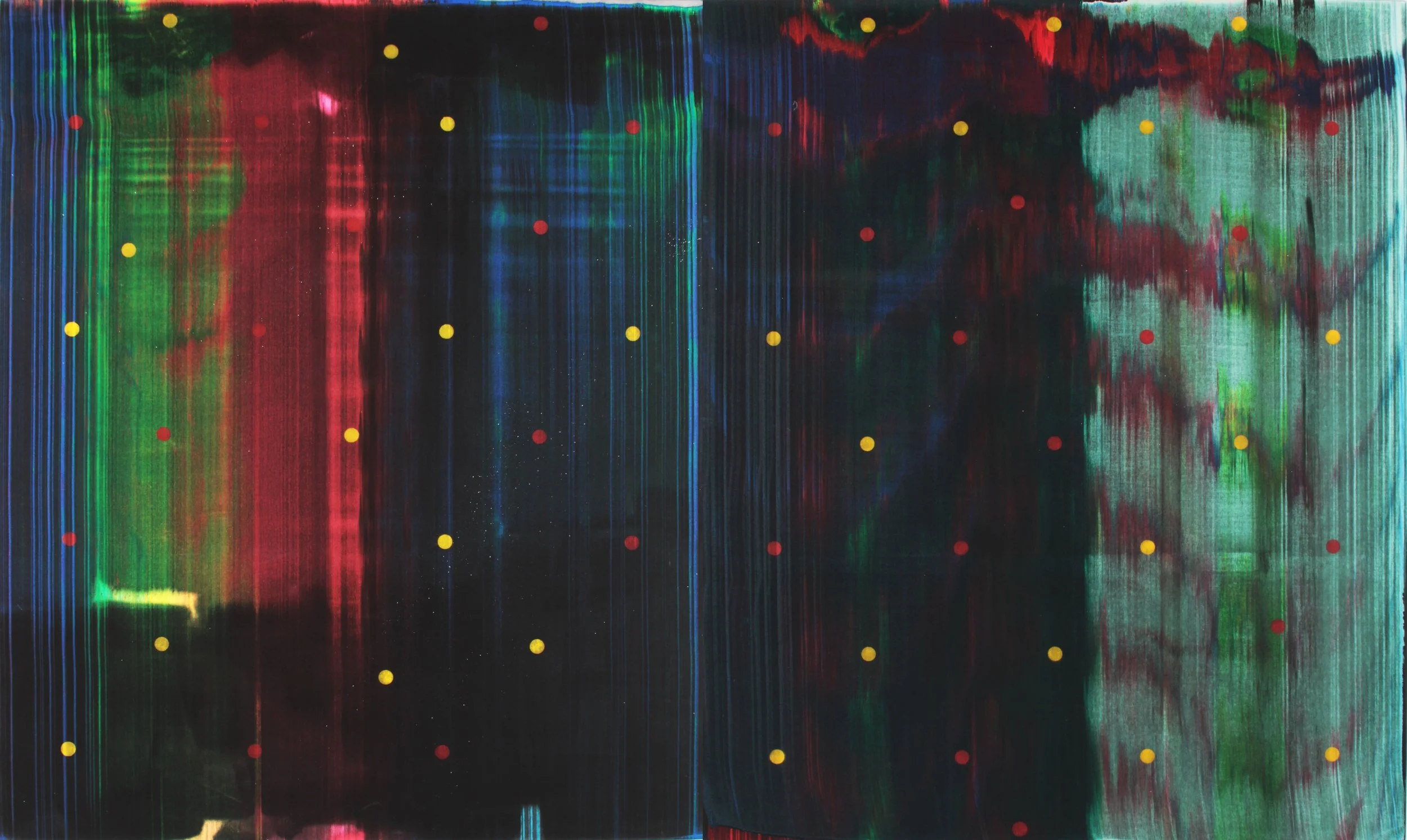
Santa Monica, CA — William Turner Gallery is pleased to present Moses @ 100, an exhibition of works by Ed Moses marking the centennial year of the artist’s birth. Opening Saturday, July 11 from 5–8 PM and on view through September 5, 2026, the exhibition brings together a focused selection of works that underscore the restless experimentation and continual reinvention that defined Moses’ practice for more than six decades.

Moses @ 100 offers an opportunity to reconsider the enduring relevance of a practice rooted in experimentation, intuition, and constant renewal. At a moment when contemporary painting continues to grapple with questions of process, authorship, and materiality, Moses’ work remains strikingly relevant: a testament to an artist who never stopped searching.

Born in Long Beach in 1926, Moses did not initially set out to become an artist. After serving as a surgical technician during World War II, he enrolled in a pre-med program with the intention of becoming a doctor. A chance encounter with painting altered the course of his life. He entered UCLA’s MFA program, where he met Craig Kauffman and was introduced to Walter Hopps, ultimately becoming part of the legendary Ferus Gallery circle. Alongside Robert Irwin, Billy Al Bengston, Ken Price, Ed Ruscha, Larry Bell, John Altoon, Wallace Berman, and Edward Kienholz, Moses helped shape the emerging Los Angeles art scene at a time when virtually no contemporary art infrastructure existed in the city.

Moses often referred to himself as a “mutator,” driven less by self-expression than by an insatiable curiosity to discover. Never content to remain within a singular visual language, he moved freely between styles and techniques, producing bodies of work that ranged from intense graphite drawings to an astonishing array of painterly styles and visual languages. The titles he gave these series—Roses, Wedges, Grids, Jabberwockys, Edges, Magmas, Waterfalls, Sponges, and Crackles, among many others—offer a glimpse into the restless range of his imagination. His refusal to settle into a recognizable signature style became one of the defining aspects of his legacy.

A Buddhist practitioner since the 1970’s, Moses viewed painting as both a metaphysical and experiential act, remarking that “the point is not to be in control, but to be in tune.” Preferring the descriptions “painter” or “mark maker” to that of “artist,” he believed paintings should be evidence of a journey rather than manifestations of a preconceived idea.

His influence extended well beyond the studio. Architect Frank Gehry, one of Moses’ closest friends, reflected on the artist’s impact: “He opened a lot of doors for me, doors of thinking, to a way of looking at life, of thinking about work and creativity and freedom and expressing oneself—taking chances.”

Moses remained remarkably vital and productive until his death in 2018 at age ninety-one. Even into his nineties, he painted daily in his Venice studio, pursuing the unknown with the same intensity that had defined his earliest years. As Michael Govan observed on the occasion of Moses’ 2015 exhibition at LACMA, “Ed Moses has been central to the history of art making in Los Angeles for more than half a century.”

Moses’ work is included in the collections of the Los Angeles County Museum of Art, Museum of Contemporary Art, Hammer Museum, San Francisco Museum of Modern Art, Whitney Museum of American Art, The Museum of Modern Art, New York, The Broad, The Frederick R. Weisman Art Foundation, and the Norton Simon Museum, among many others.

One hundred years after his birth, Ed Moses remains one of the most original and influential figures in American art. Moses @ 100 celebrates a lifetime devoted to discovery, honoring an artist who embraced uncertainty, resisted complacency, and continually reinvented himself. For more than six decades, Moses pursued the unknown with unwavering intensity—a pursuit that continued until his final days and remains vividly present in the work he left behind.
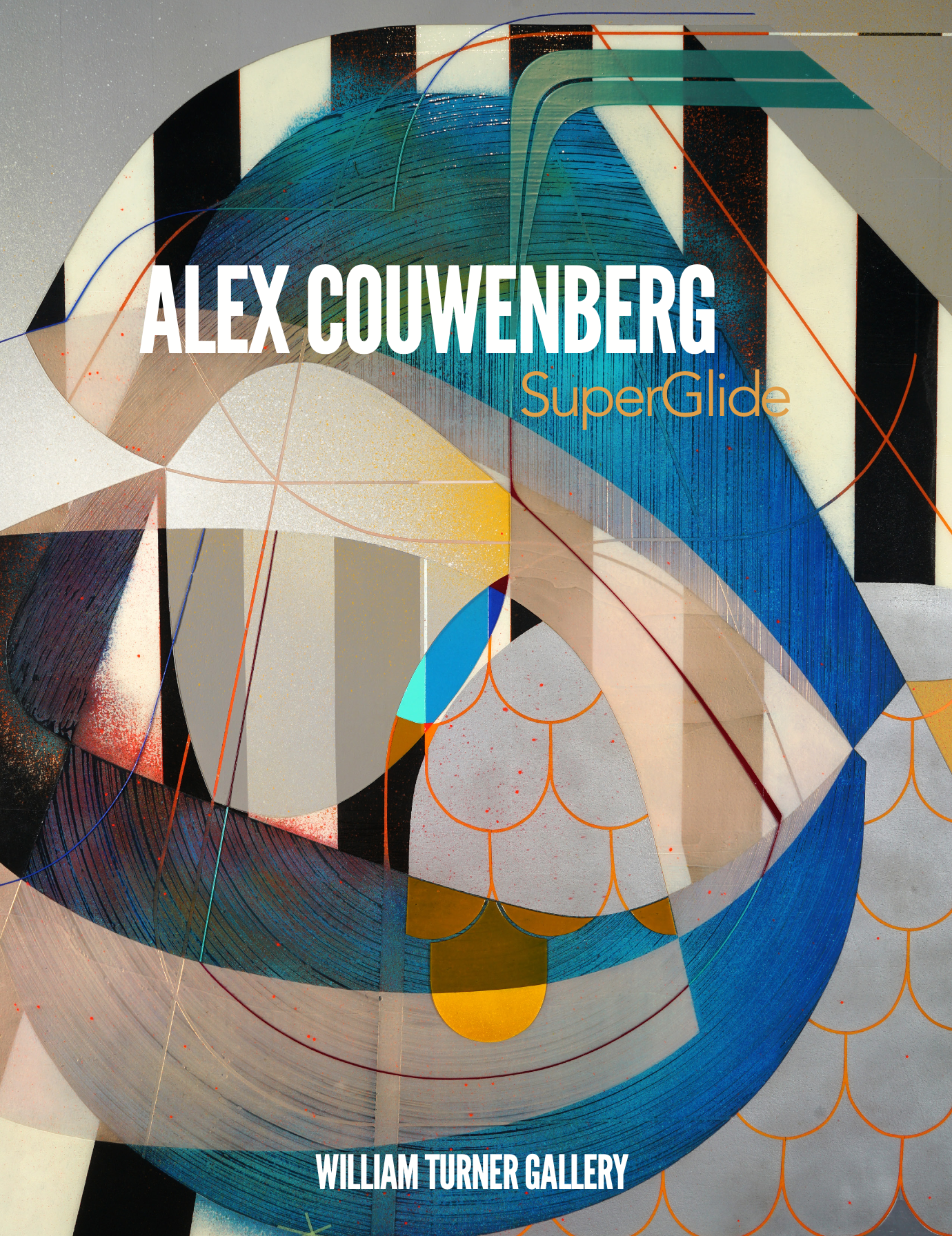
Alex Couwenberg: SuperGlide - Exhibition Catalog Now Available

In this new series of visually exquisite works, Alex Couwenberg utilizes a jazz-like ensemble of color, line and texture to create lyrically engaging, deftly complex compositions. These multi-layered canvases captivate the viewer with the precision of their virtuosic execution, but they are at heart wonderful improvisations - reductive and additive processes drawing upon his intuitive and spontaneous reactions in the moment. Couwenberg simultaneously builds upon and excavates the surfaces of his paintings, constructing an abstract archaeology of his own deeply personal, semiotic patois. Born and raised in Southern California, Couwenberg’s work expresses the seemingly contradictory sensibilities of the region - the love of nature, and its variegated, open-spaced color and light, and, conversely, the embrace of an urban architecture, in all of its physical and cultural density.

A graduate of The Art Center College of Design and The Claremont Graduate School, Couwenberg worked under the guidance of Karl Benjamin, one of the leading figures in the Southern California-base school of Hard-edge geometric abstraction. Beginning in the mid to late 60s, Benjamin was instrumental in developing a highly refined painting style, process, and philosophy of tightly ruled shapes and edges. Concurrently, other artists in LA began working with industrial materials to create highly refined surfaces, termed “Finish Fetish”, and investigating alternative mediums and technological advances. Both of these influences coalesce into Couwenberg’s post-postmodern vernacular, characterized by its layered formal, material, and textured surfaces.

A synthesis of styles and processes particular to the artist's experience materialize on the canvas to construct the poetics of his investigations. Masking off portions of the painting in his process recalls the batik technique of wax-resist dying and geometric patterning used in his father’s birthplace of Java, Indonesia, a former Dutch colony. His parents met in the Netherlands and immigrated to the U.S., making Couwenberg a first-generation Eurasian American. This synthesis of cultures manifests in his pristine Neo-Plast lines, which disrupt the rigid grid of De Stijl to formulate topsy-turvy cartographies embedded with encoded sign- systems. The alternating black-and-white banding alludes to “Invasion Stripes” used by Allied forces to define friendly aircrafts on their fuselages and wings during World War II but can also refer to Chevron stripes. The industrial spray gun is employed to create diaphanous atmospheric effects, where the foreground and background oscillate, while pearlescent paints shimmer on the surface. Couwenberg lacerates striations on portions of the architectonic compositions with tools such as brooms, all the while revealing intersections between the complex networks of positive and negative spaces. These circuits are comparable to the labyrinthine freeways Angeleno’s surmount and the dextrous, freestyle choreographies skaters wreath. Couwenberg orchestrates self-portraits that intimate a collective unconscious unveiled through material and process, ultimately converting them into cultural artifacts.

Chasing Pono, 2022, acrylic and spray on canvas, 72“ x 66“

Couwenberg’s paintings have been shown in several solo and group exhibitions throughout the United States, Canada, Europe, and Asia. His work can be found in numerous public, private, corporate, and museum collections around the world. Museum acquisitions include the Crocker Museum of Art, the Daum Museum in Missouri, Lancaster Museum of Art and History, Laguna Art Museum, Long Beach Museum of Art, and Nushi-Umeda, Tokyo to name a few. In 2007, Couwenberg was awarded the prestigious Joan Mitchell Foundation Award for his achievements in painting and in 2012 was featured as the subject of Los Angeles based filmmaker Eric Minh Swenson’s project titled “The Making Of La Fonda,” which focuses on the artist's life and studio practices.

Commemorating Ed Moses

Today we commemorate the art and life of the late Ed Moses. Born on April 9, 1926, Ed Moses rose to become an important figure in Post War art. Moses had his first exhibition at the legendary Ferus Gallery in 1958 while still a graduate student at UCLA. In 1996 Ed had a career retrospective at MOCA and most recently an exhibition of works on paper from the 60’s & 70’s at the LA County Museum of Art. Ed’s work is in the collection of countless important international institutions and was featured in the 2008 documentary The Cool School.

A constant innovator and experimenter Ed tested the boundaries of materials and processes delivering exhibitions up to the year of his passing that were often completely unique from past production, a feat of creativity rarely witnessed in the history of art.

Ed was a storyteller both in paint and the spoken word. Years later those stories live on, through his survived contemporaries, his dealers, his friends and his family. He was a passionate and fearless innovator, an intellectual, a gifted orator and a phenomenal artist. His story has only begun to be written and we are honored at the gallery to have been a part of it.

Ed Moses - Examining the last 5 years of an iconic artist’s life

Through the Looking Glass presents an overview of this last period, with a selection of work Moses produced over the last five years of his life. The work is ambitious and adventurous, and is marked by the artist’s spontaneity and expansive visual vocabulary.

The exhibition reveals an artist fully engaged, working in the moment, embracing a career’s worth of stylistic approaches, while incorporating new ones, as Moses boldly entered the labyrinths of the creative process. The works are dramatic in scope and exemplify the breadth of his reach.

The title of the exhibition is from Lewis Carroll, one of Moses’s favorite writers, and refers to one of the artist’s fundamental beliefs - that art, at its best, is a portal to the unknown, through which one is transported to magical realms.

Moses did not paint to express; he painted to discover. Restless curiosity was his driving force - chance and circumstance his guiding principles. Often Moses would see the ghost images that appeared on the backs of his paintings as the very point and pith of the effort - subconscious postern doors opening to new dimensions through a willingness to embrace the unexpected.

It has been a year since Ed Moses has passed to the other side of the looking glass. We are honored to present these late works, by this incredibly gifted, committed, and important painter.

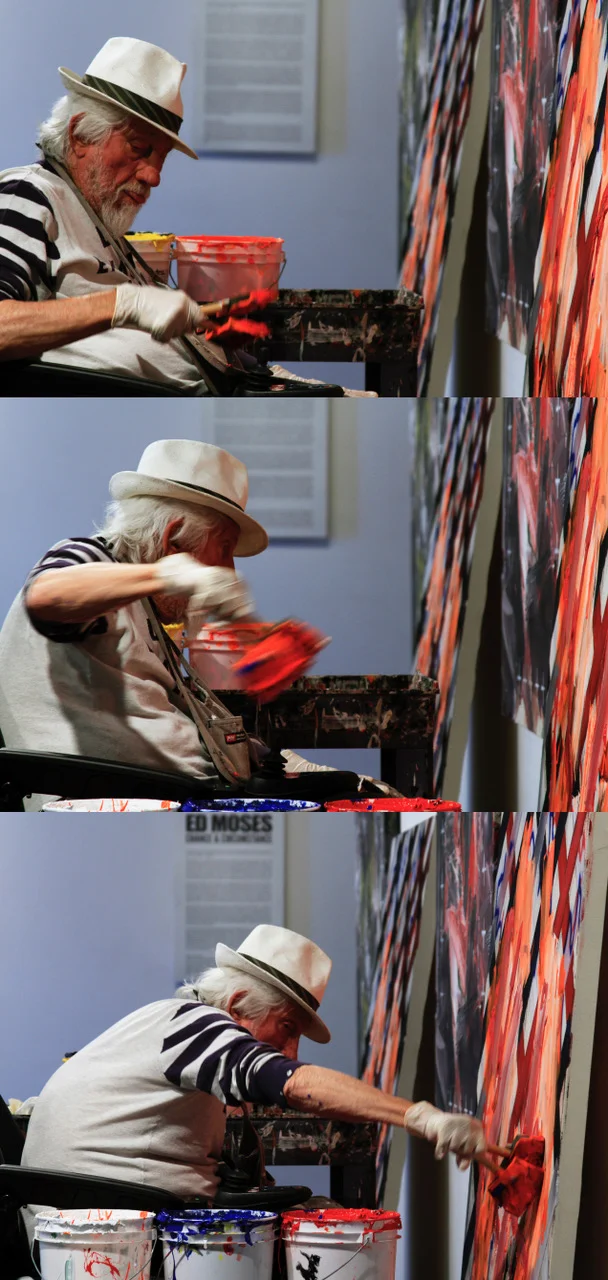
Moses obsessively mined the possibilities of abstract painting for over 60 years, leaving an indelible mark on the contemporary art world. He was extraordinarily productive, and as he entered his 90s, he showed little signs of slowing down, painting daily, as he had done for decades, outdoors at his Venice studio, and attending numerous exhibitions of his work at various venues throughout the city.

Moses received national and international recognition for his singular, categorically evasive practice. Known for his restless intensity and ever-evolving style, Moses was considered one of LA’s most innovative painters, and a central figure in the city’s art scene since first gracing the walls of its legendary Ferus Gallery in 1958. Moses often referred to himself as a “mutator," driven less by the desire for self-expression than by a voracious appetite for experimentation and discovery. Describing his approach, Moses said, “The rational mind constantly wants to be in charge. The other parts want to fly. My painting is the encounter between the mind’s necessity for control and its yearning to fly, to be free from our ever- confining skull.”

A 200-page, fully illustrated artist monograph is forthcoming in 2019, and will include critical essays about the artist’s life and work by Richard Davey, Ph.D., author, and Chaplain at Nottingham Trent University, UK; and Thomas Krens, former Director of the Solomon R. Guggenheim Foundation in New York City, and current Senior Advisor for International Affairs.