
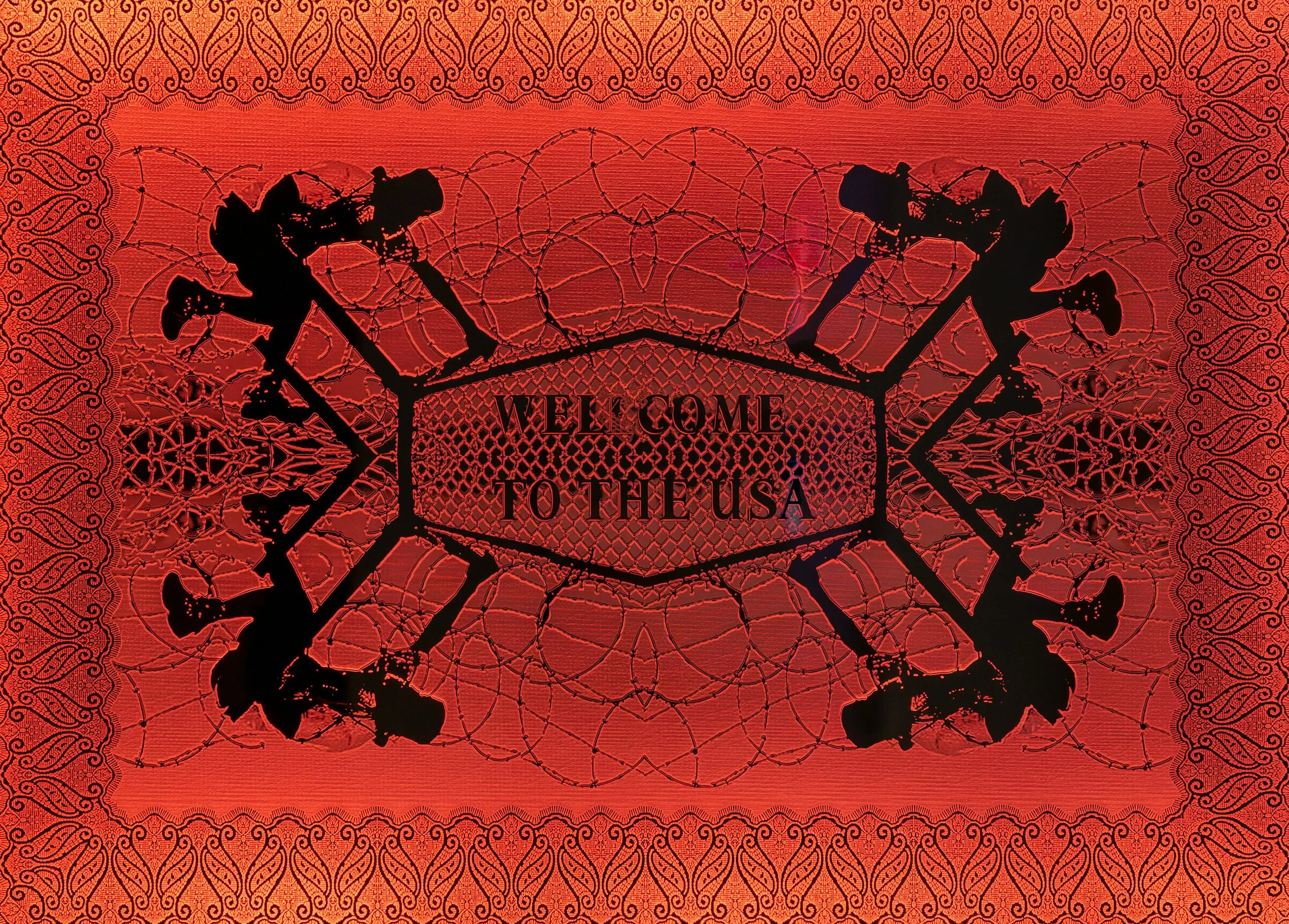

Opening Tomorrow 12-6PM - C O N F L U E N C E
/
With increased vaccinations and decreased threat of the pandemic, it has been enormously gratifying to hear the exclamations of joy and excitement as people begin to return to the gallery to experience art again in person. Our response to this pent up desire has been to celebrate as many of the gallery’s artists as possible as we get back to some semblance of normal. Our previous exhibition, CrossCurrents, showcased a cross-section of the gallery’s artists and work produced during the pandemic.
Confluence expands on this notion by introducing an exciting sampling of work by new and familiar artists on the gallery’s roster - their unique and disparate voices finding surprising harmonies through shared passions for art-making and expressing the human spirit in visual form. Many of the artists in this exhibition continue to experiment and probe the expressive possibilities of the materials with which they are working, creating works that in some instances inspire meditative reflection, and in others utilize materials to inspire movement and interactivity.
Natalie Arnoldi
Arnoldi states that, “These paintings represent a literal and figurative interface: between air and water, humans and the ocean, viewer and painting”. Growing up in Malibu, Natalie Arnoldi has spent much of her life in and near the ocean which became the inspiration for both her academic and artistic pursuits. The artist’s paintings of lightening exemplify her fascination with the vastness of the seas and mysterious forces of nature. Working in a limited palette that evokes the deep ocean depths, dark, inky pools of blue provide the moody backdrop for charged flashes of light. Arnoldi’s love of the ocean has found expression not only through in her powerful artwork, but has been complimented by a deep love of science, evidenced by her simultaneous pursuit of a Phd in Marine Biology from Stanford. The result has given us exquisite body of paintings, informed by scientific knowledge & creative passion.
Kim DeJesus
We are excited to introduce the work of Kim DeJesus to the gallery. Her improvisational abstractions tap into her interest in memory - how it works, and what it reveals about us and the world. In this new body of work, DeJesus explores how marks, colors, layers, erasures, and patches, evoke remembrance and forgetfulness and suggest the discoveries we make and the absences in our lives. Her work is informed by a concern with natural processes, particularly as they symbolize the relationship between ourselves and nature and the dichotomy we face in being simultaneously "a part of” and "apart from” the natural world. As the artist states: "This tension is echoed in the way I work. The material is not entirely controlled in my studio, allowing for accidents, discoveries, and an ongoing conversation between myself, the material, and what’s appearing on the canvas or paper. Frequently, I introduce marks and collage elements whose intentionality disrupts the happenstance of their fluid elements. The completed painting is a record of that process and the corrections and alterations that months of work bring about. Ultimately, I’m looking for artworks that depend for their transcendence in the tension between beauty and flaw, between grand ambition and simple means."
Eric Johnson
Inspired by both art and science, Eric Johnson creates composite works of pigment, wood and resin that reference a kinship with other artists: to the sensuality of Brancusi, the architectural vigor of Bontecou, and the works of DeLap. The handcrafted abstract works are often sheathed in resin skins, often revealing glimpses of skeletal armatures and hidden architectures. In reflection, Johnson’s structural forms are influenced by a severe neck injury and dealing with intense spinal pain. Other influences have been the aerospace industry and ancestral boat builder heritage. Initially the constructs hid their “bones” under a “skin”, time capsule artifacts within. Over the past twelve years, the structures have become organic and revealing to their formation. The current work merges the passion for depth and structure with an obsession for color and surface. Johnson has spent decades working with polyester resin. Like many artists of his generation, Johnson embraced the hot-rod culture of Southern California. As often was the case for many artists working in the 1970s, industrial products found their way into Johnson’s early studio practice and have remained there ever since. “I’ve translated all that automotive knowledge into making my artwork”,” he says. “I use the full array of auto tools and pigments.”
Javier Paláez
Based in Mexico City, Javier Peláez creates work that considers the myriad possibilities involved with the construction and perception of reality. Depicting enigmatic imagery that can be construed as simultaneously materializing and deconstructing, Peláez’s pictorial language is set in an incessant swing between opposing states of being. Fascinated by polarities, Peláez’s subjects walk the line between figuration and abstraction, disintegration and formation, certainty and uncertainty, inviting the viewer engage their imaginations as they enter to these beautiful spaces of ambiguity.
Curtis Ripley
Taking cues from the aesthetic of American Abstract Expressionists, Curtis Ripley’s process is one of spontaneity and gesture. Color is applied in broad strokes atop murky, moody surfaces. Ripley uses brushes and rags to wipe out and repaint the surface, obscuring previous layers while gradually building up others to create even deeper space and movement. As Ripley says of his work - “My hope is to create paintings that are timeless, poetic and full of life.” Music plays an important role in Ripley’s creative process. His rhythmic brushstrokes dance across the canvases and these flickering flashes of color result in bursts of sparkling light. Ripley’s paintings are lyrical - he cites poetry as a key influence, stating, “It is the economy of means, the resistance to strict interpretation and the intimate relationship with the viewer which I find essential. These paintings are not puzzles. They are meant to be experienced.”
Gustavo Ramos Rivera
Over the past four decades, Gustavo Ramos Rivera has developed a unique visual language that manifests throughout his paintings, monotypes and collages. His playful and powerful abstract compositions can be read like a visual diary, the expression of which works on both intellectual and emotional levels. Ramos Rivera’s fields of rich color and glyph-like mark making recall both the work of Joan Miro, Paul Klee and Cy Twombly and the iconography of the indigenous cultural heritage of his native Mexico. The marriage of spontaneous linework with technicolor fields create a highly personal symbology that speaks to memory, experience and shared history. Ramos Rivera says of his practice, “Painting is a delightful devotion, a mirror of truth; it’s an invention of anything you want.”
Michel Tabori
Michel Tabori’s work depicts symmetric transformations of the natural world, from fast moving action, landscapes and intimate portraits, as experienced both directly and through reflections of the subject’s surroundings. With a 30-year background as an award winning cinematographer, Tabori brings his highly attuned eye and technical proficiency to an ever-evolving repertoire in manifesting his poetic depictions of nature. Utilizing photography, digital imagery, airbrush, while painting on canvas and most recently, aluminum, Tabori has created works of captivating beauty. The result is not a static painting, but rather a work of continually shifting optics achieved through the use of materials that interact with the reflections of light and movement.
Tomorrow is the last day of CrossCurrents! Join us tomorrow from 11-6PM
/
Alex Couwenberg, Troubadour, acrylic & spray on canvas, 72”x66”
CrossCurrents Catalog Now Available →
/
Digital Catalog for the 2021 exhibition CrossCurrents at William Turner Gallery is now available.
Read MoreHappy Birthday to William Turner AND William Turner Gallery!!!
/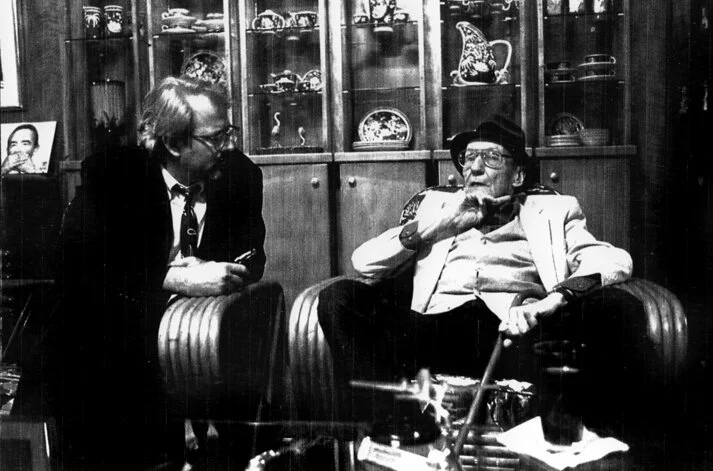
William Turner speaks with William S. Burroughs for Venice Magazine in 1992.
Read MoreAndy Moses: Recent Works - Extended Through February 27, 2021
/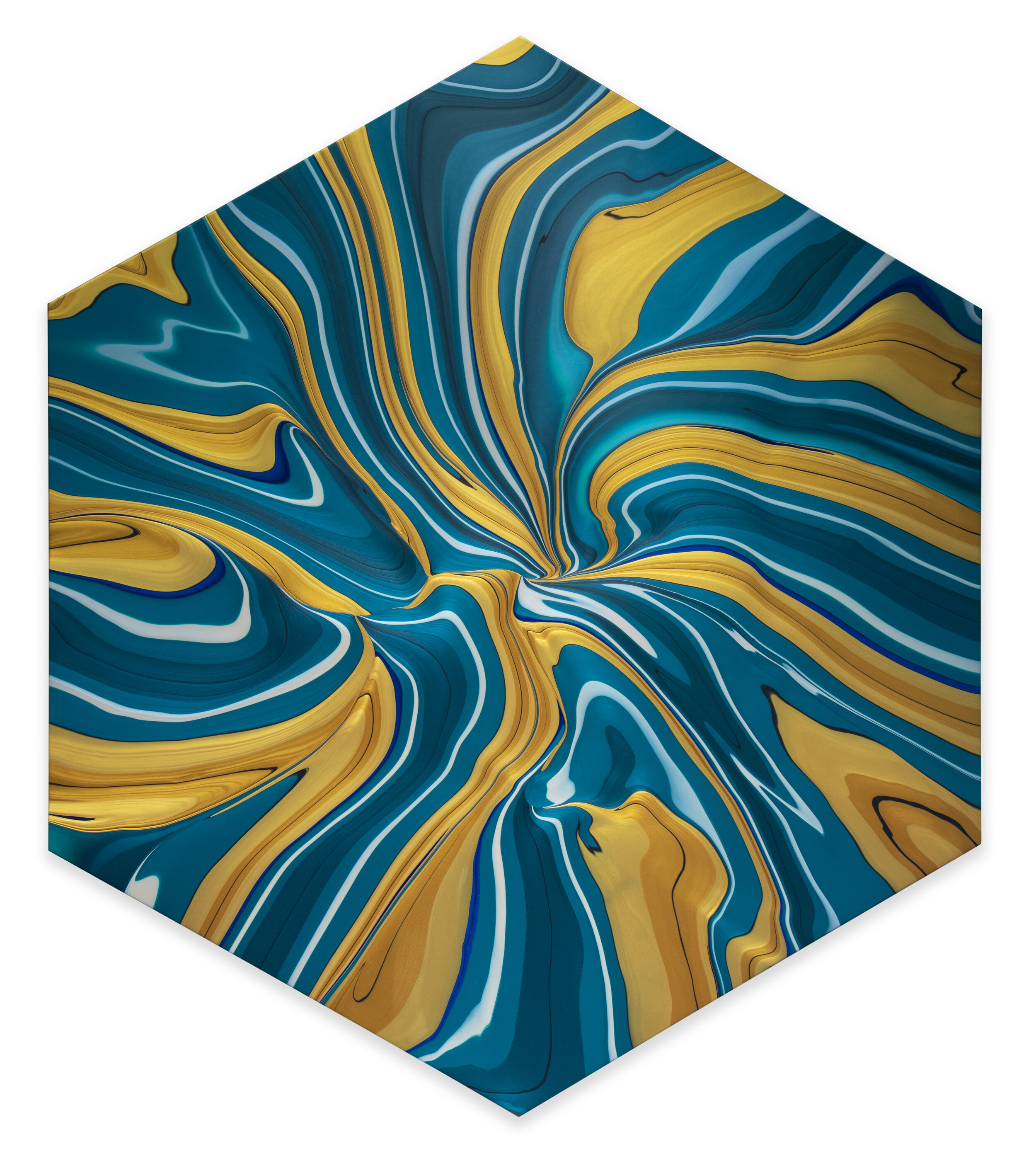
William Turner Gallery is pleased to announce that we will be extending access to Andy Moses: Recent Works until February 27 due to overwhelming demand. The gallery will be offering increased appointment availability through February 27, 2021.
Appointments will still be booked on the William Turner Gallery web site and appointments will be available from 1-5PM, Tuesday through Saturday.
Exhibition Viewing + Catalog Signing with Andy Moses today 1-5PM @ William Turner Gallery
/
Andy Moses: RECENT WORKS 74-page Fully Illustrated Catalog Now Available at the gallery.

TODAY 1-5 PM @ William Turner Gallery - Please visit the web site for appointments
Gallery artist Andy Moses will be at the William Turner Gallery this Saturday, February 6, from 1-5pm to talk about the work, sign copies of the exhibition catalog and meet with guests visiting the exhibition.
Social distancing guidlines will be strictly adhered to and masks are required. You can make appointments for a viewing on the gallery web site or by clicking the button labeled appointments below.
SPECTRUM NEWS 1 FEATURE - Andy Moses: Recent Works
/
SANTA MONICA, Calif. — Four years ago, artist Andy Moses was celebrated in a 30-year survey of his life’s work not far from where he grew up.
Mid-career, his work showed a consistent palette inspired by his time spent in the water while surfing off the beaches of Southern California.
What You Need To Know
"Recent Works" by Andy Moses is currently on view at the William Turner Gallery in Bergamot Station until February 10
While attending CalArts, Moses focused on performance, film, and painting and studied with Michael Asher, John Baldessari, and Barbara Kruger
Moses' father Ed was an American painter and was part of a group of artists called the “Cool School” that included artists Ed Ruscha, Edward Kienholz, and Ken Price
In 2017, 30 years of Andy Moses’ work was celebrated in a survey in the Pete and Susan Barrett Art Gallery at Santa Monica College
“You never saw the same thing twice,” said Moses. “The line was always moving. The colors were always shifting.”
Looking at his most recent artwork today, you still see the same influence.
“Then when you rode a wave, you saw the texture on the wave, you saw the changing light, the shifting shades of color, and those were gigantic influences on me as a painter,” he said.
Interested in the physical properties of paint, Moses developed a method of painting through chemical reactions and by playing with viscosity and gravity to create compositions that simulate nature. Even the shape of his canvas looks like a wave.
“I’m interested in how they suggest landscape or this kind of Earthscape, capturing a view of somewhere of the Earth,” said Moses. “It could be oceanic, it could be desert, but you’re looking through this flat space into the infinite and you’re capturing all the subtle change of light that actually happens when you’re looking at this kind of phenomenon.”
Growing up as the son of Ed Moses, one of the most celebrated artists in Los Angeles' history, Moses had a lot to live up to once he decided to become an artist himself. While studying film at CalArts, Moses discovered he preferred having sole control of a canvas over a camera. He now paints out of his father’s old studio, where his spirit can be found everywhere.
“It was great growing up with a father for a painter,” said Moses. “There was always something to look at. He was always pushing the boundaries. He was always evolving. He was always moving forward.”
Now, it’s his turn to move forward to his newest show called "Recent Works" at the William Turner Gallery in Santa Monica's Bergamot Station.
Related Stories
The Black Index: Artists Present Works of Mourning, Community
John Outterbridge Leaves Behind Legacy of Arts Education
Santa Monica Asks Artists to Help Economic Recovery Efforts
Artist Recreates Objects Mistaken for Weapons by Police
“One of the things that I love when people have come to the gallery, especially during this time of COVID, there’s this appetite to be in the presence of an actual work of art, not just see something digitally or online or virtually, and these pieces are really interactive,” said gallery director William Turner.
Opening during a pandemic does limit visitors, but Moses' work gets their full attention.
“For 35 years now, I’ve been interested in exploring this line between abstraction and the galactic and microscopic phenomenon on a human scale, and how we relate to it,” he said.
Art is human, and human is nature.
Andy Moses: Recent Works Exhibition Video
/
Short video celebrating highlights from Andy Moses: Recent Works currently on view at William Turner
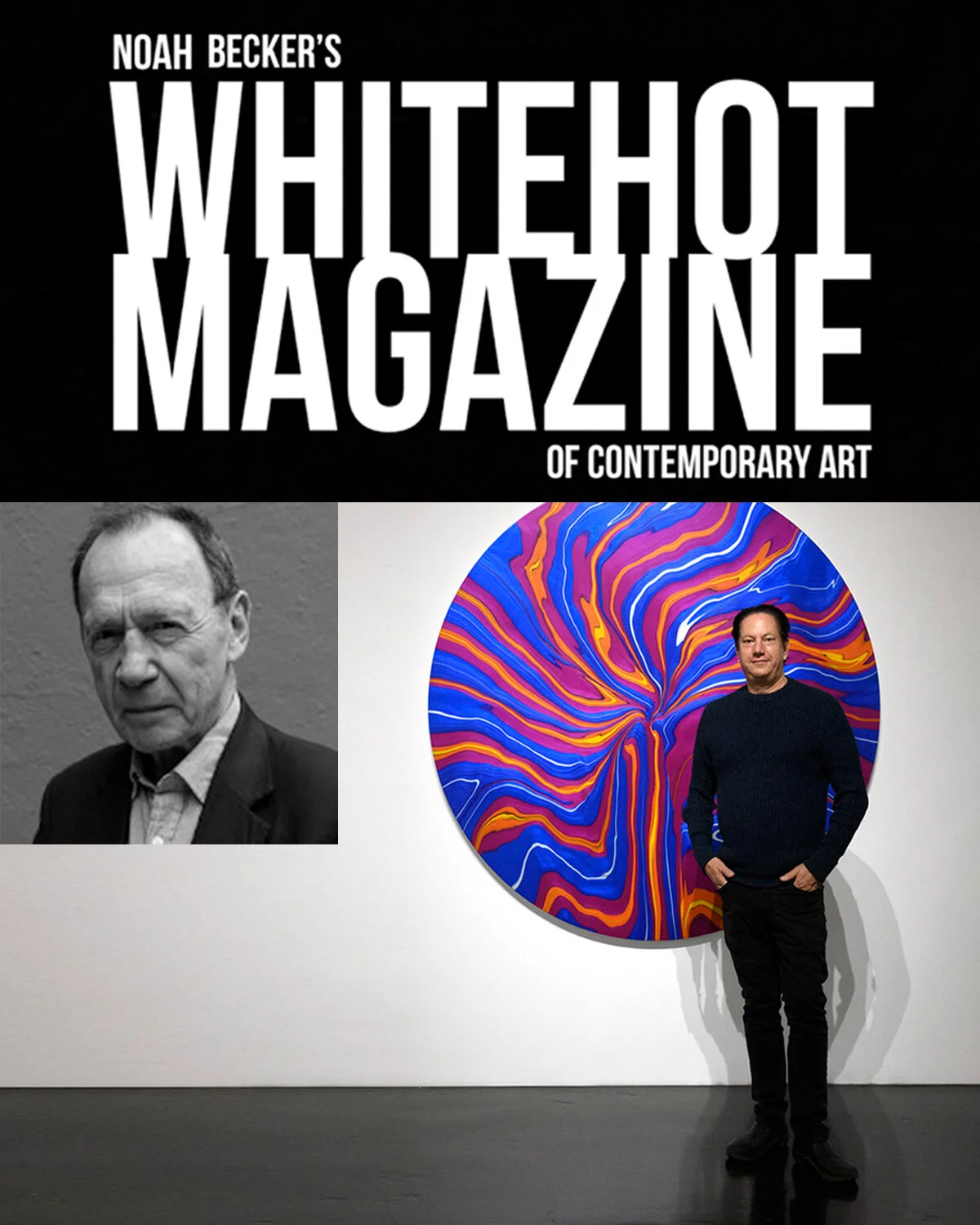
WHITE HOT MAGAZINE - Andy Moses: Recent Works
/Anthony Haden-Guest for WHITE HOT MAGAZINE
ANTHONY HADEN-GUEST
Anthony Haden-Guest (born 2 February 1937) is a British-American writer, reporter, cartoonist, art critic, poet, and socialite who lives in New York City and London. He is a frequent contributor to major magazines and has had several books published including TRUE COLORS: The Real Life of the Art World and The Last Party, Studio 54, Disco and the Culture of the Night.
Andy Moses’ father, Ed Moses, was an artist with the Ferus Gallery, now enshrined as LA’s Cool School, and Andy grew up in the Santa Monica Canyon, looking out onto the ocean. He went to the California Institute of Arts, where the Death of Painting was a given and Concept art and Minimalism ruled, so for two years he worked with film and video. But an urge to pick up a brush seized him in his third year and he describes his instant conversion to pigment as a chemical rush. Upon leaving Cal Arts in 1982 he headed straightaway for New York where the break-out of the Neo-Exes had brought painting back to robust life.
Moses’ earliest work in New York were black-and-white abstractions and these were in his first exhibition at Annina Nosei. There was a distinctive edge to his project from the get-go. “I almost went into the scientific world when I was young,” Moses says. “I was very good at math and science. It’s always in the back of my mind and the way I make paintings is kind of scientific. Basically I experiment and try to figure out how paint flows.”
Such thinking entered the content too. “I was taking stories out of the New York Timesand silkscreening them on the sides of images to create complex narratives that were very much about language,” he says. “Things disintegrating, things forming. So I was kind of telling the audience what I was interested in.” The opening of a show in which he had work brought him back to Southern California in January 2000. “I fell in love with LA all over again,” he says. His New York period was done.
Moses settled first in Malibu. “It was right on the water. I used to commute to my Venice studio,” he says. “In New York I would go to Montauk. But you didn’t get the sense of infinite horizon that you get out here. There’s a point where the horizon connects with the sky. And sometimes it’s very well defined, but sometimes there’s a haze, a blur, and one thing begins to turn into another. I’m interested in that mirroring effect, of looking out into space, seeing one thing mirror another. You see it a lot in the desert, you see it a lot in the ocean.”
This got into his art. “The work shifted pretty quickly.” Moses says. “The very first ones I started doing were long and horizontal, mostly pearlescent white, and quite simple images.” He began keeping precise color notes. “I have an assistant who reads these charts and follows these tabulations,” he says. “We have thousands of pages going back years and years.”
He will begin a painting by figuring out the colors. Basing his choices on what?
“Things I’ve seen. Like things I’ve seen out in the natural world.” he says. The commutes on the Pacific Coast Highway have been a slipstream of visual event. “They are engrained on my memory. Then I focus on certain colors that might work together. What I’ll do is experiment on small paintings to see how much of these colors I should put in. It’s very interesting. Because reds and greens seem to expand, the blues seem to contract. So I have an idea what I’m going to do. But either they follow what I’m trying to get at or they don’t. And what’s cool is there is a certain amount of control but I also have to react to a situation in the moment.”
Accident being crucial.
“It’s a brand-new experience every single time,” Moses says “And that’s what makes it exciting. I don’t know what the end is going to be. I have to discover it as the paint is flowing. And react. And the paint reacts to what I do. And I react to what it does.”
He uses a dozen buckets, holding a couple of quarts of paint apiece, on each canvas. “I’ll walk around and pour in from one side and pour in from another side,” Moses says. “Everything is moving towards the center. And if I lift the painting up as it’s moving, everything will run the other way. So it is this juggling act of trying to get the sensation of everything moving towards the center. But at the same time there is a lot of circular movement that is happening.
“And other lines will be pushed by other buckets of paint. They will start to recede and come forward, which creates a three dimensional aspect. So I really never know what a painting is going to look like until it’s finished. Each one begins and ends in its own way. And there’s a million possibilities every time. And at a certain point I have to let go. And say that’s it!
“Once the color is down and the surface is all wet I can work on it for a couple of hours. It’s an intensely focused period of time. And the painting has to be done in one sitting every single time. It’s always done in a day. And it’s a long day.”
The sheer size of today’s’ art world, including the number of working artists, means that a walk-through of galleries in any art capital will reveal an acreage of beautifully-made work, sometimes described as “zombie formalism” or “crapstraction”, so that it’s almost jarring to confront the real thing. Andy Moses is not alone there – Hello, Sean Scully – but there he is, a figure in what has been described as a new Pictorialism.
“I do think it’s that,” Moses says. “Pictorialism is very much about
how things come into being. It is about energy and light turning into
matter”
Abstraction can be just that, I observed. Abstract. But abstraction
can also depict life, if not in forms with which we are familiar.
“I think so,” Moses said. “Somehow we are familiar with it and
Somehow we’re not. And I’m really trying to focus on that, the
essential force that’s all around us. I think it’s the emergence of how
we perceive images and how images come into being. And how
energy creates things – light and motion and movement. I really
want the energy of these to be the energy of the earth, the world.
Everything is dynamic, everything is changing, everything is
moving, everything is shifting ... and everything has that dynamic
aspect. You can see the world. And that it’s alive.” WM
Andy Moses: RECENT WORKS - Digital Catalog Now Available
/
William Turner Gallery is pleased to present the digital catalog for Recent Works, an expansive new series of paintings by Los Angeles-based artist Andy Moses. This extensive presentation marks the artist’s first solo exhibition since his highly acclaimed 30 Year Survey exhibition in 2017 at the Santa Monica College Pete and Susan Barrett Art Gallery.
Andy Moses: Recent Works presents an artist fully engaged and at the height of his creative process, showcasing perhaps his most ambitious and diverse body of work to date. Implementing techniques that utilize the artist’s almost obsessive study of the alchemical properties of paint, Moses’s work blurs the line between abstraction and a new kind of pictorialism…
A hard copy of the catalog will be available at the gallery. To receive a copy of the catalog by mail please email at turnergallery@gmail.com.
Amanda Quinn Olivar speaks with Andy Moses for CURATOR
/
Andy Moses & Geomorphology 1707, photograph courtesy Alan Shaffer
AMANDA QUINN OLIVAR: I remember going to one of your earliest LA exhibits, with the rock paintings. When were you first inspired by nature? Has your art continued to revolve around it?
ANDY MOSES: Nature continues to be my first and main source for inspiration in my painting. I have always been interested in trying to capture that feeling of being alive. When you immerse yourself in nature you feel alive. The rock paintings you mention are from a show I had in 1988 at Asher Faure Gallery. Brian Butler, who now owns gallery 1301PE, was actually their director at that time, at Betty and Patty’s space on Almont Street. Your mother and father, Joan and Jack, actually bought two rock paintings before that exhibition in either 1986 or 1987.
AQO: Have other themes resonated throughout your career? Talk about the importance of form, energy and structure…
AM: Those are all great questions. Form, energy, and structure are what my work is very much about. I feel that form is essential to all painting. You create form in some sense within the picture field, but I’m also interested in the overall form or structure of what a painting of mine is and how that relates to form in general. In this recent exhibition at William Turner Gallery, each painting is one of three geometric forms: circular (which I refer to as tondos), hexagonal, or concave rectangles. In the tondos and hexagons, the form is emerging out of the center and the exterior form is defined by that emergence from the center. The panoramas are different. The overall composition is a little more conventional in that it is describing a pictorial landscape, or as I like to think of them, earthscapes. The earthscape being a little less like traditional landscape forms and a little more like an imagined form of some part of the earth. I am interested in this dance between pure abstraction and the suggestion of forms from the natural world. These concave curved rectangles come out of gestural abstraction but they do become pictorial, but of something that is in motion...
Andy Moses: Recent Works - A short film by EMS
/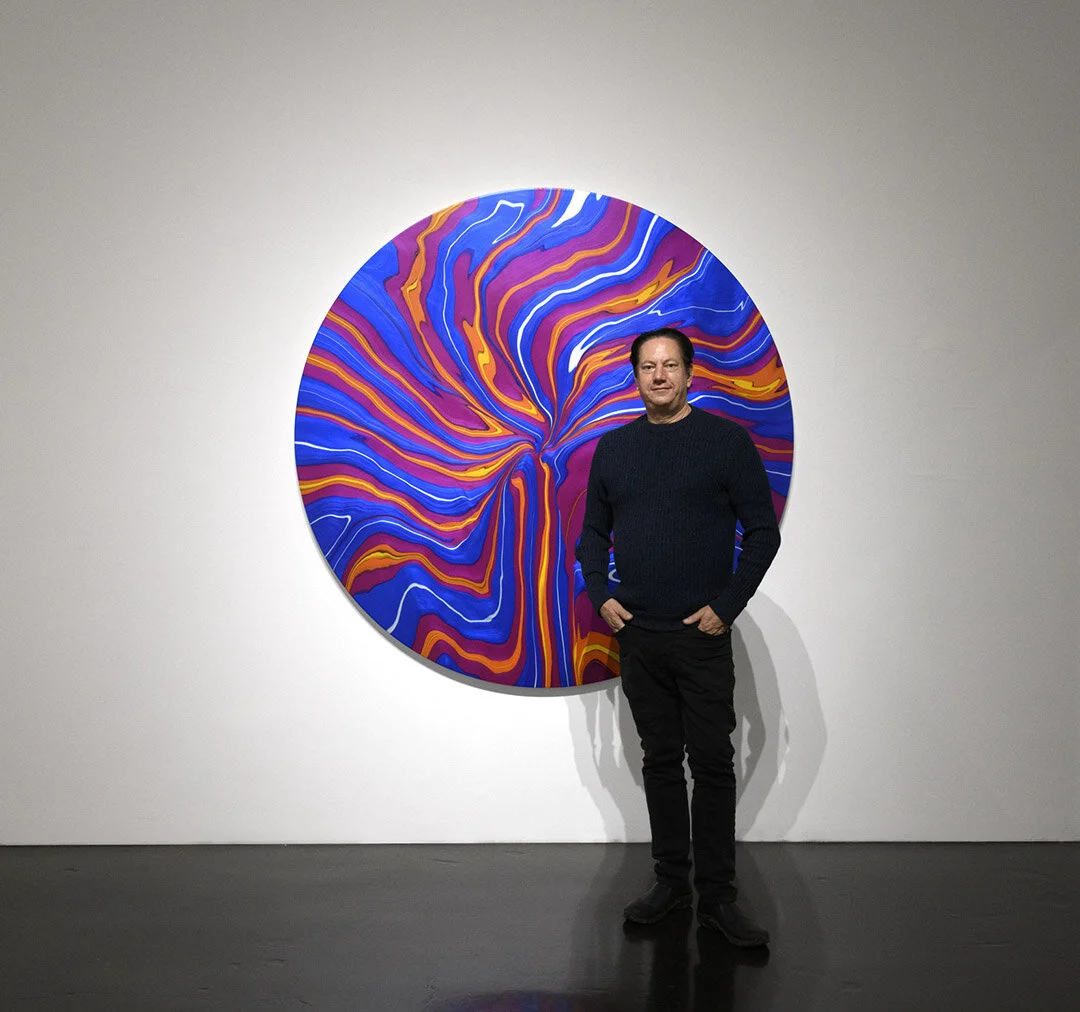
Andy Moses: RECENT WORKS - A short video about the exhibition from EMS - Photograph courtesy Alan Shaffer Photography
LA WEEKLY ARTS CALENDAR (HOMEWARD BOUND
/LA WEEKLY ARTS CALENDAR (HOMEWARD BOUND)

READ ON LA WEEKLY CALENDAR
Andy Moses: Recent Works opens this Saturday 12-7pm
/SATURDAY, DECEMBER 5 - 12-7PM - Appointments (and masks) Required
William Turner Gallery invites you to join us Saturday, December 5 from 12-7PM for an all-day, open house viewing of the exhibition. APPOINTMENTS ARE REQUIRED for this all day event. Social distancing guidelines will be strictly adhered to, and masks will be required for entry to the gallery and no more than 10 people will be admitted to the gallery at a time. Please follow the appointments link to make a reservation for December 5, or any date throughout the duration of the exhibit.
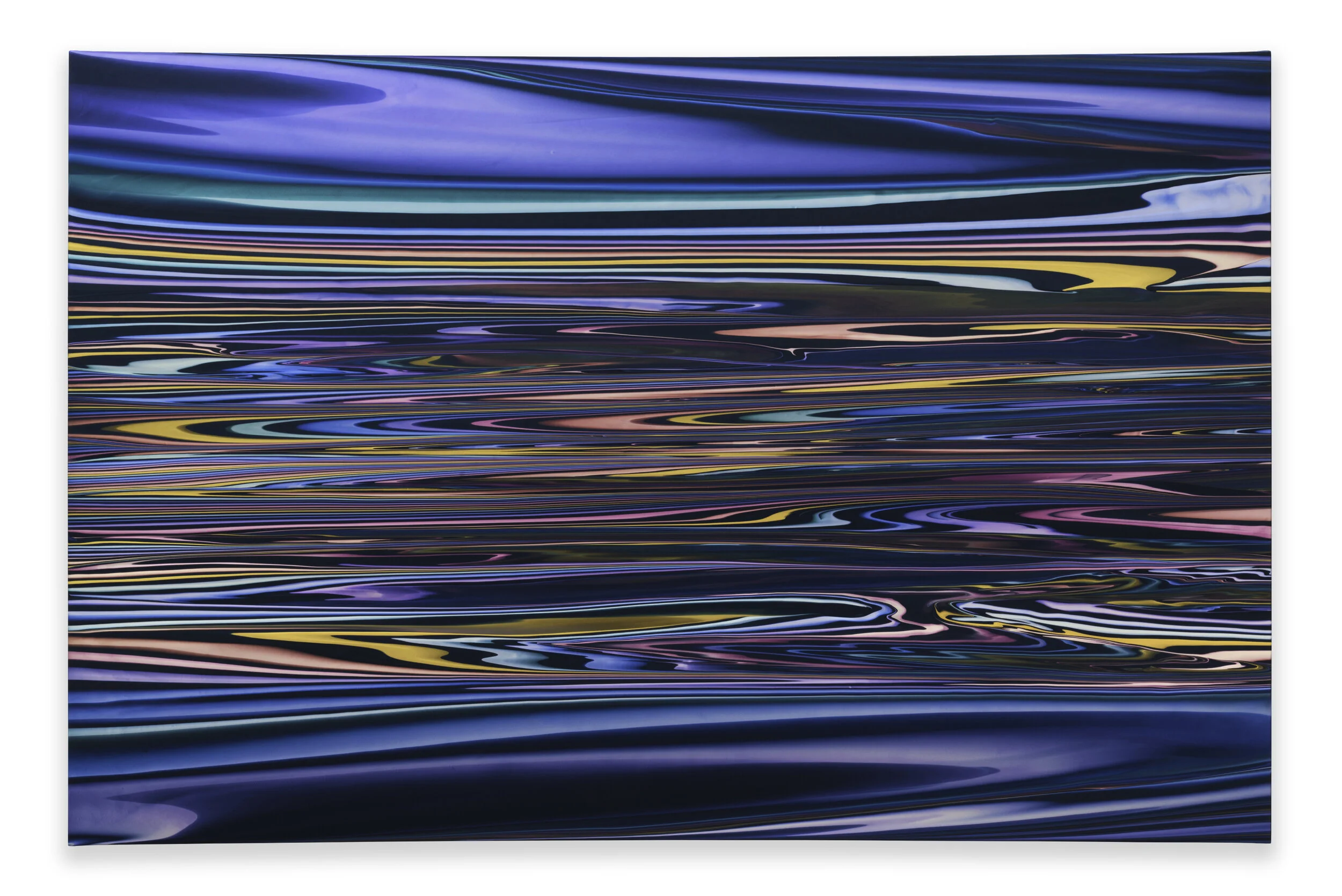
Nocturne 1502, 2020, acrylic on canvas over concave wood panel, 54"x84"x4.5
ANDY MOSES Recent Works Santa Monica, CA– William Turner Gallery is pleased to present Recent Works, an expansive new series of paintings by Los Angeles-based artist Andy Moses. This extensive presentation marks the artist’s first solo exhibition since his highly acclaimed 30 Year Survey exhibition in 2017 at the Santa Monica College Pete and Susan Barrett Art Gallery. Andy Moses: Recent Works presents an artist fully engaged and at the height of his creative process, showcasing perhaps his most ambitious and diverse body of work to date. Implementing techniques that utilize the artist’s almost obsessive study of the alchemical properties of paint, Moses’s work blurs the line between abstraction and a new kind of pictorialism.
The images reveal undeniable traces of natural phenomena, seeking not to replicate the natural world, but rather to suggest the forces of nature itself. His complex process of mixing and pouring paints conveys a sense of undulating energies pushing and pulling within the rectilinear, circular and hexagonal forms of the canvases themselves.
The paintings are sweeping and luminescent, their lustrous surfaces seemingly executed with an impossible combination of absolute precision and wild improvisation. Meandering lines of psychedelic chroma oscillate between near digital sharpness and dissolving washes of color, achieving works of captivating presence.
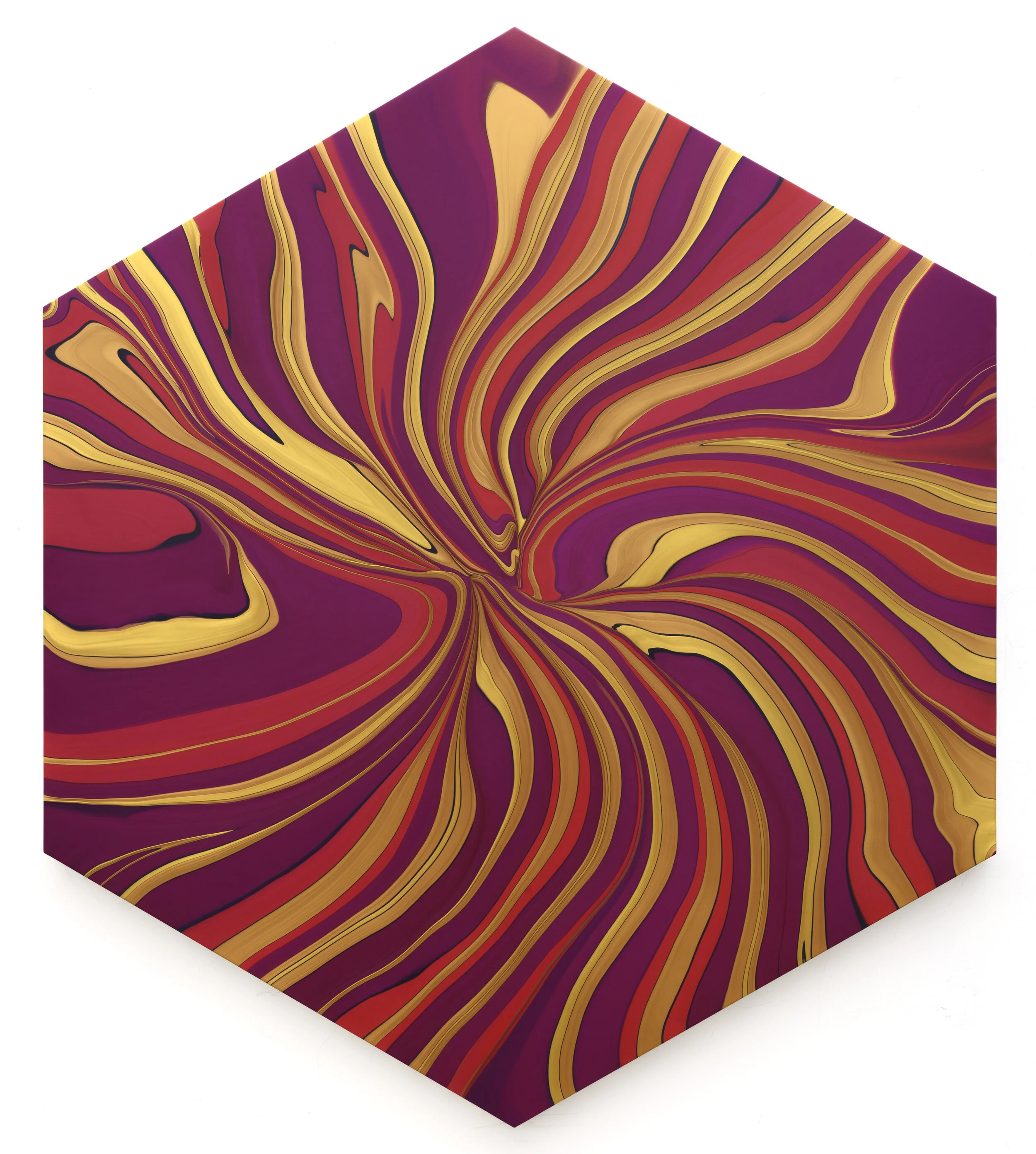
Geodynamics 1704, acrylic on canvas over hexigonal shaped wood panel, 78"x67"
Speaking about his work, Moses says, “I want the work to stop you in your tracks, to shake you out of your head and into the moment, into the present, where you can become receptive to a more meditative experience that hopefully begins to attune you to the transcendent beauty of the natural world.” As evidenced with his 30 Year Survey, Moses has long been fascinated with the forces of nature, both micro and macro, geologic and galactic. This new series expands on these themes magnificently.
Born in Los Angeles in 1962, Andy Moses attended the legendary CalArts, studying with John Baldessari, Michael Asher and Barbara Kruger. In 1982, Moses moved to New York where he worked as a studio assistant to Pat Steir. He quickly became part of the nascent 80s art scene, and became one of the youngest artists to exhibit with Annina Nosei gallery after Jean-Michael Basquitat. During that time he developed close ties with then emerging artists like Jeff Koons, Marilyn Minter, Rudolf Stingel and Christopher Wool. Moses returned to California in 2000, and really began to refine his explorations into the physical properties of paint that have brought him to the attention of museums and major collectors alike.
His work is included in the permanent collections of Los Angeles County Museum of Art, Orange County Museum of Art, Laguna Art Museum, and the Frederick R. Weisman Art Foundation. He currently lives and works in Venice, CA.
THE ARGONAUT REVIEWS BLACK MADONNA
/
By Bridgette M. Redman
Last day to see Black Madonna - 84 Page fully illustrated catalog now available.
/Please come see us at or before 5pm today for the last viewing of Black Madonna. 84-page fully illustrated catalog is now available at the gallery or for mail order. Please contact William Turner Gallery to order your copy.

Artillery Reviews Mark Steven Greenfield: Black Madonna
/
ARTILLERY MAGAZINE Reviews MarK Steven Greenfield’s exhibition Black Madonna
Read MoreFowler Museum at UCLA - A Global Destination for Art: Mark Steven Greenfield
/
Join us on Zoom as we visit with artists creating in our City of Angels
About this Event
RSVP to receive link to join as the date nears.
Mark Steven Greenfield, a native of LA, uses his art to explore the African-American experience, critiquing and offering unique perspectives on a society still grappling with the consequences of slavery and racial injustice. His newest body of work consists of 17 “Black Madonna” paintings that re-imagine Medieval religious icons rendered in the Byzantine style of their art historical predecessors. Greenfield places Black bodies in a place of exaltation, offering an imagined time that is hard to pinpoint, but during which white supremacy suffers the same vicious deaths that have historically been forced upon Black bodies.
Join Mark and Naima J. Keith for an exhibition walk-through at William Turner Gallery, followed by a conversation and Q&A
Mark Steven Greenfield studied with Charles White at Otis Art Institute; received his Bachelor’s degree in Art Education in 1973 from California State University, Long Beach; and an M.F.A. in painting and drawing from California State University, Los Angeles in 1987. Greenfield’s work has been exhibited extensively in the United States, including in a comprehensive survey exhibition at the California African American Museum in Los Angeles in 2014. From 1993-2011, Greenfield worked for the Los Angeles Department of Cultural Affairs as Director of the Watts Towers Arts Center; later, he served as Director of the Los Angeles Municipal Art Gallery in Barnsdall Park. He currently teaches drawing and design at Los Angeles City College, and serves on the board of Side Street Projects.
Naima J. Keith is Vice President of Education and Public Programs at LACMA. Previously, she was the Deputy Director and Chief Curator at the California African American Museum, where she guided the curatorial and education departments as well as marketing and communications; she was an Associate Curator at the Studio Museum in Harlem (2011–16); and held a curatorial position at the Hammer Museum. Keith has lectured extensively and her essays have appeared in numerous publications. She holds degrees from Spelman College and UCLA, and is a proud native of Los Angeles.
This program is generously supported by a grant from Lilly Endowment Inc.
A Global Destination for Art: Artists from all over the world flock to work in Los Angeles, drawn by the energy of ingenuity and the space for experimental expression. Join us on Zoom as we visit with artists creating in our City of Angels.
INCONVERSATION - Mark Steven Greenfield: BLACK MADONNA
/William Turner speaks with Mark Steven Greenfield about his groundbreaking exhibit, Black Madonna