
THE BOB BONIS ARCHIVE 1964-1966
The Bob Bonis Archive offers an unprecedented look at the early days of The Beatles and The Rolling Stones, long before they became icons, when they were simply young musicians on the edge of a cultural revolution. Bob Bonis (1932–1992) began his career as a talent agent in New York and soon found himself in a remarkable role at a pivotal moment in music history. From 1964 to 1966, he served as the U.S. Tour Manager for all three Beatles U.S. tours and the first five Rolling Stones U.S. tours, giving him unequalled access during the height of the British Invasion. A passionate photographer with a gifted eye and his Leica M3 always at hand, Bonis captured thousands of candid, intimate, and unguarded moments that no other photographer ever had the opportunity to see.
What emerged is a stunning photographic archive of images of The Beatles and The Rolling Stones, part of a larger collection of photographs documenting legends including Frank Sinatra, Simon & Garfunkel, Cream, The Hollies, The Lovin’ Spoonful, and many jazz greats. But the heart of the archive, and its historical significance, lies in the Beatles and Stones photographs: backstage glimpses, rehearsals, studio sessions, travel days, quiet snapshots between shows, and the everyday humanity behind two bands who would come to define modern music.
These images were never intended for public view. Bonis was a private man who sought no fame from his experiences; the negatives remained sealed in his basement for nearly fifty years, when upon his passing, they were rediscovered by his son. After being mismanaged for many years, the negatives were acquired in 2024 by Archive Acquisition Partners, who spent thousands of hours and millions of dollars to digitally restore, remaster and edition the archive for the first time ever.
Today, the Bob Bonis Archive stands as the largest single collection of unseen Beatles and Rolling Stones photographs known to exist - a time capsule capturing the innocence, energy, and evolution of two bands on the brink of legend.
Now, these extremely rare fine art prints will be made available in 2026.
UNIQUE TRIAL PROOFS TO SUPPORT THE 100 BILLION MEALS CHALLENGE
For the next two weeks (December 16 - December 31), the Bob Bonis Archive is offering unique trial proofs prior to publication of the newly remastered editions, scheduled for publication and exhibition in 2026.
Each trial proof of the below five photographs will be offered in a custom size for $15,000 with 10% of proceeds going to the 100 Billion Meals Challenge.
Register to Join Our Invitation-Only Debut Exhibition in 2026
Let Us Know in the Message Box Above if You’re Interested in Purchasing a Trial Proof.
For Further Information, call 310.453.0909 or email turnergallery@gmail.com
Select Photographs From the Bob Bonis Archive
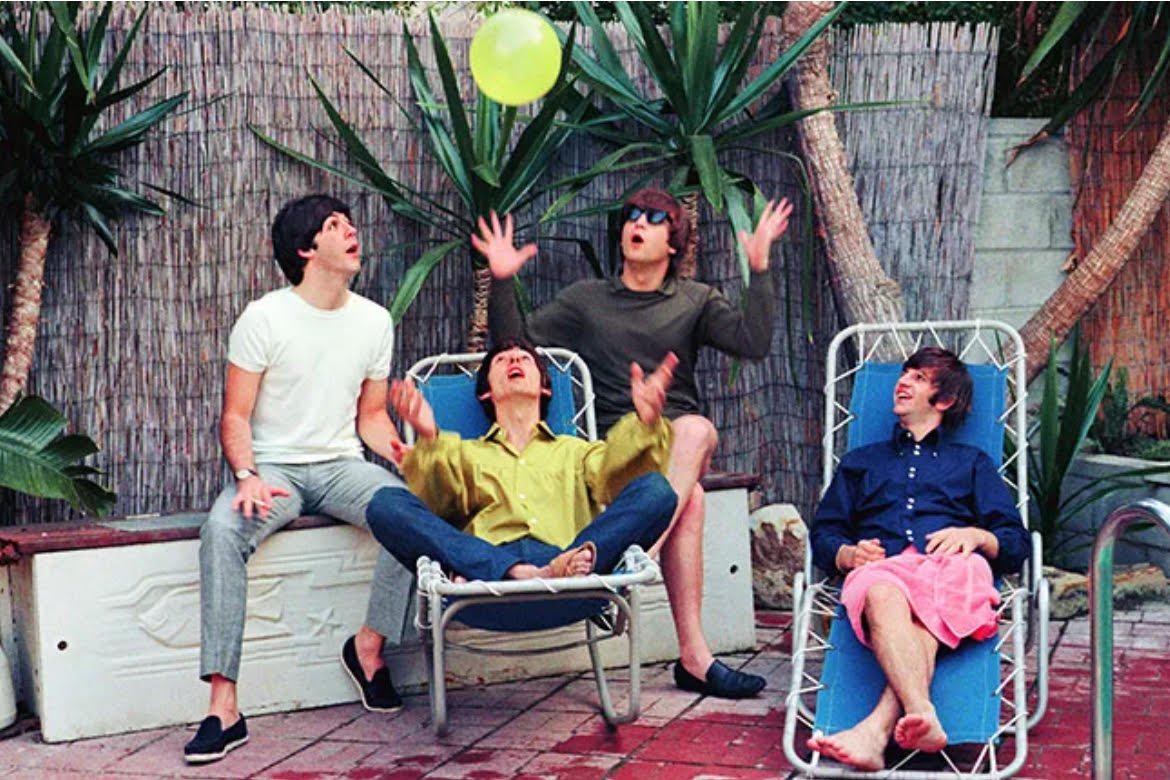
HAVING A BALL: August 1964, Bel Air, California
After their first Canadian show in Vancouver, The Beatles flew to LA, but not without turbulence. With Beatlemania in full swing, Lockheed Airport in Burbank refused their landing due to overwhelming fan crowds. LAX became Plan B. The Ambassador Hotel, also canceled their booking out of safety concerns. Enter actor Reginald Owen (best known as Ebenezer Scrooge in the 1938 film A Christmas Carol), who rented them his Bel Air mansion at 356 St. Pierre Road for $1,000. While there, The Beatles relaxed poolside before their iconic Hollywood Bowl concert. During this black and white photo shoot, Bob quickly grabbed his camera and took the only color photographs of the boys in the backyard.
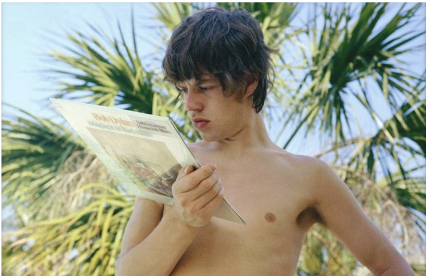
SIZING THE COMPETITION: May 1965, Manger Towne & Country Motor Lodge, Savannah, Georgia
On a break during their third U.S. tour, The Rolling Stones took a breather at the Manger Towne and Country Motor Lodge in Savannah, Georgia, en route to their next show in Clearwater, Florida. Poolside under the palms, Mick Jagger was photographed in a candid moment, reading the back cover of Bob Dylan’s just-released Bringing It All Back Home, a bold, electric turn from Dylan’s folk protest roots.
Ironically, just a year earlier, Dylan and the Stones had met for the first time backstage at Carnegie Hall after the final show of the Stones’ debut U.S. tour.
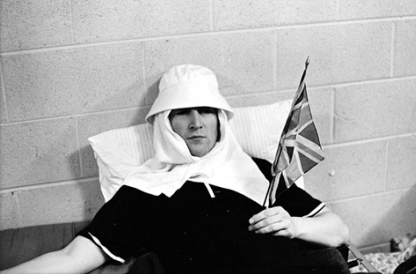
LENNON OF ARABIA; August 22, 1965, Memorial Coliseum, Portland, Oregon
With many of the Beatles second U.S. tour dates being grueling double-headers, the boys often found strange ways to entertain themselves between shows, as this extremely rare, behind-the-scenes image of John Lennon dressed as Lawrence of Arabia showcases. “Lennon of Arabia” wasn’t the only esteemed visitor, as Mike Love and Carl Wilson of the Beach Boys popped up from California for the shows, and they all met backstage for the first time and talked girls and cars.
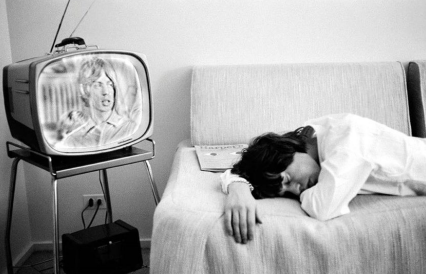
WAKE ME WHEN IT’S OVER; November 10, 1964, Chicago, Illinois
On August 5, 1964, The Rolling Stones filmed a musical segment inside the iconic London Palladium for the American television variety show The Red Skelton Hour. The episode aired exclusively in the U.S. on September 22, 1964, meaning the band, still in London at the time, never saw it live.
Months later, during their second recording stint at Chicago’s historic Chess Studios, Mick Jagger found himself unwinding at the legendary Palmer House Hotel. Bob Bonis caught Mick here flipping through channels, catching a rerun of that very broadcast. For the first time, Mick got to see the Stones perform on American television, in America, watching their own meteoric rise from the comfort of a hotel room halfway across the world....until he fell asleep.
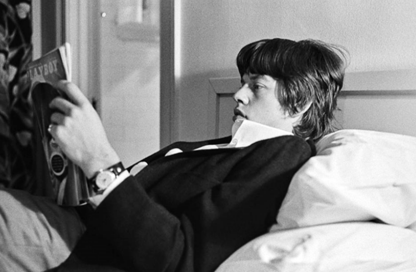
THE PLAYBOY; May 1965, Los Angeles, California
Life on tour can be thrilling on stage, but offstage, it often slows to a crawl. During their spring 1965 stay in Los Angeles, The Rolling Stones packed in concerts, TV spots (Hollywood A Go Go, Shindig!), and RCA recording sessions. In a rare quiet moment, an unsuspecting Mick Jagger was caught by Bob flipping through the June issue of Playboy, possibly eyeing the magazine’s first-ever nude pictorial of Bond girl Ursula Andress.
Fast forward four years, and Mick had gone from reader to featured subject in Playboy’s November 1969 issue. And in one final twist of fate, exactly 46 years after Mick perused that 1965 issue, his daughter Lizzy would grace the cover herself, posing for the June 2011 edition.
For Further Information, call 310.453.0909 or email turnergallery@gmail.com